
Generator and Transfer Switch Installation Cost in Canada
By Oleksandr Potapenko · 2026-11-16 · How we research prices
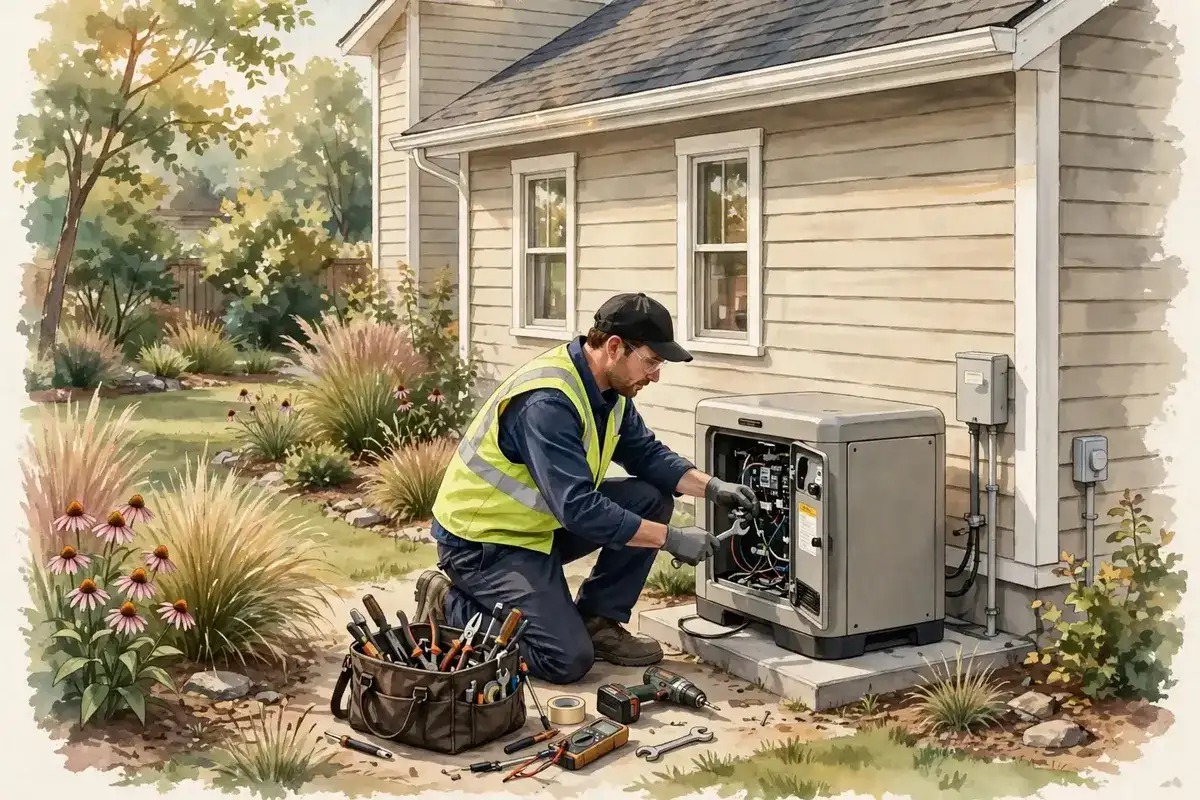
A generator is not one purchase, it is a system, and the transfer switch is the part that makes the system safe. Without it, a portable generator plugged into the house can back-feed power onto the utility lines during an outage, energizing wires that line crews believe are dead, and that has killed utility workers. With it, the house runs on generator power and the utility lines stay dead. The switch is a small sub-panel installed beside the main breaker panel by a licensed electrician, and the choice is between a manual switch for a portable generator and an automatic switch for a standby generator, with a third option, an interlock kit, sitting between them on price. HomeAdvisor puts standby generators at $5,000 to $25,000 installed and a whole-house backup generator installation at an average of $5,157, with most homeowners paying $1,512 to $8,803, which understates a typical standby job because the range includes smaller setups. Forbes Home prices a mid-size standby generator at $9,000 to $14,700 installed, and HomeGuide puts a whole-home standby at $15,000 to $25,000 or more for an 18 to 22 kilowatt unit. Converted at about 1.40 Canadian dollars per US dollar, the Forbes Home mid-size range becomes roughly $12,600 to $20,600 CAD. There is no single Canadian national price series for this work, so the Canadian figures here are estimates built from converted American data and cross-checked against Canadian contractor practice.
The manual transfer switch is the budget route, and it is the right route for occasional outages. SolarGenAdvisor's November 2026 guide, drawing on published 2026 cost guides and contractors, puts manual transfer switch installation at roughly $400 to $2,500, with a national average near $1,200. Clarity Electric in Washington quotes $800 to $1,500 installed including the permit for a manual switch covering six to ten circuits, and Brandon Electric in Tampa quotes about $400 to $2,500 or more, with many professional installs around $1,200 to $1,600. The switch kit itself runs $250 to $400: a six-circuit switch for a 5,000-watt generator costs $250 to $300, and a ten-circuit switch for a 7,500-watt generator costs $350 to $400, according to HomeAdvisor via Cinch Home Services. The standard setup is a 30-amp manual switch with an outdoor inlet box and an L14-30 cord, rated for generators up to 7,500 running watts; generators with a 50-amp outlet need a 50-amp switch rated to 12,500 running watts. Add the portable generator itself at $800 to $2,000, and the all-in portable-plus-switch package lands at $1,500 to $4,000 CAD, with manual start and manual refuelling every few hours.
The automatic transfer switch is the comfort route, and it is the only route that makes sense for a standby generator. Clarity Electric quotes $1,500 to $3,000 installed for an automatic switch, not including the generator, and Cost to Renovate puts a 100-amp automatic switch at $500 to $900 for the hardware and a 200-amp switch at $800 to $1,500. A standby generator sits outside on a pad, connects to natural gas or propane, and starts itself within seconds of an outage, switching the house over automatically. A 10 to 14 kilowatt air-cooled standby runs $4,000 to $8,000 for the unit, a 20 kilowatt unit with a 200-amp switch and a new gas line runs about $12,200 all-in at mid-range, and a whole-home system runs $15,000 to $25,000 or more. Annual professional maintenance runs $80 to $300 a year according to HomeAdvisor. Generac's 2025 annual report puts home standby penetration at about 6.75 percent of its addressable market of American homes, which is to say most houses still do not have one, and the buyers who do are buying freedom from the outage, not just electricity.
The decision rule is about how often the power goes out and who is home when it does. If outages are rare and short, buy a portable generator and a manual transfer switch, size the generator by adding up the running watts of what you must keep on, fridge, sump pump, a few lights and the furnace fan, and never run a generator indoors or in a garage, because carbon monoxide kills faster than cold. If outages are frequent or long, or if someone in the house depends on powered medical equipment, or if you travel and the house must look after itself, buy a standby generator with an automatic switch and a load-management system, and have a licensed electrician and a licensed gas contractor do the work, because the electrical permit and the fuel permit are both mandatory and the transfer switch wiring is the part that protects line crews. Get the quote in writing with the generator size, the switch type and amperage, the pad, the gas line, the permits and the maintenance plan listed. Our guide Whole-House Surge Protector Installation Cost in Canada covers the device that protects the generator's electronics from the surge when power returns, and Electrical Panel Upgrade Cost: 100A to 200A in Canada covers the panel work a standby system sometimes needs. For a rough budget before you call, the RepairPrice home calculator (home-calculator.php) gives a fair range for your city.
Common questions:
Q: How much does it cost to install a generator transfer switch in Canada? A: A manual transfer switch installation runs roughly $400 to $2,500, averaging near $1,200, with a portable generator and switch package at $1,500 to $4,000 CAD all-in. An automatic transfer switch runs $1,500 to $3,000 installed, not including the generator, and a standby system runs $12,600 to $20,600 CAD converted from Forbes Home's mid-size range.
Q: Do I need a transfer switch for a portable generator? A: Yes, if you want to power house circuits. A transfer switch or an approved interlock prevents the generator from back-feeding the utility lines, which can kill line workers. Never plug a generator into a household outlet; that is the back-feeding setup the switch exists to prevent.
Q: What size generator do I need for my house? A: Add up the running watts of what you must keep on: fridge, sump pump, furnace fan, a few lights and a phone charger. A 30-amp manual switch handles generators up to 7,500 running watts; a 50-amp switch handles up to 12,500 running watts. A whole-home standby is usually 18 to 22 kilowatts.
Q: Can I install a transfer switch myself? A: No, not safely or legally in most jurisdictions. The switch is wired inside the main panel with live service conductors, and the work needs a licensed electrician, an electrical permit and an inspection. The gas connection on a standby generator also needs a licensed gas contractor.
| Item | Typical range (CAD) | Notes |
|---|---|---|
| Portable generator + manual switch | 1,500–4,000 total | Manual start and refuelling |
| Standby generator (10–22 kW) | 7,000–17,000 | Air-cooled, most homes |
| Automatic transfer switch | 1,500–3,000 | Makes the system automatic |
| Install: gas, pad, electrical, permits | 2,000–5,000 | Placement and gas line drive cost |

 RepairPrice
