
Hot Tub Electrical Circuit Cost in Canada
By Oleksandr Potapenko · 2026-11-16 · How we research prices
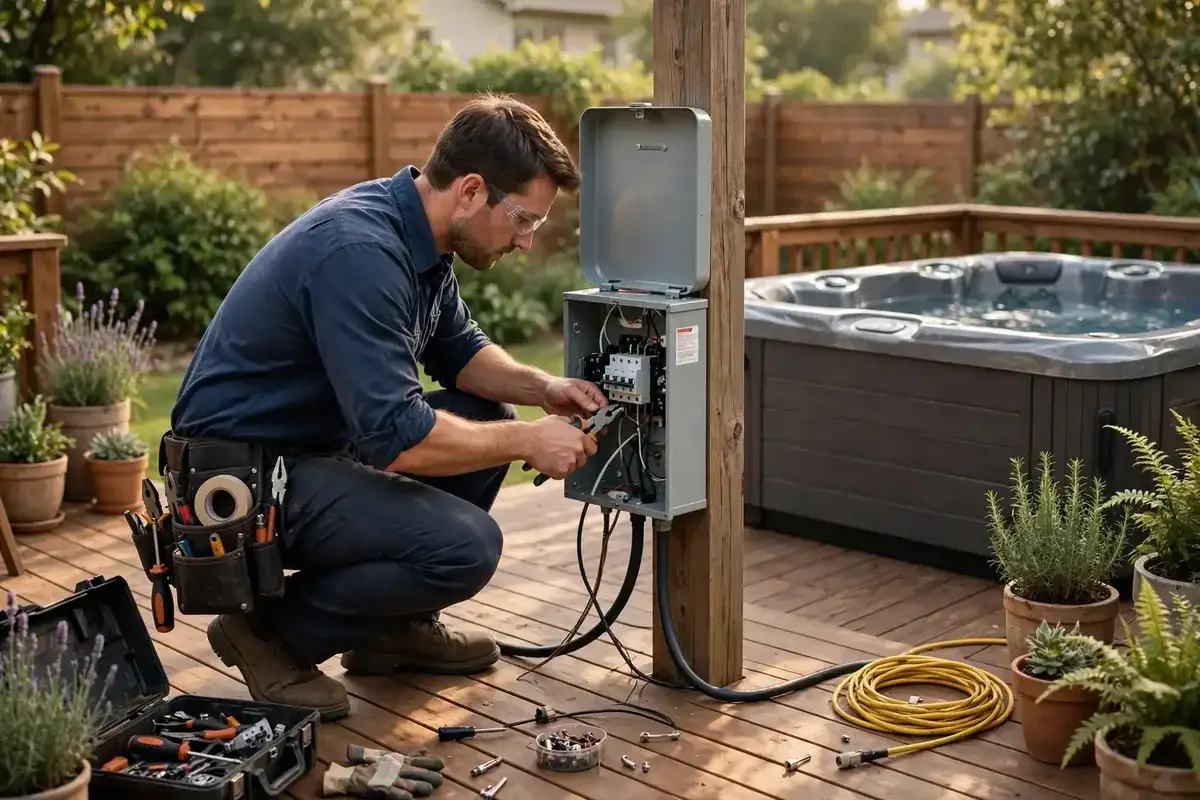
A hot tub is two purchases that arrive in one box: the tub, and the electrical circuit that feeds it. The tub gets all the attention in the showroom. The circuit gets all the attention on the invoice, because a full-size hot tub needs a dedicated 240-volt circuit, a GFCI-protected disconnect within sight of the water, and a permit, and none of that is optional. HomeAdvisor's 2025 cost guide puts the American average for hot tub wiring at $2,300 US, with a typical range of $1,900 to $4,200 US, and a subpanel at $400 to $1,800 US when the main panel cannot handle the load. HomeGuide prices the circuit itself lower, at $800 to $1,600 US for a dedicated circuit to the panel with underground conduit and wiring up to 100 feet, plus a 220-volt GFCI outlet or subpanel near the spa, and $150 to $500 US to hook up a replacement spa where wiring already exists. The gap between the two sources is scope: HomeGuide prices the circuit run, HomeAdvisor prices the whole wiring job including the disconnect, the trenching and the permit. Converted at about 1.40 Canadian dollars per US dollar, HomeAdvisor's range becomes roughly $2,660 to $5,880 CAD, which is the honest Canadian planning band for a full job. There is no single Canadian national price series for this work, so the Canadian figures here are estimates built from converted American data and cross-checked against Canadian contractor practice.
The electrical facts are set by the tub's manual, and they are not negotiable. Most full-size 240-volt tubs need a dedicated 40-amp, 50-amp or 60-amp circuit, with 50 amps the most common, hard-wired in copper through a GFCI-protected disconnect at least 5 feet from the water and within sight of the tub. Master Spas specifies a dedicated 50-amp breaker with GFCI for its 240-volt models, and Jacuzzi specifies 40, 50 or 60 amps, noting that a 40-amp breaker cannot run the jet pumps and the heater at the same time and suggesting 50 or 60 amps if you want both. The wire is copper only: a 50-amp circuit typically calls for number 6 AWG copper with at least a number 10 AWG copper ground, in a four-wire circuit with two hots, a neutral and a ground. The disconnect, often called a spa panel, sits between the main panel and the tub and carries the GFCI breaker and an emergency shutoff. Plug-and-play 120-volt tubs are the exception: they run on a standard household outlet on their own GFCI-protected circuit, they heat slowly, and they never need an extension cord, which is a fire risk and a shock risk beside water.
Distance is the price driver, more than the tub. If the panel has spare capacity and the tub sits close to the house, the circuit is a short run and the job lands at the low end. If the tub is at the far end of the yard, the electrician has to trench conduit, pull heavy copper cable, and possibly add a subpanel, and the cost climbs fast. The decision rule is to place the tub before you price the circuit: put it as close to the panel as the yard allows, on a level pad, with the disconnect location already in mind, and have the electrician price the run from the panel to that exact spot. If the panel is full or the service is 100 amps, the circuit may need a subpanel at $400 to $1,800 US or a full panel upgrade, which our guide Electrical Panel Upgrade Cost: 100A to 200A in Canada covers. Do not buy the tub first and discover the panel problem second, because the tub delivery and the electrical work are on different schedules and the tub cannot be filled until the circuit is inspected.
The running cost is the part nobody quotes in the showroom. A well-insulated tub costs roughly $30 to $60 a month in electricity in American figures, and more in provinces with high rates and cold winters, because the heater works hardest when the air is coldest. A permit and inspection are required in virtually all Canadian jurisdictions, and the work must be done by a licensed electrician, because water and electricity together are the one combination where a wiring mistake can kill. Skipping the permit can void your home insurance, and it creates liability if anyone is injured. Get the quote in writing with the breaker size, the wire gauge, the disconnect, the conduit run, the permit and the inspection listed, and confirm the tub's manual requirements against the quote before you sign, because the manual, not the electrician's habit, sets the breaker and wire size. Our guide New and Dedicated Circuit Cost in Canada covers the circuit itself, and EV Charger (Level 2) Installation Cost in Canada covers the other 240-volt circuit most houses add. For a rough budget before you call, the RepairPrice home calculator (home-calculator.php) gives a fair range for your city.
Common questions:
Q: How much does it cost to wire a hot tub in Canada? A: HomeAdvisor's American figures put a typical wiring job at $1,900 to $4,200 US, averaging $2,300 US, which converts to roughly $2,660 to $5,880 CAD. HomeGuide prices the circuit run alone at $800 to $1,600 US. A subpanel adds $400 to $1,800 US, and a panel upgrade costs more again.
Q: What size breaker does a hot tub need? A: Most full-size 240-volt tubs need a dedicated 40-amp, 50-amp or 60-amp circuit, with 50 amps the most common. The exact size is set by the tub's installation manual. A 50-amp circuit typically uses number 6 AWG copper wire with a number 10 AWG copper ground.
Q: How far must the disconnect be from the hot tub? A: The GFCI-protected disconnect must be at least 5 feet from the water and within sight of the tub, so someone in the water can see it and someone outside can reach it quickly. All receptacles within 10 feet of the tub need GFCI protection.
Q: Do I need a permit to install a hot tub circuit? A: Yes, in virtually all Canadian jurisdictions. The work must be done by a licensed electrician with a permit and inspection, because water and electricity together require code-compliant GFCI protection. Unpermitted work can void your home insurance.
| Item | Typical range (CAD) | Notes |
|---|---|---|
| Dedicated 40–60A GFCI circuit | 1,000–2,500 | Panel nearby, spare capacity |
| Long run / trenching to pad | 1,500–3,500+ total | Distance and surfaces drive cost |
| Disconnect + weatherproof fittings | 200–500 | Code-required, within sight of tub |
| Panel upgrade if needed | 3,500–8,000 extra | Only when capacity is lacking |




 RepairPrice
