
New and Dedicated Circuit Cost in Canada
By Oleksandr Potapenko · 2026-11-16 · How we research prices
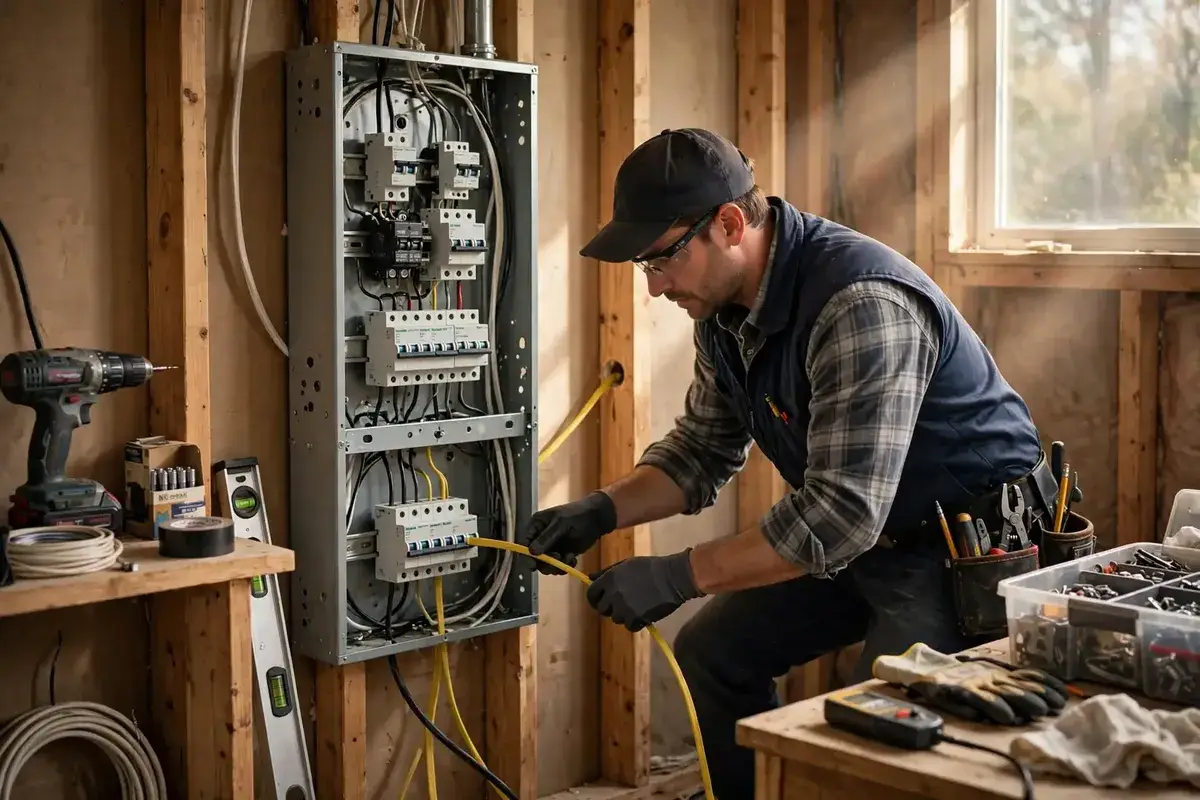
Every house has a moment when the panel runs out of easy answers. The breaker for the kitchen trips every time the microwave and the toaster run together, or the new home office needs an outlet where the wall is blank, or the air conditioner needs its own circuit because sharing one with the bedroom lights is no longer working. That moment is a new circuit, and the price is set by distance, by access, and by amperage. Ottawa Electrical, a Canadian contractor that publishes its pricing, quotes $300 to $800 CAD for adding a new circuit, including the ESA permit, materials, labour and inspection, with a simple 15-amp general circuit at $300 to $500, a 20-amp kitchen or bathroom circuit at $400 to $600, and a 240-volt appliance circuit for a dryer or range at $500 to $800. American figures agree in shape: a dedicated 20-amp circuit runs $500 to $900 US according to the contractor pricing compiled by Vifalio from HomeAdvisor, This Old House, Fixr and others, averaging about $700 US. Converted at about 1.40 Canadian dollars per US dollar, that American range becomes roughly $700 to $1,260 CAD, which sits above the Ottawa figures and reflects the difference between a short run in a new house and a long fished run through finished walls. There is no single Canadian national price series for this job, so the Canadian figures here are estimates built from converted American data and cross-checked against Ottawa Electrical's published Canadian pricing.
A dedicated circuit is not a luxury, it is how the code is written. The Canadian Electrical Code requires dedicated circuits for fixed appliances that draw a large load: the fridge, the microwave, the dishwasher, the laundry, the electric range, the dryer, and now the EV charger. The reason is the same in every case: a shared circuit means two loads fighting over one breaker, and the breaker doing its job by tripping. A 15-amp circuit at 120 volts carries about 1,800 watts; a 20-amp circuit carries about 2,400 watts. A microwave alone can draw 1,200 to 1,500 watts, which is why a microwave on a shared kitchen circuit trips the breaker the moment the toaster joins in. The decision rule is simple: if a breaker trips more than twice for the same combination of appliances, stop resetting it and get a dedicated circuit for the biggest load on it. Resetting a breaker that keeps tripping is not a fix, it is a habit that wears out the breaker and heats the wiring.
The access question is where the quote spreads. A short run near the panel, through an unfinished basement or an open attic, is a $500 to $900 CAD job including the breaker, the cable and the outlet. A long run through finished walls on the far side of the house, where the electrician has to fish cable behind drywall and patch the holes, runs $900 to $1,500 CAD or more. If the panel has no free breaker space, the answer is a subpanel at $800 to $1,500 CAD according to Ottawa Electrical, or a full panel upgrade, which our guide Electrical Panel Upgrade Cost: 100A to 200A in Canada covers. Breaker type adds cost too: an AFCI breaker, required by code in bedrooms, or a GFCI or dual-function breaker, required in kitchens and bathrooms, adds $80 to $200 to the bill, and the code requires them in many rooms whether you want them or not. The permit is included in the Ottawa pricing and it should be included in yours: in Ontario any new circuit requires an ESA permit, and in BC the permit runs through Technical Safety BC or the municipality.
Ask the electrician three questions before you approve the work. First, what amperage and what breaker type, and is the breaker AFCI or GFCI protected as the code requires for that room. Second, how will the cable get there, and is drywall patching included in the price or billed separately, because patching is the line item most often left out of an electrical quote. Third, does the panel have the capacity for another circuit, or are you one circuit away from a subpanel or an upgrade. A quote that answers all three in writing is a quote you can compare; a quote that just says "new circuit, $600" is a guess. Our guide Outlet and GFCI Outlet Installation Cost in Canada covers the outlet at the end of the new circuit, and EV Charger (Level 2) Installation Cost in Canada covers the biggest dedicated circuit most houses will ever add. For a rough number before you call, the RepairPrice home calculator (home-calculator.php) gives a fair range for your city.
Common questions:
Q: How much does it cost to add a new circuit in Canada? A: Ottawa Electrical quotes $300 to $800 CAD including the ESA permit, materials, labour and inspection, with a 15-amp circuit at $300 to $500 and a 240-volt appliance circuit at $500 to $800. A long run through finished walls costs $900 to $1,500 CAD or more.
Q: What is a dedicated circuit and which appliances need one? A: A dedicated circuit serves one appliance only, so nothing else can trip its breaker. The Canadian Electrical Code requires them for fixed heavy loads: fridge, microwave, dishwasher, laundry, range, dryer and EV charger. A 15-amp circuit carries about 1,800 watts and a 20-amp circuit about 2,400 watts.
Q: Do I need a permit to add a circuit? A: Yes, in almost every province. In Ontario a new circuit requires an ESA permit and inspection, and in BC the permit comes through Technical Safety BC or your municipality. In Ontario and New Brunswick, homeowners may not add new circuits themselves; the work belongs to a licensed electrician.
Q: Why does my breaker keep tripping? A: Usually because two heavy loads share one circuit, such as a microwave and a toaster on a 15-amp kitchen circuit. If it trips more than twice for the same combination, stop resetting it and get a dedicated circuit for the biggest load. A breaker that trips instantly on reset, or one that is hot to the touch, needs an electrician the same day.
| Job | Typical range (CAD) | Notes |
|---|---|---|
| New circuit, short run near panel | 300–800 | Breaker, cable, outlet, permit included |
| New circuit, long / finished-wall run | 900–1,500+ | Fishing cable takes time |
| Subpanel add-on (full panel) | 800–1,500 | When no breaker space remains |
| AFCI / GFCI / dual-function breaker | 80–200 extra | Code-required in many rooms |



 RepairPrice
