
Outlet and GFCI Outlet Installation Cost in Canada
By Oleksandr Potapenko · 2026-11-16 · How we research prices
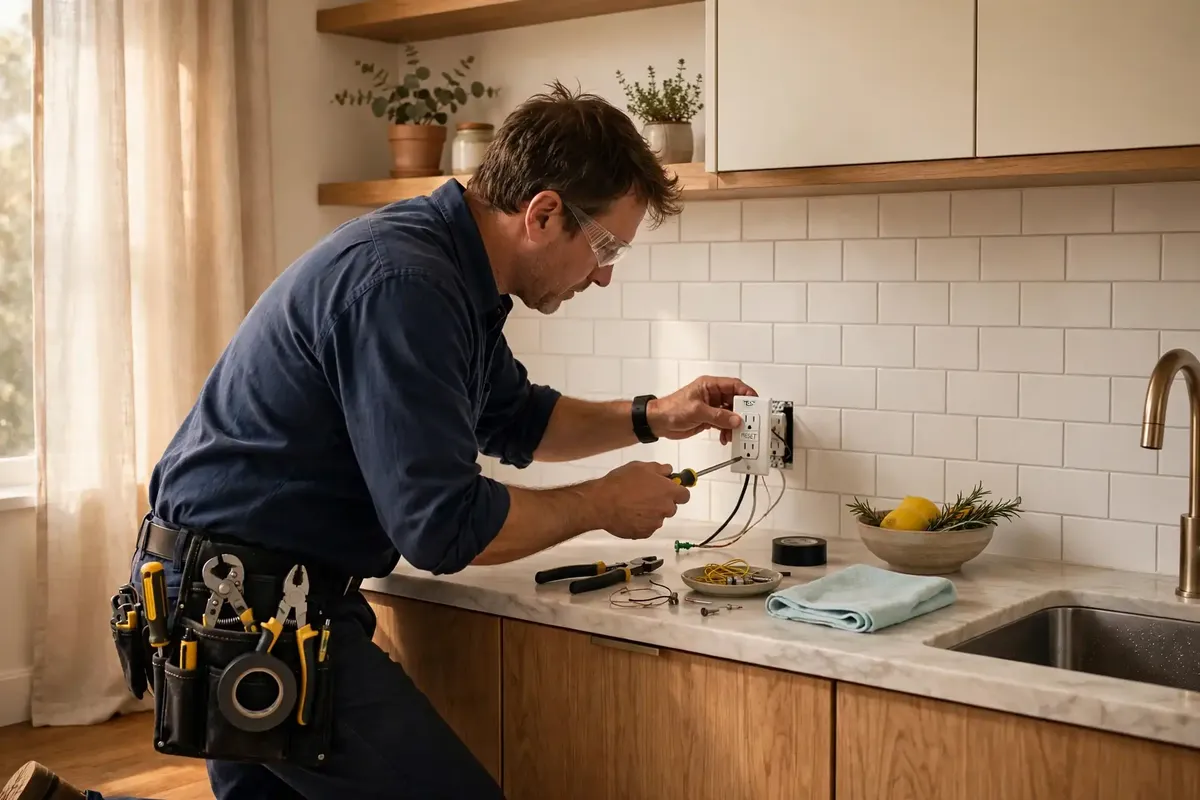
An outlet is the smallest electrical job in the house and the one most likely to be quoted three different ways, because the price depends entirely on whether the electrician is swapping a device in an existing box or running new wire through a finished wall. Angi puts the average cost to install or replace a GFCI outlet at about $210 US per outlet including materials and labour, with a typical range of $130 to $300 US, and its New York data shows $113 to $507 US per outlet depending on type, averaging $338 US in that market. The GFCI device itself costs $17 to $40 at a big-box store, about $12 to $25 more than a standard outlet, and covers add another $10 to $20. Converted at about 1.40 Canadian dollars per US dollar, Angi's $210 average becomes roughly $295 CAD, which is the middle of the Canadian band. There is no single Canadian national price series for this job, so the Canadian figures here are estimates built from converted American data and cross-checked against Canadian contractor pricing, including Ottawa Electrical, which quotes $150 to $350 CAD to add one outlet on an existing circuit and $300 to $600 CAD for an outlet in a finished wall.
The distinction that matters is replacement against new work. Replacing an existing outlet with a GFCI in the same box takes ten to fifteen minutes once the electrician is on site, and the honest price is the service-call fee plus the device, which is why bundling several outlets into one visit cuts the per-outlet cost sharply. Adding a brand-new outlet where none existed means fishing cable through the wall, cutting a box opening, and possibly adding a circuit, and that is a $300 to $700 CAD job per outlet in Canadian pricing. A USB outlet or a tamper-resistant upgrade adds $50 to $120 per outlet, which is cheap while the electrician is already there and expensive as a standalone visit. The decision rule is to batch: if you want three GFCIs in the kitchen and two in the bathrooms, have them all done in one visit, and if you want one new outlet in a finished wall, combine it with any other electrical work on your list so the service-call fee is spread across the whole job.
The safety case for GFCI protection is not a sales pitch, it is the code. A Class A GFCI trips at 5 milliamps of ground fault current, fast enough to prevent a lethal shock, and the Canadian Electrical Code requires GFCI protection for receptacles near water, outdoors, and in bathrooms and kitchens. The 2023 National Electrical Code in the US has widened GFCI coverage further, including garages and accessory buildings, and the 2026 edition extends outdoor dwelling protection to 60 amps. In Canada the practical rule is the same: any outlet within reach of a sink, a tub, a shower or the outdoors should be GFCI-protected, and every outdoor receptacle must be a listed weather-resistant type under a listed in-use cover, not a standard indoor receptacle under a flat snap cover. A GFCI does not give an ungrounded outlet a ground, which matters in older homes with knob-and-tube wiring, but it does give shock protection, and the Electrical Safety Authority recommends a GFCI exactly for those three-prong outlets in old houses.
Test the GFCI monthly with the test button on its face, and replace it if the button does not trip the outlet or if the reset button will not stay in. A GFCI that will not reset is usually doing its job and telling you there is a fault downstream, often a damp outdoor receptacle or a failing appliance, and the fix is to find the fault rather than to replace the GFCI and hope. If the outlet is warm, buzzing, sparking or scorched, stop using it and call an electrician the same day, because a loose connection behind an outlet is a fire risk, and in Calgary that kind of diagnostic visit runs $175 to $400. A permit is not usually needed for a like-for-like outlet replacement in most provinces, but a new outlet or a new circuit needs one, and in Ontario the ESA rules apply, while in New Brunswick a homeowner may replace an outlet with a GFCI but may not add new wiring without a licensed electrician and a permit. Our guide New and Dedicated Circuit Cost in Canada covers the circuit behind a new outlet, and Knob-and-Tube Rewiring Cost in Canada covers the old wiring that makes GFCI protection especially valuable. For a rough number before you call, the RepairPrice home calculator (home-calculator.php) gives a fair range for your city.
Common questions:
Q: How much does it cost to install a GFCI outlet in Canada? A: Angi's average is about $210 US per outlet including materials and labour, roughly $295 CAD converted. Canadian contractor pricing puts a replacement at $150 to $350 CAD on an existing circuit and $300 to $600 CAD for a new outlet in a finished wall. Bundling several outlets into one visit cuts the per-outlet cost.
Q: Can I install a GFCI outlet myself? A: In most provinces a homeowner may replace an existing outlet like-for-like, including upgrading to a GFCI, but may not add new wiring or a new circuit without a licensed electrician and a permit. In Ontario only like-for-like replacement is allowed for homeowners, and in New Brunswick the same rule applies. If you are not confident with a non-contact voltage tester, hire it out.
Q: Where are GFCI outlets required in Canada? A: The Canadian Electrical Code requires GFCI protection for receptacles near water, outdoors, and in bathrooms and kitchens. Every outdoor receptacle must be a listed weather-resistant type under an in-use cover. Any outlet within reach of a sink, tub or shower should be GFCI-protected.
Q: Why does my GFCI keep tripping? A: A GFCI trips at 5 milliamps of ground fault current, so it is usually detecting a real fault: a damp outdoor receptacle, a failing appliance, or moisture in a bathroom circuit. Unplug everything on the circuit and reset it; if it holds with nothing plugged in, plug items back one at a time. If it trips with nothing connected, call an electrician.
| Job | Typical range (CAD) | Notes |
|---|---|---|
| Standard outlet replacement | 150–300 each | Device plus labour |
| GFCI outlet install | 200–400 each | Required near water and outdoors |
| New outlet (new wiring run) | 300–700 each | Cable run length drives cost |
| USB / tamper-resistant upgrade | 50–120 extra each | Cheap while electrician is on site |




 RepairPrice
