
Laminate Flooring Installation Cost in Canada
By Oleksandr Potapenko · 2026-11-16 · How we research prices
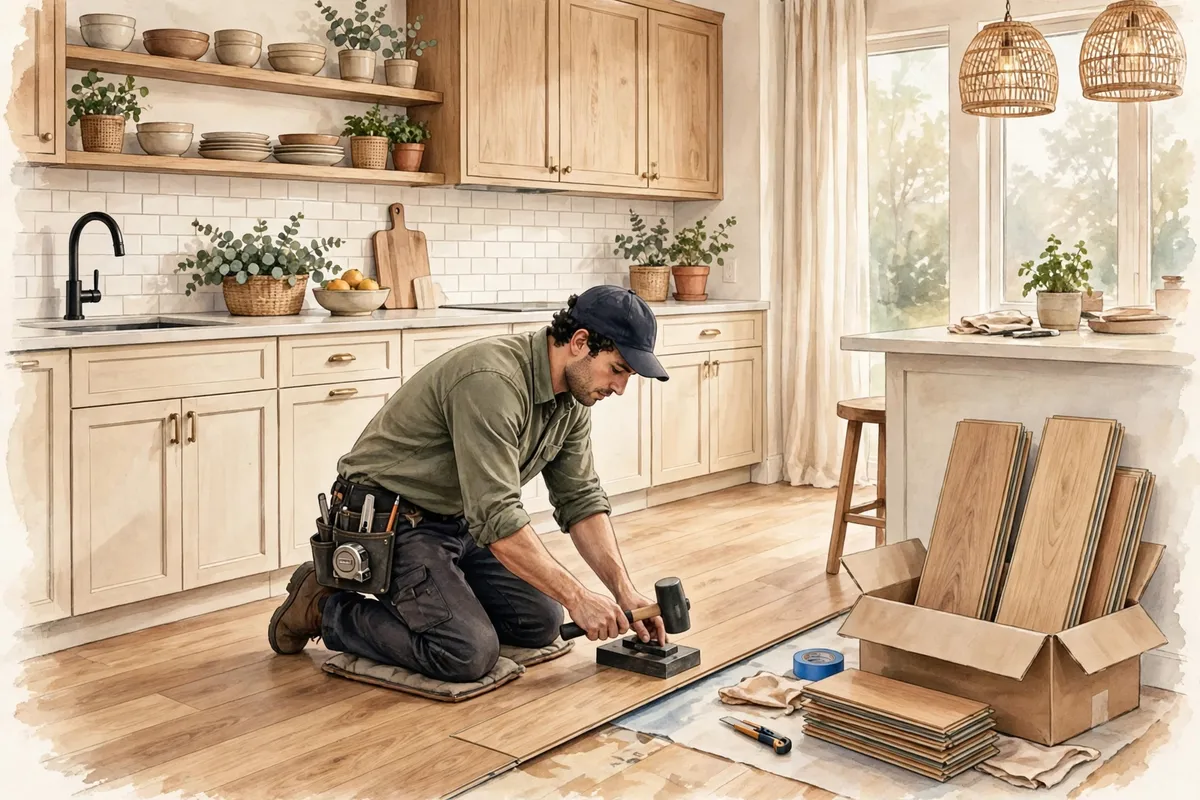
Laminate wins on one thing and one thing only: it looks like hardwood for about half the installed price, and it goes down fast. Everything else about buying it — the thickness, the wear rating, the water claims on the box — is where the money is actually won or lost. A cheap laminate that swells at the first dishwasher leak costs more than the mid-grade floor you skipped.
The price first, with the usual Canadian caveat. There is no single Canadian national price series for laminate installation, so the ranges below are estimates converted from verified American figures at 1.40 Canadian dollars per US dollar, checked against published Toronto pricing. HomeAdvisor's June 2026 guide puts laminate at $3 to $13 US per square foot installed, with the average project at $2,993 US and most jobs between $1,472 and $4,656 US. That top end surprises people, and the explanation matters: HomeAdvisor's range includes premium waterproof laminate, heavy prep, and removal, while the floor itself is cheap. This Old House, working from Fixr and HomeAdvisor data, splits it more usefully: materials $1 to $4 US per square foot, professional installation $4 to $8 US per square foot, or $1,000 to $2,400 US for a 200-square-foot room. Converted at 1.40, the typical Canadian job lands at roughly $4 to $9 per square foot installed, and the Toronto cross-check agrees: Parqueteam lists laminate at $4 to $9 Canadian installed, GMC Construction's Toronto guide lists $3 to $8 Canadian, and Floorrable's Toronto labour-only rate for click-together floating floors is $2.25 Canadian per square foot, with underlayment adding about $0.29. A 500-square-foot area therefore typically totals $2,000 to $4,500 Canadian before removal and levelling — which is where the old floor can add $500 to $1,500 you did not budget for.
The number on the box that matters most is the AC rating, and almost nobody shopping for laminate knows what it means. AC stands for Abrasion Class, a European test standard that grades the wear layer from AC1 to AC5. AC1 is light residential use — a spare bedroom nobody walks through. AC2 is general residential. AC3 is heavy residential and light commercial, and it is the minimum you should accept for a hallway, kitchen, or living room. AC4 is general commercial and the right pick for a busy family home with kids and a dog. AC5 is heavy commercial — overkill for a house, and you pay for durability you will never use. The trap is that a $2-per-square-foot AC2 floor and a $4-per-square-foot AC4 floor look identical in the showroom for the first month. The difference shows up in year three, when the traffic lane to the kitchen goes cloudy on the cheap floor and the AC4 floor still looks new. HomeAdvisor's own material pricing reflects this: an 8-millimetre plank runs about $1 to $1.80 US per square foot, a 10-millimetre plank $2 to $4 US, and a 12-millimetre plank $2.30 to $6 US.
Thickness is the second number worth paying for. A 12-millimetre plank feels solid and quiet underfoot; a 7-millimetre plank sounds hollow and flexes over any imperfection in the subfloor. Thicker planks also lock together more securely, which matters because a floating floor lives or dies by its joints. Labour runs $2 to $8 US per square foot according to HomeAdvisor, and the low end of that is a big empty rectangle while the high end is a house full of doorways, closets, and angles that need cutting.
Now the water question, because this is where laminate marketing does its worst. Laminate is water-resistant, not waterproof. Its core is high-density fibreboard — compressed wood pulp — and once standing water gets into the seams, the core swells and never goes back. ConsumerAffairs' comparison, quoting flooring retailers, puts it plainly: modern laminate with good seam protection can resist a spill for 24 to 72 hours if it is wiped up, but a leak that sits overnight can destroy the floor. "Waterproof laminate" exists, but even those products have a wood-based core underneath the water-resistant surface, so they are not a true substitute for vinyl in a room with standing water. That means no laminate in a full bathroom, no laminate in a basement with any damp history, and a hard think before putting it in a mudroom where snowmelt pools every winter. For those rooms, read "Vinyl Plank Flooring Installation Cost in Canada" — vinyl's PVC core simply does not absorb water — or "Tile Floor Installation Cost in Canada" for the entryway that takes boots and salt.
Canadian winters add a second constraint that southern buying guides never mention. Laminate expands and contracts with humidity, and a Canadian house that drops to 20 percent humidity in January without a humidifier will open gaps between planks. Installers must leave expansion gaps at the walls and use transition mouldings in large rooms and doorways, and you should keep indoor humidity around 30 to 40 percent in winter. A floor installed tight against the wall in July will buckle by August; a floor installed in January without gaps will gap by March. Ask the installer what gap they leave and whether the quote includes the mouldings — they are often a separate line of $200 to $600.
The decision rule is simple. Buy laminate when you want the hardwood look in dry rooms on a tight budget, and buy the thickest AC4 floor you can afford rather than the cheapest floor in the store. Skip laminate entirely for bathrooms, laundry rooms, and damp basements. Get the quote with underlayment, transitions, baseboard removal and reinstallation, and disposal of the old floor as separate lines, and compare it against hardwood refinishing in "Hardwood Floor Refinishing Cost in Canada" if there is old wood under your carpet — sometimes the real wood is already there. Check your square footage and waste allowance in the RepairPrice home calculator (home-calculator.php) before ordering, and add 10 percent extra material for cuts.
Common questions:
How much does laminate flooring cost to install in Canada? Typically $4 to $9 Canadian per square foot installed, or $2,000 to $4,500 for 500 square feet. HomeAdvisor's American range of $3 to $13 US converts higher at the top end, but Toronto guides from Parqueteam and GMC Construction cluster at $4 to $9 Canadian for standard work.
Is laminate flooring waterproof? No. Laminate is water-resistant, not waterproof — its fibreboard core swells permanently if standing water reaches the seams. It handles a spill wiped up quickly, but not a leak, a full bathroom, or a damp basement. Vinyl plank is the waterproof alternative.
What is the best AC rating for laminate flooring? AC3 is the minimum for hallways, kitchens, and living rooms; AC4 is the best value for a busy family home with children and pets. AC1 and AC2 are only suitable for low-traffic bedrooms, and AC5 is commercial overkill for a house.
How long does laminate flooring last? ConsumerAffairs puts laminate at 15 to 25 years with proper care, against about 25 years for vinyl. The real lifespan depends on the AC rating and water exposure: an AC4 floor in dry rooms can last two decades, while a thin AC2 floor in a kitchen may look worn in five years.
| Option | Typical range (CAD) | Notes |
|---|---|---|
| Installed, per sq ft | $4–$9 | Material $2–$5, underlayment included |
| Budget laminate (7–8 mm) | $4–$6 | Thinner, noisier, lower AC rating |
| Premium laminate (12 mm, AC4–AC5) | $7–$9 | Quieter, more scratch resistant |
| 500 sq ft area | $2,000–$4,500 | Before removal and levelling |
| Transitions and trims | $200–$600 | Doorways, room transitions |


 RepairPrice
