
Engine Sludge: Symptoms, Cleaning Cost and Prevention
By Oleksandr Potapenko · 2026-11-16 · How we research prices
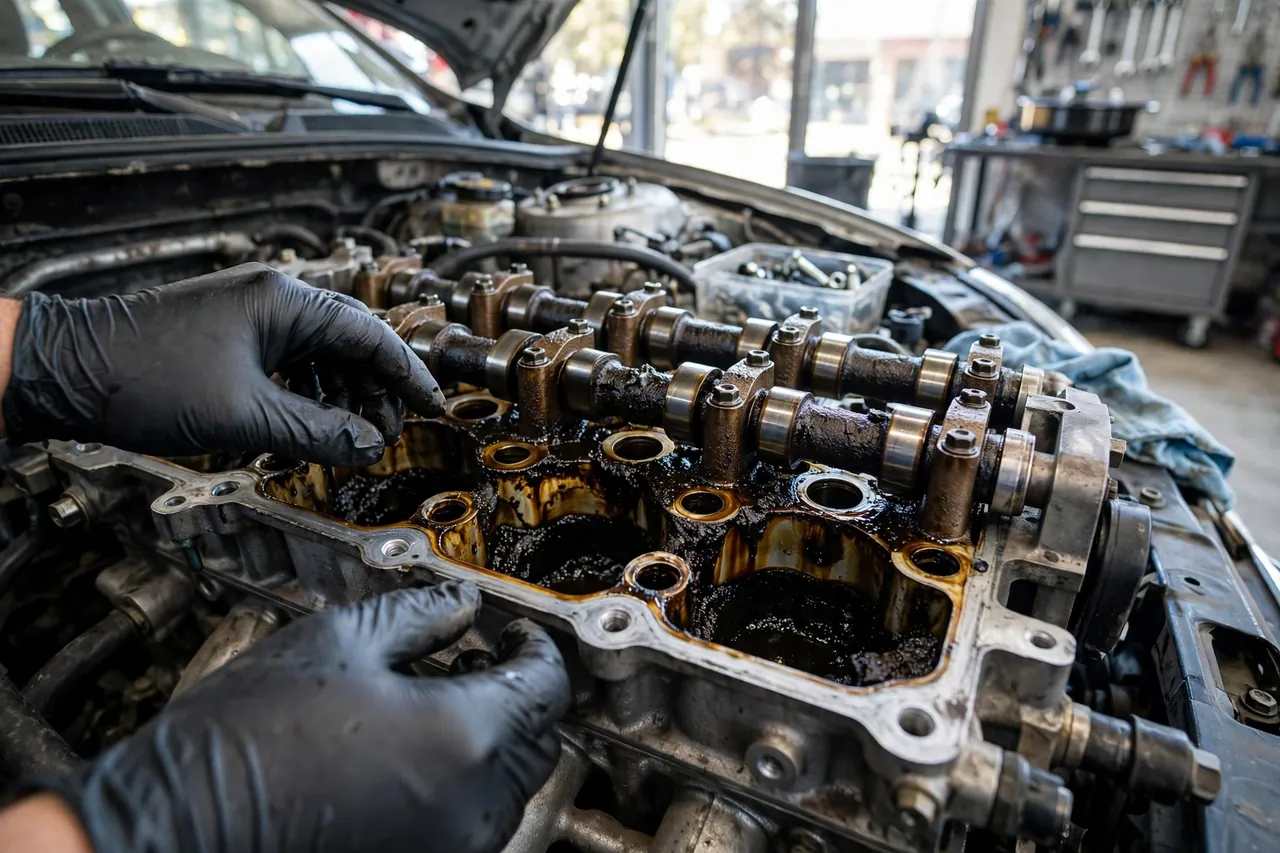
Lift the oil filler cap and look underneath. If you see a creamy or gritty brown deposit, the inside of your engine looks the same, and that is the moment this guide becomes urgent. Engine sludge is what engine oil becomes when it is cooked, contaminated and left in the engine too long: a thick, tar-like deposit that clings to the inside of the engine and blocks the narrow passages oil needs to flow through. Valvoline describes it as oxidized, thickened motor oil that has gelled and adhered to internal engine surfaces, looking like dark, tar-like residue on the underside of the oil cap, on valvetrain components and inside the oil pan. It builds slowly, and by the time it causes symptoms the deposits are already well established. Canadian driving makes it worse: short winter trips where the engine never fully warms up, stop-and-go city traffic, and stretched oil-change intervals all accelerate it. The sludge itself is not a part that breaks; it is the slow strangling of everything the oil is supposed to protect.
Valvoline lists seven warning signs, and they are worth memorizing, because sludge is cheapest when it is caught at sign one. Dark, gummy residue under the oil cap. An oil pressure light that flickers at idle, because restricted oil galleries cannot keep up with demand at low rpm. Engine knocking or ticking on cold start. Oil that looks like black molasses on the dipstick instead of translucent amber-brown. A noticeable drop in fuel economy. Higher-than-normal oil consumption between changes. And a check-engine light for oil-pressure or variable valve timing codes. Left alone, sludge starves the camshaft and turbo of oil, clogs the pickup screen, and can seize an engine that was running fine the week before. The flickering oil pressure light is the same warning covered in Oil Pressure Warning Light: Causes and Repair Cost, and it means the same thing here: stop and diagnose, do not hope it goes away.
Cleaning depends on how bad it is, and the honest answer is that there is no single sludge cleaning price, because there are three different jobs. Mild sludge often responds to a run of short-interval oil changes with full synthetic oil at $100 to $150 a change, which slowly dissolves deposits without shocking the engine loose. Valvoline's own claim is that a deposit-removing synthetic, used as directed for four or more consecutive oil changes, is clinically proven to remove up to 100 percent of piston deposits in adapted Sequence IIIH testing, which is the strongest evidence available for the gentle approach. A professional engine flush, a cleaning fluid or a series of short-interval changes to dissolve sludge before fresh oil goes in, costs roughly the same as a premium oil change, $90 to $150 at a shop, and it is not routine maintenance. For some engines it is the wrong choice, and on a high-mileage engine with heavy sludge it can free deposits that block oil passages, so a shop should assess the engine before agreeing to it. Severe sludge needs the oil pan and pickup screen cleaned by hand, and a Canadian-style estimate for that work, pan removal, hand cleaning and a new gasket, runs $600 to $1,200. EngineerFix puts professional internal engine cleaning at $600 to $1,200, and repair bills at the stage where sludge has already caused damage at $1,500 to $5,000 or more. Valvoline's own sludge guide prices the same ladder in US dollars: a deposit-cleaning synthetic at $90 to $150 for a shop oil change, a professional engine flush adding $100 to $150, and a teardown to physically clean the internals starting around $1,500 and exceeding $3,000 — about $2,070 Canadian and up, above this guide's $600 to $1,200 pan-cleaning band, because Valvoline's teardown is a full internal strip-down rather than a pan removal and hand clean. The guide's $600 to $1,200 is the shop-level pan job; budget toward Valvoline's end once bearings or the pickup are involved. A stuck PCV valve makes sludge worse by trapping moisture and blow-by gases, and replacing it costs $70 to $125, a cheap step that should come first and is covered in EGR and PCV Valve Replacement Cost. If a shop removes the valve cover to inspect or clean, expect the valve cover gasket at $230 to $380 to be part of the bill.
Prevention costs almost nothing compared with the cure, and it is almost entirely about intervals. Change the oil on the schedule in the owner's manual, not on a feeling, and use full synthetic oil, $100 to $150 a change, if the manual calls for it, because synthetic oil resists the breakdown that creates sludge. Let the engine reach full temperature on a regular basis, fix a PCV fault promptly, and keep the oil topped up; low oil runs hotter and sludges faster. Do not confuse sludge with carbon on the intake valves, which is a different deposit on direct-injection engines. That job is walnut blasting, which a Port Coquitlam NAPA AUTOPRO shop prices at $600 to $800 Canadian, with chemical induction cleaning at $190 to $300, and it is recommended every 30,000 to 50,000 km on direct-injection engines. A diagnostic scan at $95 to $130 is worth it the moment the oil pressure light flickers or the engine starts ticking. Sludge caught early is a maintenance problem, and sludge caught late is an engine rebuild at $3,875 to $6,750, which is the decision covered in Engine Rebuild vs Replace: The Decision in Canada. Check the fair price for the cleaning your engine actually needs on the RepairPrice calculator (calculator.php) before you approve a flush.
Common questions:
Q: How much does it cost to clean engine sludge in Canada? A: Mild sludge is handled with short-interval synthetic oil changes at $100 to $150 each, or a professional flush at $90 to $150. Severe sludge needing the pan removed and cleaned by hand runs $600 to $1,200. EngineerFix puts professional internal cleaning at $600 to $1,200 in US dollars; Valvoline puts a full teardown at $1,500 US and up. If sludge has already damaged bearings, the bill reaches $1,500 to $5,000 or more.
Q: Can engine sludge be removed? A: Yes, in most cases. A deposit-removing synthetic oil run for four or more consecutive changes is clinically proven to remove up to 100 percent of piston deposits, according to Valvoline's Sequence IIIH testing. If the oil pickup is fully blocked or the engine is already losing oil pressure, mechanical cleaning is required.
Q: What causes engine sludge? A: Oil that runs past its life oxidizes into a thick, tar-like sludge. Short winter trips where the engine never warms up, stop-and-go traffic, stretched oil-change intervals, and a stuck PCV valve all accelerate it.
Q: Is an engine flush safe? A: On a well-maintained engine, usually yes. On a high-mileage engine with heavy sludge, a flush can dislodge large chunks that block oil passages, so a shop should inspect first and sometimes advise against it. Short-interval oil changes are the safer route on a neglected engine.
| Service | Typical range (CAD) | Notes |
|---|---|---|
| Diagnostic scan | $95–$130 | Oil pressure and misfire faults show up here |
| PCV valve replacement | $70–$125 | Trapped moisture makes sludge worse — fix first |
| Engine flush, professional | $90–$150 | Not routine; inspect first on high-mileage engines |
| Oil change, full synthetic | $100–$150 | Short-interval changes dissolve mild sludge |
| Oil change, conventional | $80–$120 | Shorter change interval than synthetic |
| Pan removal + hand cleaning | $600–$1,200 | Severe sludge; pickup screen cleaned by hand |
| Valve cover gasket | $230–$380 | Cover removal for inspection or cleaning |
| Major engine rebuild | $3,875–$6,750 | Sludge caught too late — bearing damage |


 RepairPrice
