
Coolant Reservoir Leak: Replacement Cost in Canada
By Oleksandr Potapenko · 2026-11-16 · How we research prices
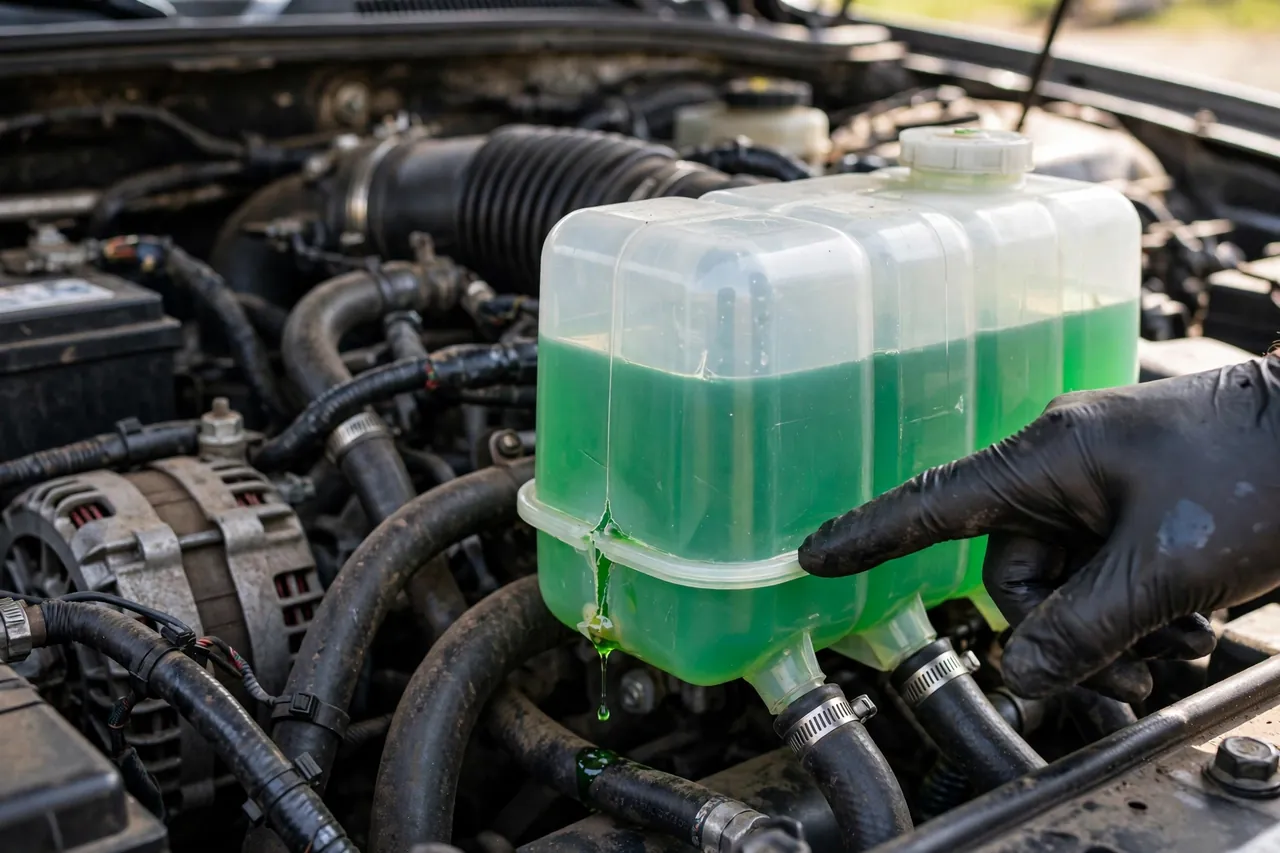
The BMW E46 is the car that made the coolant reservoir famous, and not in a good way. On 2000s BMWs with the M52 and M54 inline-six engines, the plastic expansion tank is a notorious failure point: the original plastic becomes brittle from constant exposure to heat and pressure, and failure is a matter of when, not if. Go-Parts, a parts supplier that specialises in these cars, recommends proactively replacing the tank every 80,000 to 100,000 miles, and prices a genuine BMW tank at $110 to $220 US, an OEM-supplier tank from Behr, Mahle, or Rein at $45 to $75 US, and shop labour at $120 to $250 US for one to one and a half hours. The same story plays out on the 2010 to 2016 Porsche Panamera, where Go-Parts prices a new Porsche tank at $160 to $215 US, an aftermarket tank at $70 to $110 US, and labour at $122 to $179 US. The reservoir is the simplest part of the cooling system, and it is also one of the most exposed to heat, which is why it fails on almost every brand eventually.
Replacing a coolant reservoir in Canada costs roughly $230 to $550 at an independent shop for a typical car, and the range is an estimate built from two named US sources converted at about 1.38 Canadian dollars to the US dollar. RepairPal puts the national average for a coolant reservoir replacement at $480 to $536 US, which converts to roughly $660 to $740 Canadian, while SuperCarDigest's 2026 coolant leak guide prices the reservoir at $150 to $400 US, with the part at $40 to $200 US and half an hour to an hour of labour, converting to roughly $205 to $550 Canadian. EngineerFix's 2026 guide agrees with the lower figure, putting a professional replacement at $150 to $400 US, with an aftermarket tank as low as $30 to $50 US and a factory tank with integrated sensors at $100 to $150 US or more. The two sources disagree because they are pricing different cars: RepairPal's average leans toward newer vehicles with sensor-equipped tanks and dealer-level labour, while SuperCarDigest and EngineerFix describe the common case, a plain plastic tank on a mainstream car. If your car has a coolant level sensor built into the tank, expect the RepairPal end of the range; if it is a plain tank on a Corolla or a Civic, expect the lower end.
The reservoir, also called the expansion tank or overflow tank, is the translucent plastic bottle beside the radiator. It gives hot, expanding coolant somewhere to go, and feeds it back as the engine cools. After eight to ten years of hot-cold cycles the plastic loses flexibility, and the highest-stress points, the filler neck, the hose nipples, and the moulded seams, develop hairline cracks. The signs are easy to spot once you know them: the level in the tank keeps dropping with no puddle under the car, a sweet smell after parking, white or pink crust around the tank seams or the cap, and a temperature gauge that creeps up in traffic. In a Canadian winter the leak often announces itself on the coldest morning, when the plastic contracts and a hairline crack opens just enough to weep. A cracked tank cannot be patched reliably, and Go-Parts is blunt about it on the Panamera: plastic epoxies and sealants will not provide a safe, permanent repair, and the only correct solution is to replace the tank.
The diagnostic trap with a reservoir leak is that an empty reservoir does not always mean the tank itself is broken. It may indicate a leak elsewhere in the system, a hose, the radiator, or the water pump, or a failure to recirculate fluid properly. A pressure test of the cooling system finds the real leak, and a shop should do one before replacing anything. The other trap is the cap: a reservoir or radiator cap costs $15 to $40, and a failed cap that cannot hold pressure will push coolant out of the overflow and look exactly like a cracked tank. Ask the shop to test the cap and pressure-test the system before you approve a tank, because a $40 cap beats a $400 tank every time. If the tank is genuinely cracked, replace the cap with it, because the old cap is the same age and the new tank deserves a cap that holds its rated pressure.
The decision rule is short. Replace the tank if it is cracked, yellowed, or weeping at a seam, and do it this week, not next month, because a hairline crack can split open without warning and dump the coolant in seconds. Do not drive with a leaking reservoir, as Go-Parts warns for the BMW: a sudden crack causes rapid coolant loss, severe overheating, and potentially catastrophic engine damage. While the system is open, consider the thermostat and a coolant flush together, because our guides "Thermostat Replacement Cost in Canada" and "Coolant Flush Cost in Canada" price both, and the coolant has to come out for the tank anyway. If the engine has been driven hot for months because of a slow leak, budget for the worst case too: a head gasket damaged by repeated overheating, which our guide "Head Gasket Repair Cost in Canada" prices, is the repair that turns a $300 tank into a $3,000 bill. Check the range for your car with the RepairPrice calculator (calculator.php) before you call a shop, and ask for the part brand in writing: an OEM-supplier tank from Behr, Mahle, or Rein costs little more than an economy tank and lasts far longer.
Common questions:
Q: How much does it cost to replace a coolant reservoir in Canada? A: Roughly $230 to $550 at an independent shop for a typical car. RepairPal's US average of $480 to $536 converts to about $660 to $740 Canadian, while SuperCarDigest's $150 to $400 US and EngineerFix's $150 to $400 US convert to roughly $205 to $550 Canadian; the difference is sensor-equipped tanks on newer cars versus plain tanks on mainstream cars.
Q: Can I drive with a leaking coolant reservoir? A: Only for a short distance, with the coolant topped up and the gauge watched, and only if the leak is minor. A sudden crack can dump the coolant in seconds and overheat the engine, so a leaking tank is a repair to schedule this week, not next month.
Q: Can a cracked coolant reservoir be repaired? A: No, not reliably. Epoxy and sealants will not provide a safe, permanent repair on a pressurised plastic tank, and the tank will crack again. The only correct fix is replacement, plus a new cap.
Q: Why is my coolant reservoir always empty? A: Not always because the tank is broken. It can mean a leak elsewhere, a hose, the radiator, or the water pump, or a failed cap that cannot hold pressure. A cooling system pressure test finds the real source before you pay for a tank.
| Service | Typical range (CAD) | Notes |
|---|---|---|
| Coolant reservoir replacement | $230–$550 | RepairPal $480–$536 US; SuperCarDigest $150–$400 US, converted |
| Diagnostic + pressure test | $120–$180 | Finds the real leak before parts are ordered |
| Coolant flush, car | $165–$260 | Often done with a reservoir or hose job |
| Thermostat replacement | $250–$600 | Same area, same age range — consider together |
| Water pump replacement | $650–$950 | The expensive leak suspect |
| Radiator replacement | $550–$1,050 | Radiator $180–$450 + about 2.5 h labour |
| Head gasket replacement | $2,000–$4,500 | Worst case after months of low coolant; RepairPal $2,572–$3,386 US |




 RepairPrice
