
Water Heater Repair Cost: No Hot Water in Canada
By Oleksandr Potapenko · 2026-11-16 · How we research prices
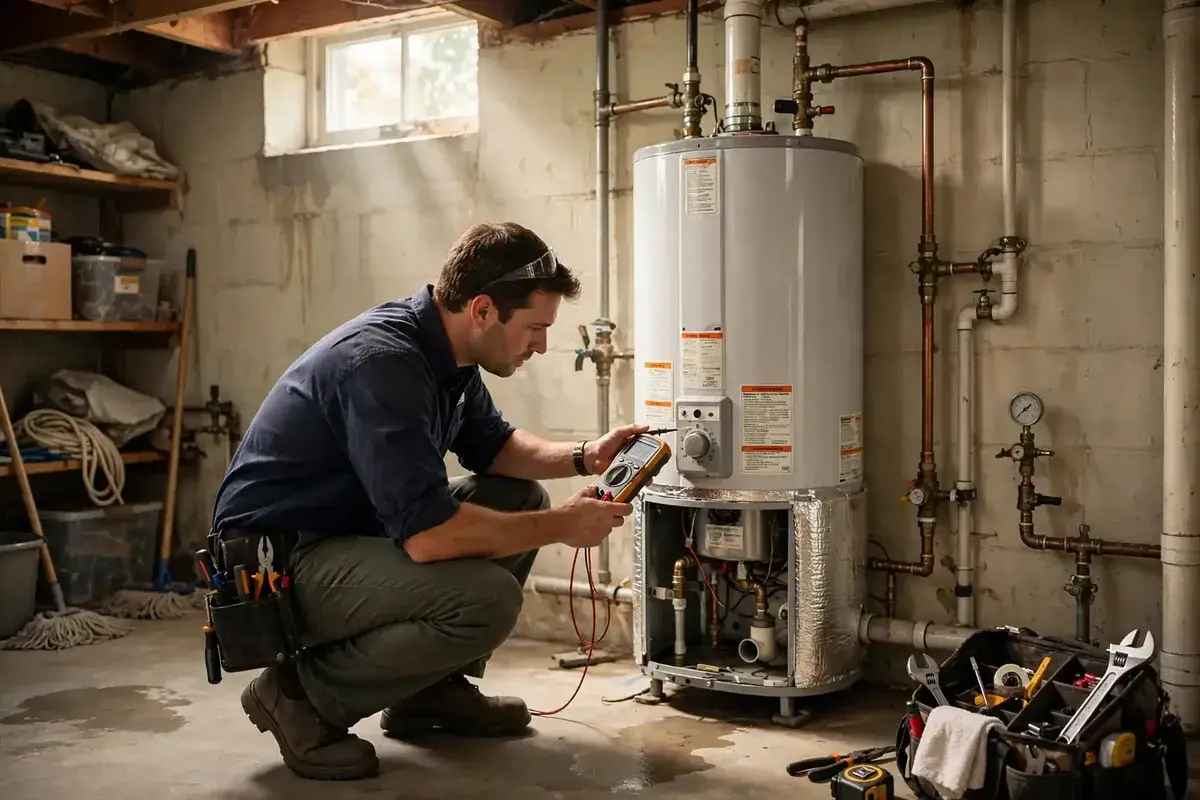
No hot water is rarely a dead water heater. Most often the heater has lost its power, its gas, or its flame, or someone changed a setting. HomeAdvisor puts the national average water heater repair at 615 USD, with most homeowners paying 228 to 1,017 USD, or roughly 315 to 1,415 CAD at the 1.39 rate used in this guide. The range is wide because the failed part decides the price: a pressure relief valve costs 20 to 200 USD, a thermostat 150 to 200 USD, a heating element 200 to 300 USD, a thermocouple about 150 USD, and a gas control valve 350 USD or more. Gas repairs run 150 to 500 USD; electric repairs run 20 to 300 USD, because an electric tank has fewer parts that can fail expensively. There is no Canadian national series for water heater repair, so these converted US figures are checked against Canadian plumber rates of 105 to 175 CAD per hour: a one- to two-hour diagnostic and repair visit plus a 30 to 400 CAD part reproduces the same band.
Before you call anyone, do the two-minute checks that fix the problem for free in a surprising number of cases. On an electric heater, check the breaker: an electric tank runs on its own 240-volt double breaker, and if it has tripped, the tank goes cold within hours. Reset it once. If it trips again, stop: a breaker that trips repeatedly means a failed element or thermostat, and the reset button next to the 240-volt terminals is not a DIY job. On a gas heater, check the gas dial: the US Department of Energy recommends 120 degrees Fahrenheit, about 49 Celsius, for most homes, and a dial turned to Warm or Vacation feels exactly like a broken heater. Check the pilot light. If it is out and will not stay lit, the thermocouple is the usual suspect. And check whether anyone in the house turned the cold-water inlet valve on top of the heater, which is the valve you close when the tank leaks. None of these checks costs anything, and together they solve a large share of no-hot-water calls before a plumber is involved.
The symptom tells you the part, and knowing that before the visit keeps the quote honest. Water that starts hot and turns lukewarm after a few minutes means the heater works but holds less hot water than it should: usually a failed lower element on an electric tank, or a broken dip tube that lets cold water mix at the top. No hot water at all on an electric tank usually means the top element or its thermostat has failed, because the top element heats first and the bottom one never gets its turn. A gas heater that will not light usually means the thermocouple, the igniter, or the gas control valve, in that order of cost. Rusty hot water, or water around the base of the tank, means something else entirely: the tank itself is failing, and no part replacement will save it. HomeAdvisor puts a replacement at about 875 to 1,800 USD installed, or roughly 1,215 to 2,500 CAD, and a tank leaking from the body is the one repair that is never worth attempting.
The repair-or-replace decision follows the same age rule plumbers use for every appliance. The US Department of Energy puts a conventional storage tank at 10 to 15 years of life. Under six years old, repair it unless the tank body is cracked or leaking. Past its midpoint, use the 50 percent rule: if the repair quote is more than half the price of a comparable new unit, replacement almost always wins. A 615 USD average repair on a 12-year-old tank is a bad bet; the same repair on a four-year-old tank is a bargain. The other number to weigh is the cost of the next repair. A tank that has needed a thermostat this year and an element last year is telling you its remaining parts are the same age and will fail in the same order. Our guide Water Heater Tank Replacement Cost in Canada has the replacement numbers, and Tankless Water Heater Installation Cost in Canada and Heat Pump Water Heater Cost in Canada cover the upgrades worth pricing when the tank dies. Run all three through the RepairPrice home calculator (home-calculator.php) before you authorise a repair over 500 CAD on an old tank.
One safety note, because it matters more than the price. If it is a gas unit and you smell gas near the heater, shut off the gas supply valve, do not touch any electrical switch, leave the area, and call your gas utility or 911. If you see water leaking, shut off the cold-water inlet valve on top of the heater and turn off the power at the breaker or the gas to the unit. A leak from a valve or a fitting on top is often a 20 to 200 USD repair. A leak from the bottom of the tank means the tank has rusted through, and the only fix is a new heater. Do not wait on a leaking tank: it does not get better, and the floor underneath it does not forgive.
Common questions:
Q: How much does it cost to fix a water heater with no hot water?
A: HomeAdvisor puts most repairs at 228 to 1,017 USD, about 315 to 1,415 CAD, averaging 615 USD. A heating element runs 200 to 300 USD, a thermostat 150 to 200 USD, and a thermocouple about 150 USD. Often the fix is free: a tripped breaker or a dial turned down.
Q: Why is my water heater not producing hot water?
A: On an electric tank, usually a tripped breaker, a failed top element, or a failed thermostat. On a gas tank, usually a pilot light out, a failed thermocouple, or a gas control valve. Water that starts hot and goes lukewarm usually means a failed lower element or a broken dip tube.
Q: How do I know if my water heater needs replacing?
A: It is over 10 to 15 years old, it leaks from the tank body, the hot water is rusty, or the repair costs more than half a new unit. A tank leaking from the bottom is never repairable.
Q: Is it safe to reset my water heater myself?
A: The breaker reset is safe to try once. The reset button next to the 240-volt terminals is not: leave it to a plumber or electrician, because a button that tripped once usually trips again until the failed part is replaced.
| Problem | Typical repair range (CAD) | Likely fix |
|---|---|---|
| No hot water (electric) | 200–450 | Thermostat, element, reset or breaker |
| Pilot out / won't stay lit | 200–400 | Thermocouple or igniter |
| Gas valve / control failure | 400–800 | Valve or board replacement |
| Tank leaking from the body | Replacement | Tanks are not patch-repaired |

 RepairPrice
