
Tankless Water Heater Installation Cost in Canada
By Oleksandr Potapenko · 2026-11-16 · How we research prices
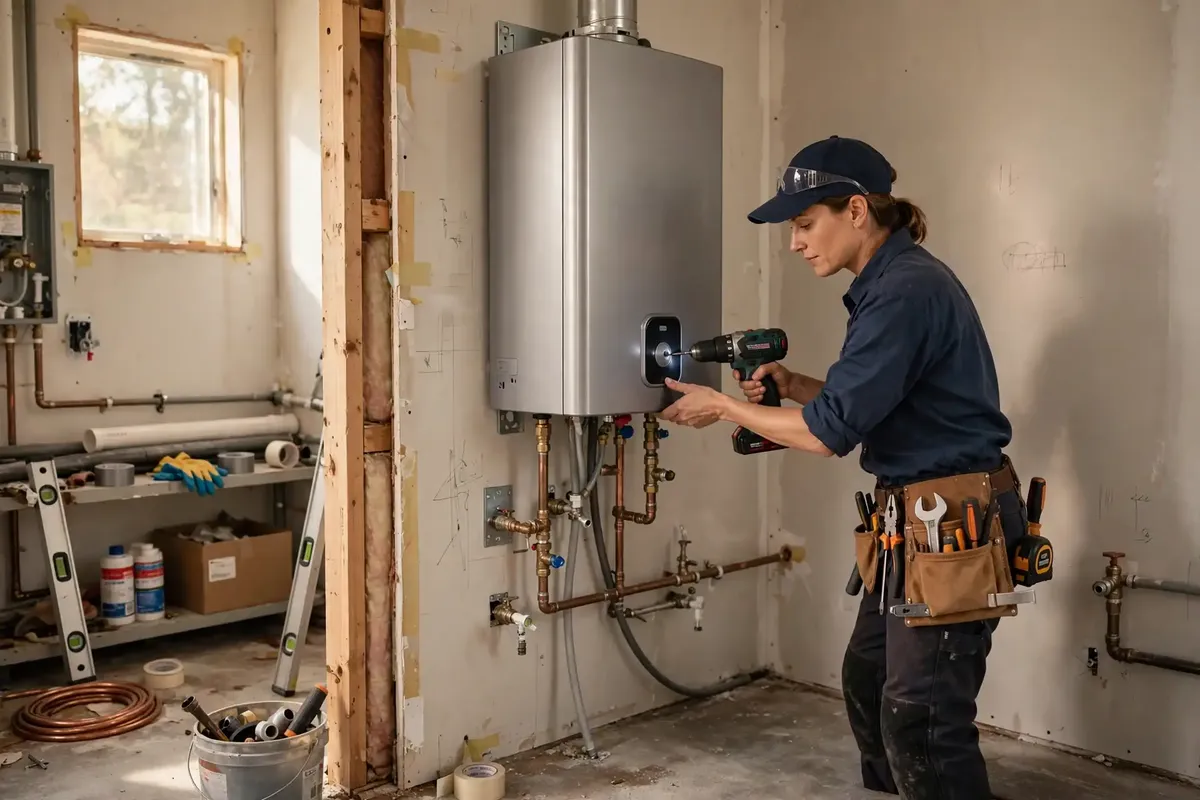
A tankless water heater promises the thing every family wants: hot water that never runs out. The price of that promise is the highest upfront cost of any residential water heater. HomeAdvisor, Angi, and Fixr agree unusually well on this one: HomeAdvisor puts the average at 2,638 USD, Angi at 2,629 USD, and Fixr at 2,811 USD, with most projects landing between 1,400 and 3,900 USD. Converted at 1.39, that is an average of about 3,660 CAD, with most jobs between 1,950 and 5,420 CAD. By type, the split is sharp: an electric whole-home tankless runs 1,400 to 3,000 USD installed, and a gas whole-home tankless runs 2,100 to 5,600 USD. HomeAdvisor estimates labour alone at 600 to 1,900 USD for a tankless unit, and 150 to 2,500 USD to convert from a tank to tankless. Canadian market reporting fits: Hamilton data puts tankless gas water heaters at 2,500 to 3,500 CAD installed, and Ottawa data at 2,500 to 4,500 CAD depending on size and venting. There is no Canadian national series for tankless installation, so these converted US figures are anchored to those Canadian city markets, and the Canadian numbers sit at the low end because they assume simpler conversions.
The unit is only part of the bill, and it is the part that gets all the attention. A gas tankless unit costs 1,500 to 2,600 USD for the unit alone, according to HomeGuide, while an electric unit costs 600 to 1,000 USD. But a gas conversion needs three things a tank never needed: a larger gas line, a new vent, and a condensate drain. HomeGuide puts a first-time vent at 500 to 1,500 USD and a larger gas line at 350 to 750 USD, and some jobs need 350 to 2,000 USD of gas line work. A condensing tankless, which is the efficient kind worth buying, needs a condensate drain to a floor drain or a pump, and it needs its exhaust vented in PVC or stainless, not the old metal flue. A like-for-like replacement of an existing tankless is a different job and a cheaper one: the venting and the gas line are already there, and the total runs 2,500 to 4,500 CAD. The question to ask any quote is not the price of the unit. It is what the conversion adds.
The efficiency case is real but it is often oversold. The US Department of Energy says tankless units are 24 to 34 percent more energy efficient than tanks for the average household, and HomeAdvisor says a tankless can last 20 years or more with good care, against 10 to 15 years for a tank. That is a real saving and a real lifespan advantage. But the payback depends on what you are replacing and what fuel you burn. Against an electric tank in a house with expensive electricity, the payback is strong. Against a cheap natural gas tank in a house with cheap gas, the payback stretches, because the gas tank was already cheap to run and the tankless costs twice as much to install. Do the arithmetic on your own bills before you decide: the installed price difference is about 1,500 to 3,000 CAD, and the annual saving has to repay it. The other cost nobody mentions is descaling. In hard-water areas, a tankless needs an annual descaling service at 150 to 300 CAD, and skipping it voids warranties and kills the heat exchanger. A tank forgives hard water for years. A tankless does not.
Size is measured differently, and getting it wrong is the most common tankless regret. A tank is sized in gallons. A tankless is sized in flow rate, in gallons per minute, and in temperature rise. A unit that delivers 9 gallons per minute at a 35-degree rise will run two showers at once in summer, when the incoming water is 15 degrees, and struggle to run one in a Canadian January, when the incoming water is 5 degrees and the rise needed is 50 degrees or more. The fix is a larger unit, usually 199,000 BTU for gas, which is the standard whole-home size, and it is the reason a gas tankless in a cold-climate house needs the bigger gas line. Before you buy, ask the installer for the flow rate at your winter incoming water temperature, in writing. A unit sized for a Florida winter is not sized for an Edmonton one.
The decision rule is about the house, not the heater. Choose tankless when the tank has died and you want endless hot water, when space matters because the tank is in the way, or when you are on expensive electricity and the efficiency gain pays back. Choose another tank when the budget is tight, when the gas line and venting would double the job, or when the house has very hard water and nobody will descale annually. And if you do go tankless, buy condensing, buy a known brand with local parts and service, and get the descaling done every year. Our guide Water Heater Tank Replacement Cost in Canada has the tank numbers for comparison, and Heat Pump Water Heater Cost in Canada covers the other high-efficiency option, which suits electric houses better than tankless does in many cases. Compare all three in the RepairPrice home calculator (home-calculator.php) before you sign.
Common questions:
Q: How much does a tankless water heater cost in Canada?
A: Most installations run 1,950 to 5,420 CAD, averaging about 3,660 CAD, based on HomeAdvisor, Angi, and Fixr figures converted at 1.39. Canadian city data puts a gas tankless at 2,500 to 4,500 CAD installed. Electric whole-home units are cheaper; gas conversions with new venting and gas lines are dearer.
Q: How long does a tankless water heater last?
A: Twenty years or more with good care, according to HomeAdvisor, against 10 to 15 years for a tank. Annual descaling in hard-water areas is what makes that lifespan real.
Q: Is a tankless water heater worth it?
A: For endless hot water and 24 to 34 percent better efficiency, yes, according to the US Department of Energy. But the payback is slow against a cheap natural gas tank, and the installation costs twice as much. Do the arithmetic on your own fuel bills first.
Q: What size tankless water heater do I need?
A: A whole-home gas unit is usually 199,000 BTU. The critical number is flow rate at your winter incoming water temperature: Canadian groundwater at 5 degrees needs a much bigger temperature rise than summer water, so size for January, not July.
| Item | Typical range (CAD) | Notes |
|---|---|---|
| Tankless unit | 1,500–3,500 | Condensing models cost more |
| Labour + venting + permits | 1,500–3,500 | Gas-line upsizing is the wild card |
| Replacement of existing tankless | 2,500–4,500 total | Venting and gas already in place |
| Annual descaling service | 150–300 / year | Essential in hard-water areas |

 RepairPrice
