
Central Vacuum Installation Cost in Canada
By Oleksandr Potapenko · 2026-11-16 · How we research prices
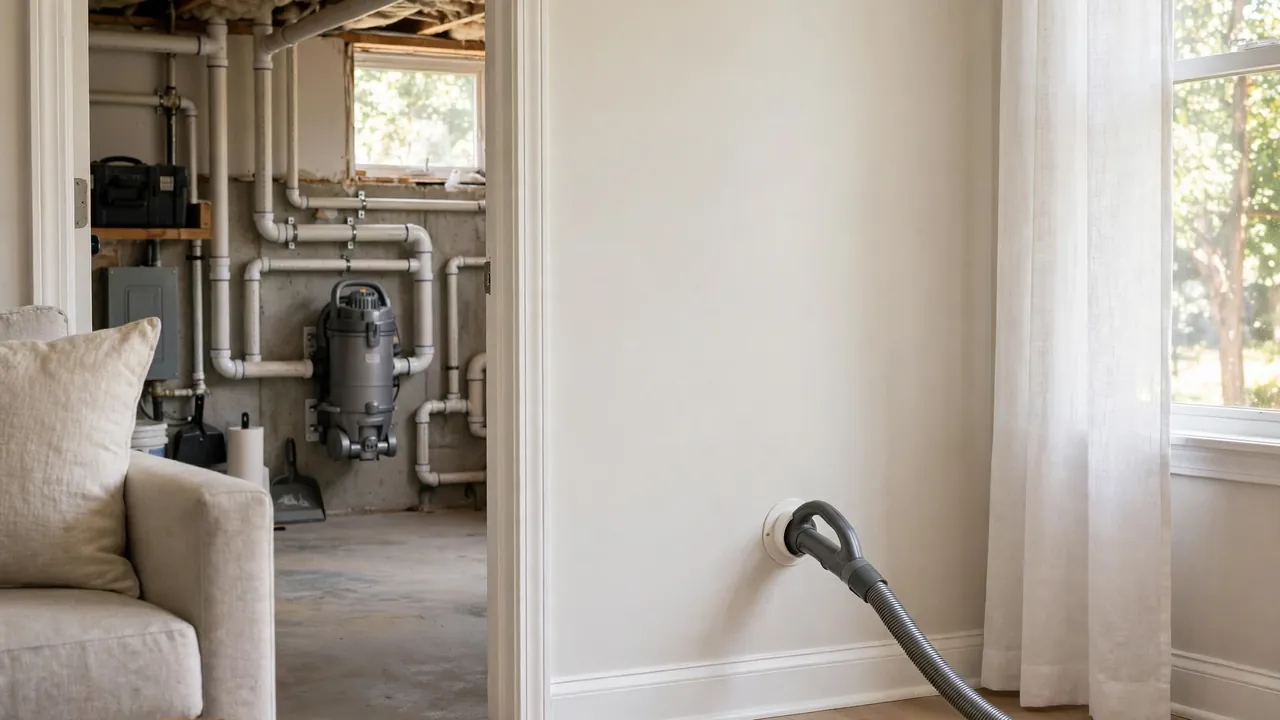
A central vacuum is the only home appliance you buy once and then live inside. The power unit sits in the basement or garage, the tubing runs through the walls, and all you carry from room to room is a lightweight hose. It is also the only appliance whose price depends more on when you install it than on what you buy. Put it in while the walls are open and it is a modest job. Put it in after the drywall is up and it is a renovation.
Angi puts central vacuum system installation at $1,000 to $2,000 US, and HomeAdvisor puts the average installation at about $1,600 US, with a range of $240 to $3,000 depending on system type, home size, accessories and labour. The two guides agree on the centre and diverge at the edges for a good reason: a pre-piped home where the tubing is already in the walls is a power-unit swap, while a finished home with no tubing is a fishing job through joists and closets. The Nifty House guide, working from the same published cost data, puts a full installation at $1,200 to $3,000 US for a 3,000-square-foot home, with a four-inlet system at $1,200 to $2,800 in new construction and $1,500 to $3,100 as a retrofit, and a retractable-hose system at $2,400 to $3,900 new and $2,700 to $4,200 retrofit.
There is no single Canadian national price series for central vacuum installation, so the Canadian figures here are estimates converted from those verified US figures at 1.40 Canadian dollars per US dollar, then cross-checked against a named Canadian shop. Angi's $1,000 to $2,000 becomes roughly $1,400 to $2,800 Canadian. The Vacuum District in Calgary, the Canadian cross-check, puts a power unit replacement at $500 to $1,200 plus Canadian using existing wall piping, a pre-piped system install at $800 to $1,500 plus, and a full retrofit installation at $1,500 to $2,800 plus, running new in-wall tubing, installing three to five wall inlets, mounting the power unit and testing. The Calgary retrofit band matches the converted Angi band almost exactly, which is the corroboration this guide leans on. HausVac, a Long Island installer with over 10,000 systems installed since 1981, adds the rule of thumb that new-construction installation runs $2 to $5 US per square foot, and that rough-in during the open-wall phase costs 30 to 40 percent less than retrofit work because the walls are already open.
The timing decision is the whole economics of this purchase. The optimal time is the rough-in phase, after framing but before drywall, when the tubing can be run through open studs in hours rather than fished through finished walls over days. If you are opening walls anyway for a kitchen remodel, an addition or a basement finish, adding the vacuum rough-in to that scope is the cheapest it will ever be. Retrofitting a finished home is consistently $400 to $1,000 US more than installing the same system during construction, according to the Montclair guide's summary of the published cost guides, because tubing has to be fished through finished walls and joist bays instead of run through open framing. The Calgary shop makes the same point in practical terms: retrofits run tubing through interior closets, cold air returns, basements and attics with minimal drywall intrusion, but minimal is not zero, and patching and painting are part of the real cost.
What you are buying, beyond the tubing, is suction and silence. Central vacuum systems deliver 500 to 700 air watts of suction power, according to HausVac, against a fraction of that from a portable, and the noise stays in the basement with the power unit. The system lasts 20 years or more with basic maintenance, which changes the comparison with portables: HausVac's 20-year maths puts a household cycling through two or three Dyson V15 units at $750 each, plus replacement batteries, filters and accessories, at $4,500 to $9,000 over 20 years, against a central system installed during new construction at $2 to $5 per square foot. The numbers are close enough that the decision is about the house, not the arithmetic: a central vacuum suits a multi-storey home where hauling a heavy portable up and down stairs is the daily friction, and it suits allergy households, because it expels exhaust air outside the living space entirely rather than recirculating it.
The running costs are small but not zero. HomeAdvisor puts the average central vacuum repair at $290 US, against $15 to $55 an hour for a traditional vacuum repair. Budget for bags or a filter, a hose replacement every several years, and an annual checkup. The cheapest inlet you will ever buy is the one added during installation: about an hour of labour then, against a return visit, drywall cutting and patching later. Plan the inlet count on paper before anyone drills: one per floor minimum, one per large open area, and one in the garage if you clean the car at home.
Ask for a written quote that separates the power unit, the tubing and inlets, the hose kit, and the labour, and ask whether drywall patching and painting are included. Confirm the power unit's air-watt rating and its warranty, and ask how the system vents: outside is better for air quality. Then check the total on the RepairPrice home calculator (home-calculator.php) and read the related guides: Appliance Installation and Hookup Cost in Canada for the wider installation picture, Gas Range Hookup and Conversion Cost in Canada if the renovation scope also touches the gas line, and Appliance Repair Visit Cost in Canada: Repair or Replace? for the repair-versus-replace logic that also applies when an old power unit fails.
Common questions:
How much does central vacuum installation cost in Canada? A full retrofit runs $1,500 to $2,800 plus Canadian, based on the Vacuum District in Calgary, and converted from Angi's US $1,000 to $2,000 at 1.40 the same band is about $1,400 to $2,800. A pre-piped install is $800 to $1,500 plus in Calgary, and a power unit replacement alone is $500 to $1,200 plus.
Is a central vacuum worth it? It depends on the house and the timing. Installed during new construction at $2 to $5 US per square foot, with a 20-year-plus lifespan and 500 to 700 air watts of suction, it competes well with cycling through portables over 20 years. As a retrofit into a finished home, it costs $400 to $1,000 US more, so it makes most sense when walls are already open for other work.
Can you install a central vacuum in an existing home? Yes. Retrofitting is very common, according to the Vacuum District in Calgary: technicians run tubing through interior closets, cold air returns, basements and attics with minimal drywall intrusion. Expect a full retrofit at $1,500 to $2,800 plus Canadian, and budget for patching and painting.
How long does a central vacuum last? Twenty years or more with basic maintenance, according to HausVac, which has installed over 10,000 systems since 1981. The power unit is the part that eventually fails, at $500 to $1,200 plus Canadian for a replacement in Calgary, while the in-wall tubing normally outlasts the house.
| Service | Typical range (CAD) | Notes |
|---|---|---|
| New-build rough-in, labour 4–6 h | $500–$1,260 | Pipes before drywall; electrician rates $90–$150 per hour |
| Retrofit install, labour 8–12 h | $1,000–$2,520 | Fishing pipes through finished walls |
| Additional inlet valve, about 1 h | $125–$210 | Cheap during install, expensive afterwards |
| Annual maintenance visit, about 1 h | $85–$140 | Handyman rate; bags, filter, checkup |
| Power unit, hose, and inlets | $700–$1,700 | Power unit alone $500–$1,200+ (Calgary); hose and inlets extra |

 RepairPrice
