
Gas Range Hookup and Conversion Cost in Canada
By Oleksandr Potapenko · 2026-11-16 · How we research prices
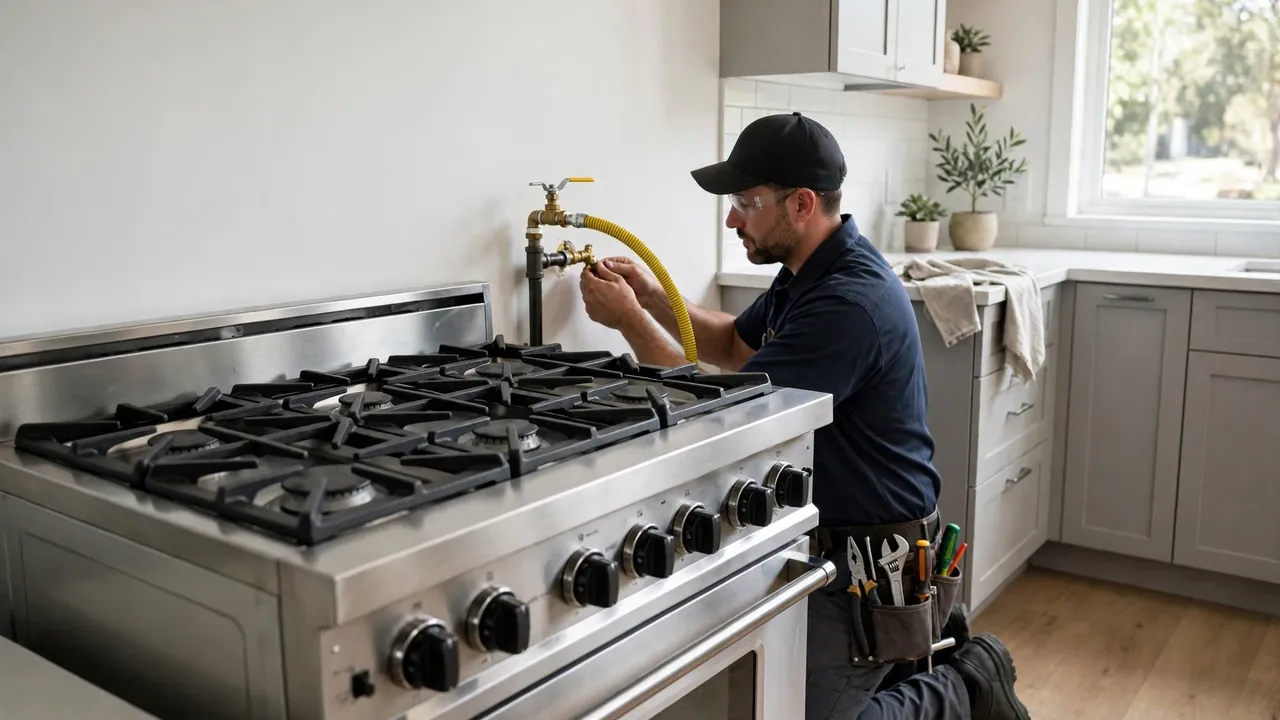
Switching a kitchen to gas is two projects wearing one name, and they have two different prices. The first is running a gas line to the kitchen, which is plumbing and permitting. The second is converting the range itself from natural gas to propane, or back again, which is a parts swap and a regulator adjustment. People who budget for one and get quoted for the other are the ones who feel overcharged, so this guide prices them separately.
Start with the gas line, because it is the bigger number. Oria Heating and Cooling in Ottawa puts a gas line for a single appliance such as a range, dryer or barbecue at $350 to $1,000 Canadian, including sizing the pipe for the home's total gas load, running it in black iron or flexible CSST, installing a shut-off valve, pressure-testing the line and connecting the appliance to Ontario code. Justyn Rook Contracting, also in Ottawa, quotes a simple reconnect or flex connector replacement at $150 to $300, a new gas line from the meter or basement supply to the kitchen at $400 to $900, and $1,000 to $2,500 plus if the main gas line needs upsizing or the utility must be involved. EVA Contracting, writing about Canada generally, puts residential gas line installation at $400 to $2,000 Canadian on average, depending on distance, pipe material, diameter, permit fees and accessibility. ALP Heating puts a gas stove installation at $400 to $2,500 or more in total, with labour at $75 to $200 an hour for two to four hours. The Canadian sources agree with each other: a straightforward new line to the kitchen is $350 to $1,000, and anything involving a new service, a main upsizing or a long run is $1,000 to $2,500 plus. There is no single Canadian national price series for this work, so these are named-shop prices, not a national average, and the range reflects distance and access more than anything else.
The rules around gas work are not optional. In Ontario, gas piping must be installed by a certified gas technician working for a TSSA-registered contractor, and it must follow the CSA B149.1 installation code. The same licensing principle applies across Canada under provincial codes. A permit is required for a new gas line installation, the work must be inspected before the gas is turned on, and homeowner gas work can create insurance problems. A gas range also needs a standard 120-volt outlet for the igniter and clock, which an electrician can add if one is not already there, and a range is typically 50,000 to 65,000 BTU per hour, which is the number the gas fitter uses to size the pipe.
The conversion itself is the smaller job, and it is worth understanding what actually changes. Propane packs more energy per cubic foot than natural gas, and it runs at higher pressure: a typical appliance pressure is about 3.5 inches of water column for natural gas and about 10 inches for propane. So the orifice, the tiny hole that sprays gas into the burner, must be smaller for propane than for natural gas to keep the flames steady and safe. A conversion means swapping the burner orifices for smaller ones, flipping or replacing the regulator cap from the natural gas setting to the propane setting, and adjusting the low-flame screws, then leak-testing and verifying the flame. Most modern ranges ship ready for natural gas and include the propane kit in a bag or taped near the regulator. If the kit is missing, the manufacturer kit is the only correct replacement: AppliancePartsPros lists genuine Whirlpool LP conversion kits at $18.23 to $107.38 US depending on the model, including the WPW10619560 kit at $18.23 and the W11087486 bake and broil orifice kit at $59.48, and Frigidaire GRLP3, GRLP4 and GRLP5 kits for its own ranges. Converted at 1.40, the kits run roughly $25 to $150 Canadian. HeaterGuides, writing about gas appliances generally, puts conversion parts at $50 to $150 US with labour adding $100 to $300 US, and a job time of one to three hours. The labour in Canada is about an hour for a straightforward range conversion by a licensed gas fitter, which is the $125 to $195 Canadian in the table.
Three things can stop a conversion outright. First, not every range is convertible: check the rating plate and the manual, and only convert if the model is listed for propane and you have the exact manufacturer kit. Drilling out jets is not acceptable, and using orifices from another model is not safe. Second, some manufacturers do not permit conversion of certain appliances at all, and doing it anyway can void the warranty and the insurance. Third, a conversion in one direction is not the same as a conversion in the other: going from propane back to natural gas needs the natural gas orifices and the regulator flipped back, and the same licensed-technician rule applies.
Get the quote in writing, with the permit and inspection fees listed separately, and confirm who books the inspection. Ask the gas fitter to leak-test every joint in front of you and to show you the shut-off valve location. Then check the total on the RepairPrice home calculator (home-calculator.php) and read the related guides: Oven and Stove Repair Cost in Canada for the range itself, Appliance Installation and Hookup Cost in Canada for the wider installation picture, and Dryer Repair Cost: Not Heating in Canada if the same gas line will also serve a gas dryer.
Common questions:
How much does it cost to run a gas line for a range in Canada? Oria Heating and Cooling in Ottawa quotes $350 to $1,000 Canadian for a single-appliance gas line. Justyn Rook Contracting quotes $400 to $900 for a new line to the kitchen, and $1,000 to $2,500 plus if the main line needs upsizing or the utility must be involved. EVA Contracting puts Canadian residential gas line installation at $400 to $2,000 on average.
How much does it cost to convert a gas range from natural gas to propane? The kit itself is roughly $25 to $150 Canadian, based on genuine Whirlpool LP kits at $18.23 to $107.38 US from AppliancePartsPros converted at 1.40. Labour is about an hour for a licensed gas fitter, or roughly $125 to $195 Canadian. Many ranges ship with the kit included.
Can any gas range be converted to propane? No. Only convert if the rating plate or manual says the model is approved for propane and you have the exact manufacturer conversion kit. Some manufacturers do not permit conversion at all. Drilling jets or using orifices from another model is not safe.
Do I need a permit to install a gas range in Canada? For a new gas line, yes, in most municipalities, and the work must be inspected before the gas is turned on. In Vancouver, the gas fitting by-law sets the permit fee at $282 for one to three appliances. In Ontario, the work must be done by a TSSA-registered contractor following the CSA B149.1 code.
| Service | Typical range (CAD) | Notes |
|---|---|---|
| New gas line to the kitchen, labour 2–3 h | $250–$590 | Plumbing rates $90–$140 per hour, pipe extra |
| Dedicated outlet, electrical, 1–2 h | $125–$420 | Electrician rates $90–$150 per hour |
| Range hookup and leak test, about 1 h | $110–$170 | Appliance rate $80–$120 per hour |
| Natural gas to propane conversion, about 1 h | $125–$195 | Orifice swap and regulator adjustment, gas fitter |
| Permit and inspection | $150–$400 | Varies by municipality; get it in writing |

 RepairPrice
