
Tree Removal Cost in Canada
By Oleksandr Potapenko · 2026-11-16 · How we research prices
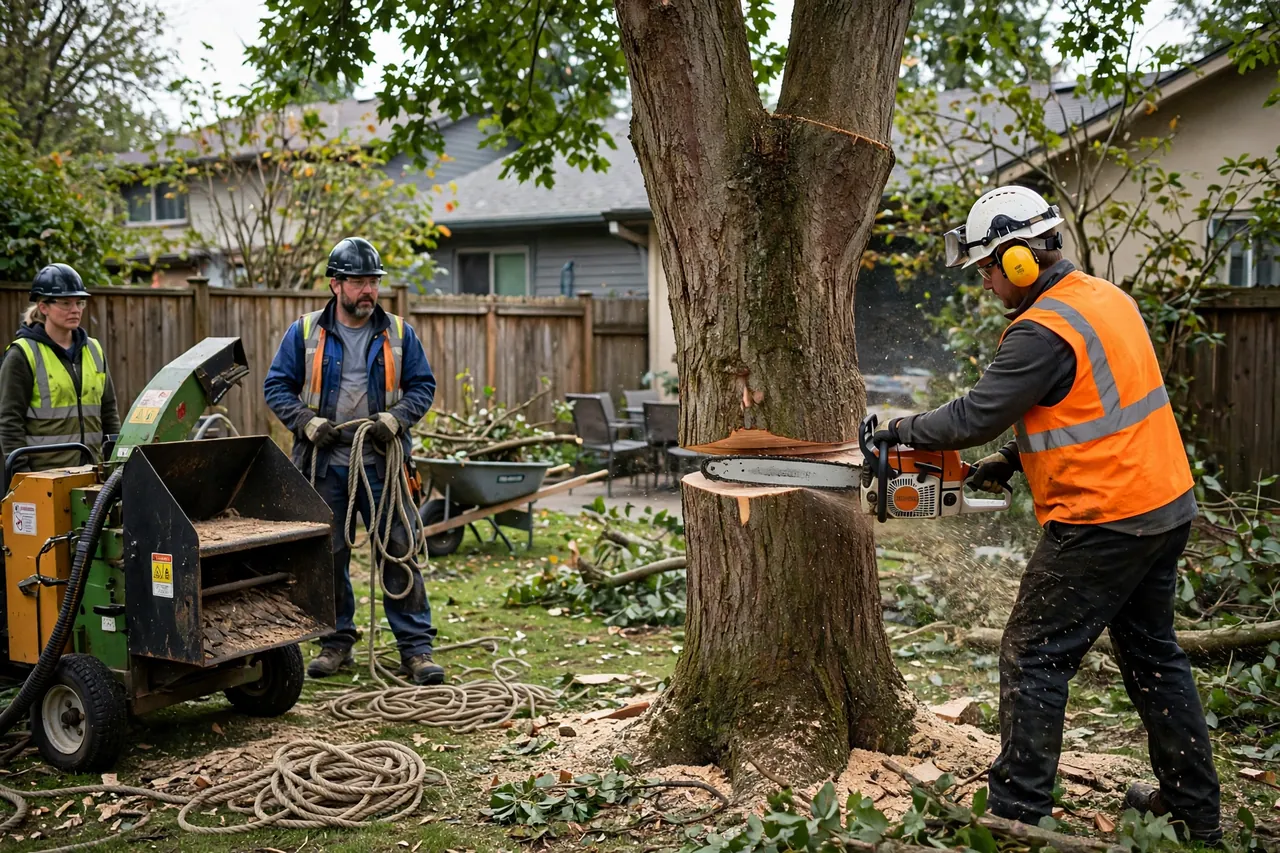
Cutting down a tree is priced by height, by access and by risk, in that order, and the spread between a $300 job and a $3,000 job is usually all three at once. In Canada, a small tree under 30 feet costs $150 to $500, a medium tree of 30 to 60 feet $500 to $1,200, a large tree of 60 to 80 feet $1,500 to $2,500, and a very large or complex tree over 80 feet $2,500 to $5,000 or more, according to HomeStars and its Toronto and Barrie cost guides. The national average sits around $750, according to Angi, HomeGuide and Lawn Love, who agree that most single-tree jobs land between $200 and $2,000 in US dollars. Converted at 1.40 Canadian dollars per US dollar, that is roughly $280 to $2,800, which lines up well with the Canadian figures once city labour rates are factored in.
Height is the headline number, but access is the number that moves the quote. A medium tree in an open yard with room to fell it in one piece is a half-day job for a two-person crew. The same tree leaning over a roof, tangled in power lines, or standing behind a narrow gate with no room for a chipper is a full-day sectional dismantling for a three-person crew with rigging, and the price doubles. West Vancouver arborists quote $2,000 to $5,000 for large trees and $5,000 to $15,000 for very large or crane-assisted removals, because steep terrain and no access change the job entirely. Condition matters too: a dead or hollow tree is unpredictable and more dangerous to climb, and a tree with a split trunk or root damage costs more because the crew cannot trust it.
Stump grinding is almost always quoted separately, and forgetting it is the most common budgeting mistake in tree work. Grinding runs $150 to $500 per stump in most Canadian cities, according to HomeStars Toronto pricing, and the details are covered in "Stump Grinding and Removal Cost in Canada". Disposal and chipping are also often separate: ask whether the quote includes hauling the wood away, or whether you will be left with a pile of logs and a bill for a second visit. A permit is another cost people miss. Many cities require a permit to remove a healthy tree above a certain diameter, and some, like Laval in Quebec, require an authorization certificate. In Alberta, elm trees can only be removed between October 1 and March 31 under the provincial pruning ban. Check your municipal tree bylaw before you book, because removing a protected tree without a permit can mean a fine larger than the removal cost.
Winter is usually the cheapest time to remove a tree, and the reason is simple: crews are quieter, leaves are off so the tree is lighter and easier to see, and frozen ground protects the lawn from equipment damage. HomeGuide notes that summer and fall demand can push prices up 10 to 20 percent, and Ottawa arborists confirm that late fall and winter are the off-season. Calgary arborists disagree slightly, noting that frozen ground makes access harder and deep snow slows cleanup, so pricing there is roughly the same year-round. The honest summary is that winter saves money in Ontario, Quebec and the Maritimes, and saves less in the Prairies. Emergency removal after a storm is the expensive exception: it typically costs 25 to 50 percent more than a scheduled job, and up to 50 to 100 percent more in some markets, according to HomeStars Barrie pricing.
The decision rule: hire a certified arborist, not a general handyman, for any tree over 30 feet, any tree near a house or power lines, or any tree that is dead, leaning or hollow. The International Society of Arboriculture, or ISA, certifies arborists in Canada, and a certified arborist carries insurance that covers the damage if something goes wrong. Get two or three written quotes that state whether stump grinding, disposal, cleanup and the permit are included, and check the totals against the RepairPrice home calculator (home-calculator.php). Never hire a crew that offers to do the job without insurance or without a written quote, and never let anyone climb a tree with a chainsaw who cannot show you their certification.
Common questions:
How much does it cost to remove a tree in Canada?
A small tree under 30 feet costs $150 to $500, a medium tree $500 to $1,200, a large tree $1,500 to $2,500, and a very large tree $2,500 to $5,000 or more, according to HomeStars. The national average is around $750, according to Angi, HomeGuide and Lawn Love.
Is it cheaper to remove a tree in winter?
Often yes. Many tree companies are slower from late fall through winter, according to HomeGuide, and frozen ground protects the lawn. Summer and fall demand can push prices up 10 to 20 percent, though Calgary arborists note pricing there is roughly the same year-round.
Do I need a permit to cut down a tree?
Many cities require a permit for a healthy tree above a certain diameter, and some require an authorization certificate. In Alberta, elm trees can only be removed between October 1 and March 31. Check your municipal tree bylaw first.
Does tree removal include stump grinding?
Usually not. Stump grinding is quoted separately at $150 to $500 per stump in most Canadian cities, according to HomeStars. Ask whether disposal, chipping and cleanup are included too.
| Job | Typical range (CAD) | Notes |
|---|---|---|
| Small tree, under 30 ft | $150–$500 | Open yard, easy access |
| Medium tree, 30–60 ft | $500–$1,200 | 2–3 person crew, half to full day |
| Large tree, 60–80 ft | $1,500–$2,500 | Sectional dismantling near structures |
| Very large tree, over 80 ft | $2,500–$5,000+ | Crane-assisted jobs cost far more |
| Emergency removal after a storm | 25–50% extra | Up to 50–100% extra in some markets |
| Stump grinding, per stump | $150–$500 | Quoted separately, by diameter |
| Disposal and chipping | Quoted separately | Ask what the quote includes |


 RepairPrice
