
Timing Belt vs Timing Chain Replacement Cost in the USA
By Oleksandr Potapenko · 2026-11-16 · How we research prices
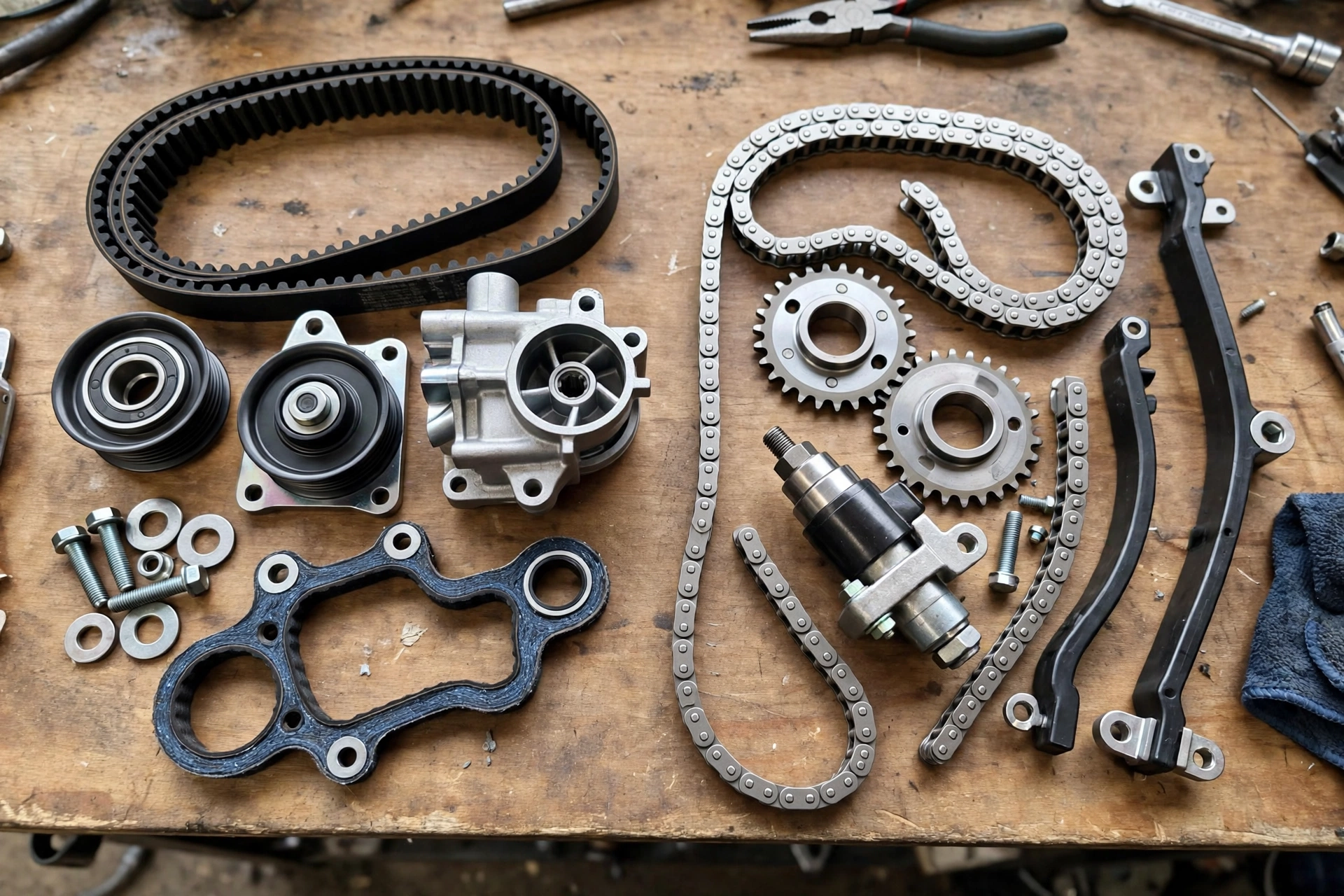
Every engine has a timing belt or a timing chain, and the difference matters more than most drivers realize, because the two parts have opposite failure stories. A timing belt is a rubber belt that needs replacing on a schedule, usually every 60,000 to 100,000 miles. A timing chain is a metal chain that is designed to last the life of the engine. The belt is cheaper to replace when it is due; the chain is more expensive when it fails, but it usually never needs replacing at all. The first question is not how much either costs, but which one your engine has, because booking the wrong job is the most common timing mistake a shop sees. Check your owner's manual or a parts catalogue by VIN before you book anything. Many cars built since the 2010s use a chain instead of a belt, and the chain job is two to three times the price of the belt job.
A timing belt replacement in the USA typically costs $500 to $1,000, and RepairPal's national average for 2026 is $918 to $1,338 including the water pump, which most shops replace at the same time. ConsumerAffairs' 2026 figure lands in the same place at $887 to $1,302, about $1,200 with the water pump. ARI's real-invoice median is higher, near $1,500, because most real invoices are full-kit jobs that bundle the water pump, tensioner and idlers, while the estimator ranges lean toward a belt-only job. A timing chain replacement typically costs $2,120 to $2,764, two to three times more, because the chain sits inside the engine behind the timing cover, and the job takes 8 to 12 hours of labor. CarTreatments puts the chain range at $1,500 to $2,700, with labor of $1,000 to $2,000 and parts of $300 to $800, and a Calgary guide puts typical chain jobs at $1,500 to $4,000 overall, with some engines well above $4,000. The chain itself is not the expensive part; getting to it is. The belt itself is the cheap part too: a quality belt is $30 to $100, and the kit with belt, tensioner and idlers is $80 to $250 in parts. Labor is 60 to 80 percent of the bill on either job, and it is the layout of your engine, not the brand of the belt, that sets it.
The reason the belt has a schedule is that a broken belt can destroy the engine. On an interference engine, which most modern cars have, a snapped timing belt lets the pistons hit the valves, and the repair jumps from a $1,000 belt job to a $3,000 to $5,000 engine rebuild. That is why the belt interval is in your owner's manual and why it should never be ignored: the belt gives no warning before it snaps. A timing chain, by contrast, usually gives warning, a rattling noise on a cold start, a check-engine light, or a stretched chain code, and it rarely snaps without warning. The intervals differ more than owners expect: Honda calls for most belts at 105,000 miles, Toyota at 60,000 to 90,000 miles depending on the engine, the 1MZ-FE V6 and 2UZ-FE V8 at 90,000, and the general rule is 60,000 to 105,000 miles or 7 years, whichever comes first. Your owner's manual is the authority, not the shop's reminder sticker. Whether a snapped belt destroys the engine depends on the design: on a non-interference engine the car simply dies and will not restart, and you are back on the road for $400 to $1,000.
When the belt is replaced, the water pump, the tensioner, and the idler pulleys should be replaced at the same time. They sit in the same place, they wear out on the same schedule, and replacing them during the belt job costs a fraction of replacing them later, because the labor to reach them is already paid for. A belt job that skips the water pump is a false economy: when the pump fails six months later, you pay the full labor all over again, and RepairPal's standalone water pump estimate is $857 to $1,106. Gates, which makes the belts, states that 95 percent of timing failures happen after only the belt was replaced, because the old tensioner or pump fails next. On a Honda transverse V6, a careful independent-shop breakdown comes to $592 for the belt alone, $738 with tensioner and idlers, and $945 for the full kit with the water pump and fresh coolant, and the same full kit at a dealer is $1,113. Per-model figures show how wide the range runs: RepairPal puts a Toyota Camry at $626 to $1,071 and a Tundra at $908 to $1,352, and by vehicle class a four-cylinder sedan averages about $890 for the full kit, a V6 SUV about $1,025, and a European luxury car $1,200 to $2,000 or more. The full belt job is covered in Timing Belt Replacement Cost in the USA, and the Canadian figures are in Timing Belt Replacement Cost in Canada and Timing Chain Replacement Cost in Canada. Check the fair price for your exact car on the RepairPrice calculator (calculator.php) before you say yes to a quote.
Common questions:
Q: How much does a timing belt replacement cost? A: Typically $500 to $1,000, and RepairPal's 2026 national average is $918 to $1,338 including the water pump. A full kit on a four-cylinder sedan averages about $890, on a V6 SUV about $1,025.
Q: How much does a timing chain replacement cost? A: Typically $2,120 to $2,764, two to three times more than a belt, because the chain sits inside the engine and the job takes 8 to 12 hours of labor. Chains rarely need replacing at all.
Q: Does my car have a timing belt or a timing chain? A: Check your owner's manual or a parts catalogue by VIN. As a rough guide, many Honda, Toyota, Volkswagen and Hyundai models from the 2000s and early 2010s use belts, while most cars built since the mid-2010s use chains.
Q: What happens if my timing belt breaks? A: On an interference engine the pistons hit the valves, and the repair becomes a $3,000 to $6,000 engine rebuild. On a non-interference engine the car simply dies and will not restart, and the repair is roughly the cost of the belt job itself.
| Job | Typical range (USD) | Notes |
|---|---|---|
| Timing belt replacement | $500–$1,000 | Every 60,000–100,000 miles |
| Timing belt + water pump (full kit) | $918–$1,338 | RepairPal 2026 average; pump included |
| Timing chain replacement | $2,120–$2,764 | 8–12 hours of labor; rarely needed |
| Belt snapped on interference engine | $3,000–$5,000+ | Pistons hit valves; engine rebuild |
| Water pump alone, later | $400–$800 | Paying the labor twice — avoid it |


 RepairPrice
