
Solar Panels Installation Cost in Canada
By Oleksandr Potapenko · 2026-11-16 · How we research prices
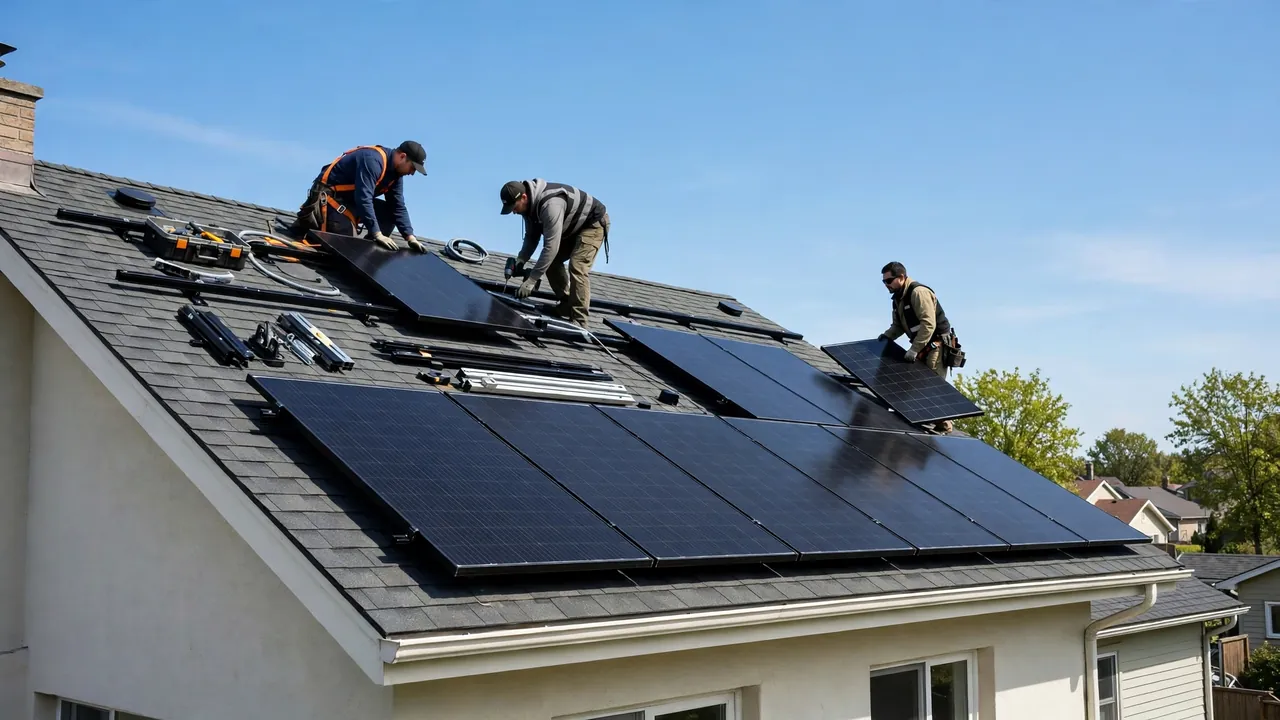
Solar panels on a Canadian roof work better than most people expect and worse than the brochures suggest, and both halves of that sentence matter before you spend the money. The panels themselves work well in the cold, because solar cells are more efficient at low temperatures, and a south-facing roof in Alberta or Saskatchewan gets more sun than most of Europe. But the Canadian year is lopsided: long summer days produce far more than the house uses, and short winter days produce far less, right when the heating load is highest. A system sized for the summer will not carry the winter, and a system sized for the winter will export most of its summer production to the grid at a fraction of the retail price. The honest way to judge solar in Canada is by the cost per watt and the payback period, not by the brochure's annual production figure.
The cost per watt is the number every installer quotes, and the Canadian sources agree on it closely. SolarGuide, verified in July 2026, puts the average residential system at $2.50 to $3.50 per watt before incentives, which means a 10-kilowatt system at $25,000 to $35,000 before rebates. SolarQuotes puts the 2026 benchmark at $2.70 per watt installed, with a 5-kilowatt system at $13,500, an 8-kilowatt system at $21,600, a 10-kilowatt system at $27,000 and a 15-kilowatt system at $40,500. SolarWeb puts the range at $2.40 to $3.80 per watt, with a standard 8-kilowatt system at $19,200 to $30,400 before incentives. EcoFlow's September 2026 planning range is $2.50 to $3.50 per installed watt. The spread between the sources is mostly system size: small systems cost more per watt because the fixed costs of design, permitting and the inverter are spread over fewer watts. A typical 8-kilowatt system, which suits a three-bedroom home, lands at about $20,000 to $28,000 before incentives, and after rebates most homeowners pay $10,000 to $20,000 for a system that offsets 80 to 100 percent of their electricity bill, according to SolarWeb. Labour and the inverter combined typically exceed the cost of the panels themselves, which is why panel-price drops do not translate into install-price drops one-for-one.
The payback period is where the provinces diverge, and it is the number that decides whether solar is an investment or a hobby. SolarWeb puts the average payback at 8 to 14 years, with panels lasting 25 years or more. SolarGuide puts a 10-kilowatt system at a 10 to 16 year payback before incentives, with annual savings of $1,600 to $2,400 at the national average electricity rate of about 14 cents per kilowatt-hour. SolarQuotes puts the payback at 6 years in high-rate provinces with rebates, such as Prince Edward Island and Nova Scotia, and 15 years or more in low-rate provinces such as Manitoba and Quebec without rebates. The rule is simple: solar pays fastest where electricity is expensive and the sun is strong, which is Alberta and Saskatchewan, and slowest where electricity is cheap, which is Quebec and Manitoba. Alberta and Quebec are the cheapest per watt at $2.55 to $2.60 installed, according to SolarQuotes, and the most expensive markets are the territories, at up to $4.32 per watt in the Northwest Territories.
The rebate landscape changed in 2025 and again in 2026, and most of what older guides promise no longer exists. Both federal Greener Homes programs are closed: the $5,000 grant closed to new applicants in early 2024, and the interest-free loan closed on October 1, 2025 after its $2 billion budget was fully allocated. There is no federal solar rebate for homeowners in 2026, and individual homeowners are not eligible for the federal Clean Technology Investment Tax Credit, which is for businesses only. The active programs are provincial. Ontario's Home Renovation Savings program pays $1,000 per kilowatt for solar up to $5,000, plus $300 per kilowatt-hour for a paired battery up to $5,000, each capped at 50 percent of costs, for up to $10,000 in total. Quebec launched a new $1,000-per-kilowatt grant in April 2026. British Columbia offers a PST exemption on solar equipment and BC Hydro solar and battery rebates launched in April 2025. Nova Scotia offers $0.30 per watt up to $3,000, and Alberta's municipal CEIP program finances installations through property taxes in more than 23 communities. On September 17, 2026 the Canadian International Trade Tribunal ended its review of the trade order on solar modules from China and rescinded it, so anti-dumping duties on Chinese panels are gone, but the effect on installed home prices is not known yet.
The decision rule starts with the roof, not the panels. If the roof is more than 15 years old, re-roof before you install solar, because removing and reinstalling panels to re-roof costs thousands and voids the economics. Then get three quotes that each state the system size in kilowatts, the panel brand and wattage, the inverter type, the expected annual production in kilowatt-hours, and the price per watt, and compare the production figure, not the price alone, because a cheap system that produces little is the most expensive system of all. Check whether the panel upgrade is included, because a 100-amp service may need upgrading before a solar install, which our guide Electrical Panel Upgrade Cost: 100A to 200A in Canada covers. Confirm the net metering arrangement with your utility, because the value of exported summer power is set by that arrangement, and it varies by province. For a rough budget before you call, the RepairPrice home calculator (home-calculator.php) gives a fair range for your city, and our guide EV Charger (Level 2) Installation Cost in Canada covers the other big electrical load that often arrives with solar.
Common questions:
Q: How much do solar panels cost in Canada? A: SolarGuide puts the average at $2.50 to $3.50 per watt before incentives, or $25,000 to $35,000 for a 10-kilowatt system. SolarQuotes benchmarks $2.70 per watt, with an 8-kilowatt system at $21,600. After provincial rebates most homeowners pay $10,000 to $20,000 for a system offsetting 80 to 100 percent of their bill.
Q: How long does it take for solar panels to pay for themselves in Canada? A: SolarWeb puts the average payback at 8 to 14 years, with panels lasting 25 years or more. The payback is about 6 years in high-rate provinces with rebates such as Nova Scotia, and 15 years or more in low-rate provinces such as Quebec and Manitoba without rebates.
Q: Are there still solar rebates in Canada? A: No federal rebate for homeowners in 2026: both Greener Homes programs are closed. Provincial programs are active: Ontario's Home Renovation Savings pays up to $10,000 for solar and battery, Quebec launched a $1,000-per-kilowatt grant in April 2026, and BC offers a PST exemption plus BC Hydro rebates.
Q: Should I replace my roof before installing solar panels? A: Yes, if the roof is more than 15 years old. Removing and reinstalling panels to re-roof costs thousands and destroys the economics. A new roof under a 25-year panel system is the cheapest order of operations.
| System | Typical range (CAD) | Notes |
|---|---|---|
| Cost per watt installed | 2.50–3.50 / W | Before incentives; small systems cost more per watt |
| 5 kW system | 12,500–17,500 | Small home or condo |
| 8 kW system | 20,000–28,000 | Typical 3-bedroom home |
| 10 kW system | 25,000–35,000 | Larger home, gas heat |
| Ontario HRS solar rebate | Up to 5,000 back | 1,000 per kW; plus 5,000 for a battery |




 RepairPrice
