
Range Hood Installation Cost in Canada
By Oleksandr Potapenko · 2026-11-16 · How we research prices
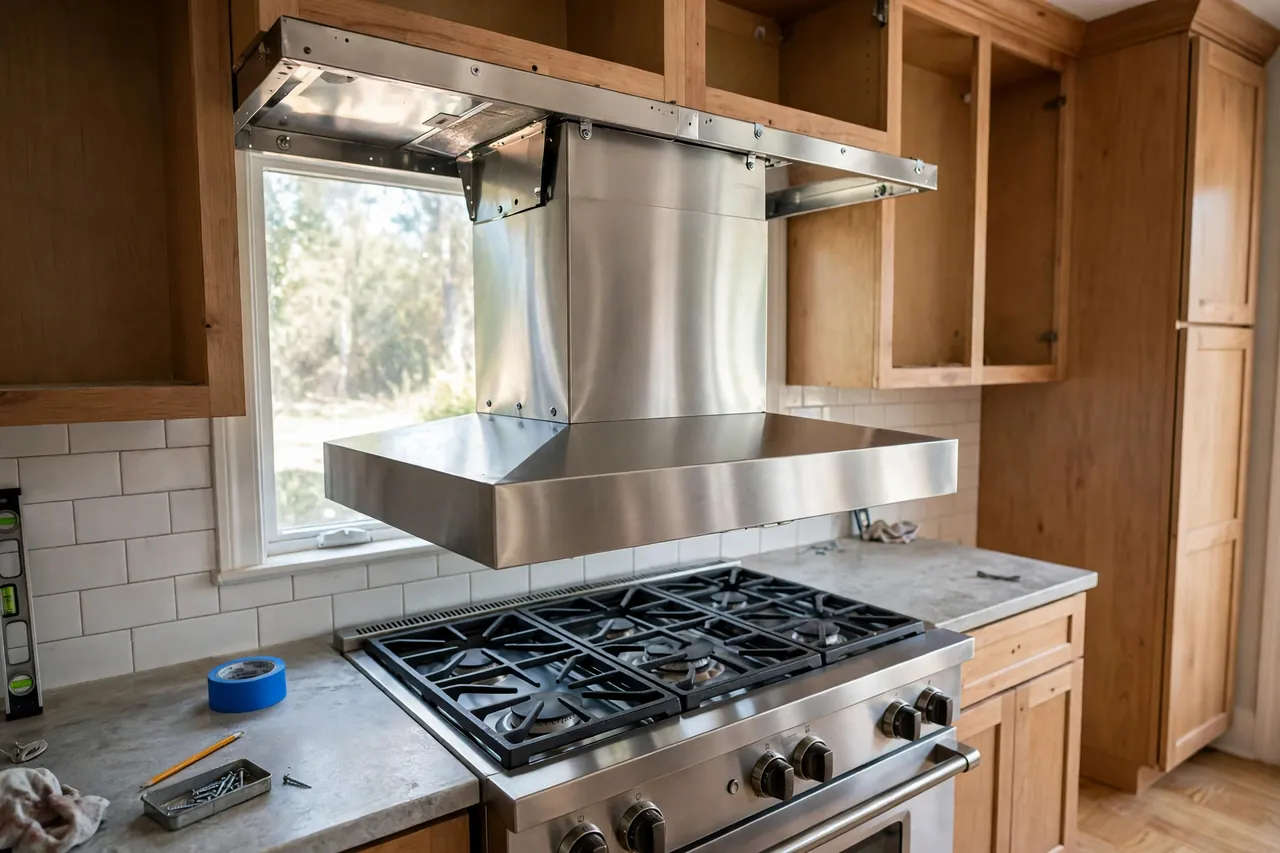
A range hood is the cheapest appliance in the kitchen to buy badly. The wrong one is too weak to clear smoke, too loud to leave on, or vented nowhere at all, and all three failures cost more to fix than the hood itself. The right way to buy one is backwards from how most people shop: size the airflow first, decide the duct route second, and pick the style last. The price follows those three decisions in that order.
Airflow is measured in CFM, cubic feet per minute, and the math depends on what you cook on. For electric and induction cooktops, the common rule is about 100 CFM for every linear foot of cooktop width, so a standard 30-inch range needs at least 250 to 300 CFM. For gas, the rule is about 100 CFM for every 10,000 BTUs of total burner output: add up every burner, and a range with 60,000 total BTUs needs at least 600 CFM. FOTILE, a range hood manufacturer, gives the same two formulas and adds the two refinements that matter: an island cooktop needs roughly 50 percent more CFM than a wall cooktop, because cross-drafts pull smoke away from the hood, and professional gas ranges can top 80,000 BTUs, which puts you at 800 to 900 CFM or more. The other sizing rule is width: the hood should be at least as wide as the cooktop, and ideally 3 to 6 inches wider on each side, so the outer burners are covered. Mounting height matters too: manufacturers generally specify 24 to 30 inches above an electric or induction cooktop and 30 to 36 inches above gas, measured from the cooking surface to the bottom of the hood. Mount it lower and you create a fire hazard; mount it higher and smoke escapes past the edges before the suction can catch it.
Ducted or ductless is the decision that changes the price most. A ducted hood vents smoke, heat, moisture, and grease outside the house through a rigid metal duct. A ductless hood, also called recirculating, pulls air through a grease filter and a charcoal filter and blows it back into the kitchen. It catches grease and some odour, but it removes no heat and no moisture, which in a Canadian winter is the part that condenses on cold windows and feeds mould. Angi puts ductless hoods at US$200 to US$400 including labour, ducted hoods at US$100 to US$1,000 for the exhaust work, and convertible hoods, which can run either way, at US$200 to US$1,200. The honest advice is to buy ducted whenever a duct route exists, and to treat ductless as the answer only for apartments, high-rise condos, or interior kitchens where no exterior wall or roof is reachable.
The cost figures come from Angi's September 2026 guide, and they are the freshest named source available for this job. Angi puts professional range hood installation at a national average of US$1,750, with most homeowners spending US$650 to US$2,500, ductwork installation around US$500, and labour at US$50 to US$100 an hour for one to four hours. By type, Angi gives wall-mounted hoods at US$700 to US$1,000, island hoods at US$500 to US$1,400, under-cabinet hoods at US$700 to US$1,000, and downdraft hoods at US$1,500 to US$3,000. Converted at the 1.40 rate used in this guide, the Angi average becomes roughly $2,450 Canadian, with most projects at $900 to $3,500 Canadian. There is no official Canadian range hood price series, and no Canadian cost guide publishes a competing national figure, so these Canadian ranges are estimates from the named Angi figures converted at 1.40. The ductwork is the wild card in every quote: Angi puts ductwork at about US$85 an hour, with exterior routing taking up to four hours and totalling about US$350 plus materials, while a long run up through the attic and out the roof costs far more, involving a roof cap, sealing, and insulation around the duct so steam does not condense inside it in winter and drip back down.
Two details catch buyers out. The first is make-up air. A hood rated above 400 CFM in a modern, tightly sealed house pulls out more air than cracks can supply, and the International Residential Code, which many Canadian jurisdictions follow in spirit, requires make-up air for hoods over 400 CFM. That is a separate cost to know about before the installer arrives, not after. The second is the duct itself: FOTILE advises matching the duct to the hood outlet and never stepping it down, keeping the run short, under 30 feet straight, under 25 feet with one elbow, and under 20 feet with two, and running 18 to 24 inches of straight duct above the hood before the first turn. A strong fan on a long, bent, or undersized duct moves far less air than its rating, which is how a 600 CFM hood ends up performing like a 300 CFM one.
Buy it in this order. First, add up your BTUs or measure your cooktop and pick the CFM floor. Second, walk the duct route with the installer and get the ducting as a separate line on the quote, because it is the part that varies most between houses. Third, confirm the electrical: a new circuit or an upgrade runs roughly $200 to $600, and it should be electrician work, not a handyman add-on. Fourth, check noise: a hood that is loud enough that nobody turns it on is a decoration, so look for the sone rating and a low-speed setting you will actually use. Keep the filters clean, since a grease-clogged filter is a fire risk and moves barely more air than no hood at all. If the hood is part of a bigger kitchen project, read Kitchen Renovation Cost in Canada and Kitchen Countertop Replacement Cost in Canada before you lock the layout, and run the hood against the whole budget in the RepairPrice home calculator (home-calculator.php). A hood is a small line in a renovation, but it is the line that decides whether the new kitchen smells like dinner for an hour or for a day.
Common questions:
How much does range hood installation cost in Canada? Angi puts the American average at US$1,750, with most homeowners spending US$650 to US$2,500, which converts to roughly $2,450 Canadian on average and $900 to $3,500 for most projects at the 1.40 rate used here. Ductwork adds about US$500, and a long attic or roof run costs more.
What size range hood do I need? At least as wide as your cooktop, ideally a few inches wider on each side. For airflow, allow about 100 CFM per linear foot of electric cooktop width, or about 100 CFM per 10,000 BTUs of total gas burner output, and add roughly 50 percent for an island cooktop.
Is a ducted or ductless range hood better? Ducted is better whenever a duct route exists: it removes smoke, heat, moisture, and grease from the house. Ductless only filters grease and odour and returns the air to the kitchen, so it does nothing for heat or moisture. Choose ductless only when running a duct outside is not practical.
How high should a range hood be above the stove? Generally 24 to 30 inches above an electric or induction cooktop and 30 to 36 inches above a gas range, measured from the cooking surface to the bottom of the hood. Always follow your hood's manual, which sets the true minimum.
| Task | Typical range (CAD) | Notes |
|---|---|---|
| Under-cabinet hood, unit + install | $900–$1,400 | Most common, simplest install |
| Wall-mounted chimney hood | $1,000–$1,800 | Unit + install, ducted |
| Island hood, unit + install | $1,200–$2,500 | Ceiling mount, longer duct run |
| Downdraft hood, unit + install | $2,100–$4,200 | Costliest type, rises from counter |
| New ductwork run | $500–$1,000 | Wall or roof route, materials + labour |
| Electrical upgrade / new circuit | $200–$600 | Electrician work, if needed |




 RepairPrice
