
EV Charger (Level 2) Installation Cost in Canada
By Oleksandr Potapenko · 2026-11-16 · How we research prices
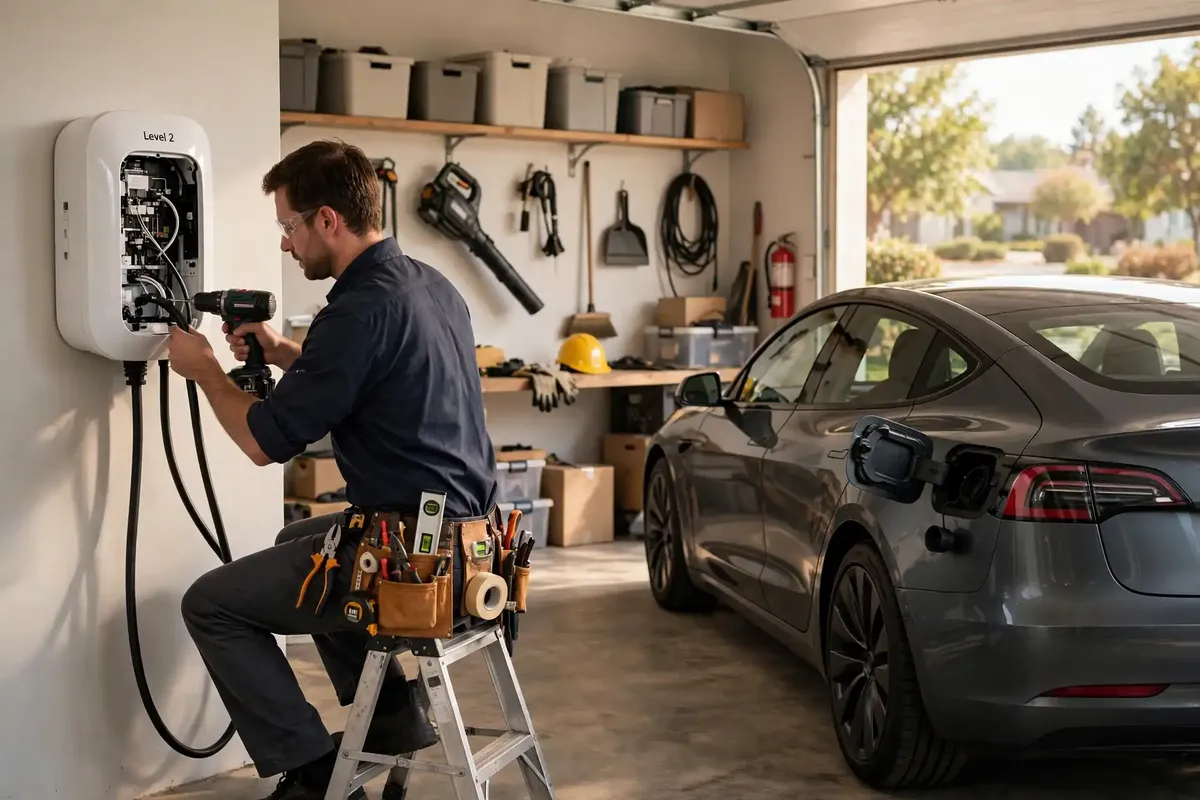
A Level 2 home charger is the cheapest fuel your car will ever drink, but the installation bill is where the money goes, and it ranges from about $1,000 to about $3,500 depending on two things only: how far the charger sits from your panel, and whether your panel has room for it. ThinkEV, a Canadian EV guide updated in March 2026, puts a typical all-in installation at $1,000 to $2,600, broken down as $500 to $1,100 for the charger itself, $500 to $1,500 for professional installation, and $1,500 to $3,000 for a panel upgrade if one is needed. HomeAdvisor's American figures agree in shape: a national average near $967 US, with a common band of $555 to $1,380 US. Converted at about 1.40 Canadian dollars per US dollar, that American band becomes roughly $780 to $1,930, which sits inside the Canadian range once you allow for higher Canadian labour rates and permit fees. There is no single Canadian national price series for this job, so treat the Canadian figures as estimates built from converted American data and cross-checked against Canadian sources such as ThinkEV, BrokerLink and the provincial rebate programs.
The charger itself is the easy part. A quality Level 2 unit from FLO, Grizzl-E, Wallbox or ChargePoint runs $400 to $900, with smart 48-amp hardwired models at the top end and basic 32-amp plug-in units at the bottom. A Level 2 charger runs on a 240-volt circuit at 7.2 to 11.5 kW, delivering roughly 30 to 50 kilometres of range per hour, which means an overnight charge covers 300 to 500 kilometres, more than most Canadians drive in a week. Home charging costs $0.07 to $0.16 per kilowatt-hour on residential electricity, against $1.00 to $2.50 an hour for public Level 2, which is why the charger pays for itself in convenience even before you count the fuel saving. Buy a charger rated for Canadian winters, with a cable that stays flexible at minus 30, and check whether your utility offers overnight rates 30 to 50 percent below peak, as BC Hydro, Hydro One and Hydro-Quebec's Hilo program all do.
The panel is where the job gets expensive, and it is also where most people get surprised. Homes built after 2000 with 200-amp service usually have room for a 40-amp or 50-amp charger circuit. Homes on 100 amps often do not, and the fix is either a load-management device at roughly $1,000 to $2,500 or a full service upgrade at $1,500 to $4,000, and sometimes more. The decision rule is to check the panel before you buy the charger: have an electrician do a load calculation under Canadian Electrical Code Rule 8-200 and tell you in writing whether the panel can carry the charger. If it cannot, ask about load management first, because it is a fifth of the price of an upgrade and it is the right answer for a single charger in most houses. Our guide Electrical Panel Upgrade Cost: 100A to 200A in Canada walks through the upgrade numbers in detail.
Rebates change the math, and they changed recently, so check the current program before you budget. British Columbia's CleanBC program, through BC Hydro, pays up to $350 toward an eligible Level 2 charger and its installation, covering up to 50 percent of eligible costs, and the charger must be on BC Hydro's eligible list with the work done by a licensed electrician. Quebec's program is now called Ecorecharge, which replaced the home-charging part of Roulez vert on March 17, 2026; it pays up to $600 toward an eligible home charging station and its installation, but since April 1, 2026 only connected chargers qualify, meaning the unit must accept remote commands from an app, and the installation must be done by an electrician holding an RBQ licence subcategory 16. Ontario has no province-wide charger rebate as of 2026, and there is no federal home-charger rebate: the federal EVAP program launched in February 2026 covers the vehicle purchase only, up to $5,000, and does not touch the charger. Older guides still naming Roulez vert are out of date, and any quote that promises a federal charger rebate is wrong.
A permit is required almost everywhere in Canada for a Level 2 install, because it is a new dedicated 240-volt circuit, and the Canadian Electrical Code requires a separate disconnecting means for charging equipment rated at 60 amps or more. In Ontario the ESA permit and inspection apply; in BC the permit runs through Technical Safety BC or the municipality. If you live in a condo or a strata building, add strata approval to the sequence, and note that BC and Quebec have right-to-charge legislation that limits how much a strata board can block an install. Get the quote in writing with the charger model, the breaker size, the wire run length, the permit and the rebate paperwork spelled out, and confirm the installer will file the rebate forms. For a rough budget before you call, the RepairPrice home calculator (home-calculator.php) gives a fair range for your city, and our guide New and Dedicated Circuit Cost in Canada covers the circuit itself.
Common questions:
Q: How much does it cost to install a Level 2 EV charger at home in Canada? A: ThinkEV puts a typical all-in installation at $1,000 to $2,600, with the charger at $500 to $1,100 and installation at $500 to $1,500. A detached garage, a long wire run or a full panel can push the total past $3,500, while BC and Quebec rebates of up to $350 and $600 bring the net cost down.
Q: Do I need a permit to install an EV charger in Canada? A: Yes, in almost every jurisdiction, because a Level 2 charger needs a new dedicated 240-volt circuit. In Ontario the ESA permit and inspection apply, and in BC the permit comes through Technical Safety BC or your municipality. The installer should pull the permit and meet the inspector.
Q: Can I install an EV charger on a 100-amp panel? A: Sometimes. A load calculation under Canadian Electrical Code Rule 8-200 decides. If the panel is full, a load-management device at about $1,000 to $2,500 often solves it by pausing the charger when other big loads run. If that is not enough, a full upgrade to 200 amps runs $1,500 to $4,000 or more.
Q: Is there still a rebate for home EV chargers in Canada? A: In BC, CleanBC pays up to $350 through BC Hydro. In Quebec, Ecorecharge pays up to $600, but only for connected chargers installed by an RBQ-licensed electrician since April 2026. Ontario has no province-wide rebate, and there is no federal home-charger rebate.
| Item | Typical range (CAD) | Notes |
|---|---|---|
| Level 2 charger unit | 500–1,200 | Smart / long-cable models cost more |
| Standard install (near panel) | 700–1,500 | Short run, spare capacity |
| Long run / detached garage | 1,500–3,500+ | Trenching and cable length drive cost |
| Load management or panel upgrade | 1,000–8,000 | Only if the panel lacks capacity |

 RepairPrice
