
EV Battery Replacement Cost in the USA
By Oleksandr Potapenko · 2026-11-16 · How we research prices
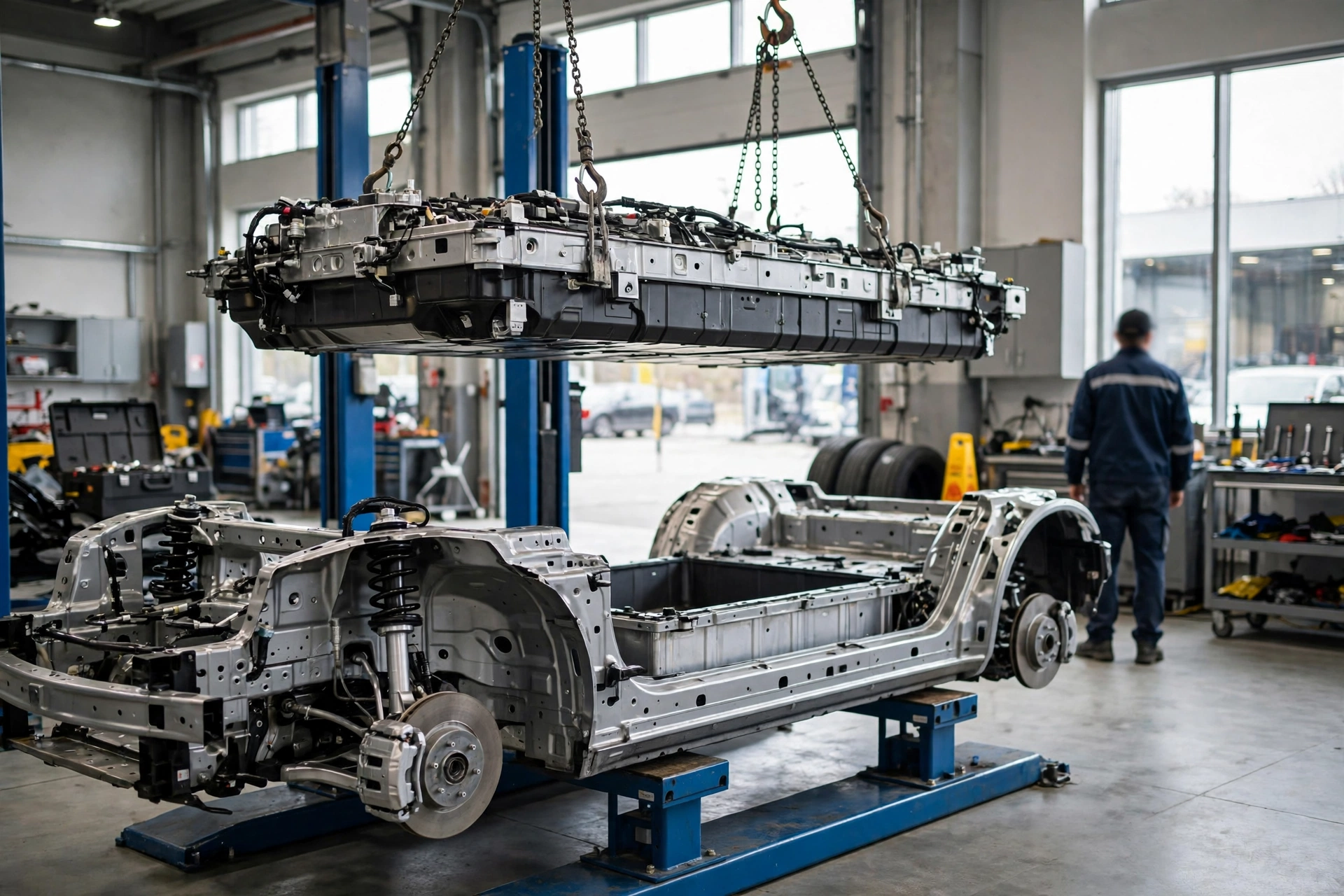
Start with the number that makes the rest of this guide less frightening: 2.5 percent. That is the share of EVs in the Recurrent community that ever needed a battery replacement, according to Recurrent Auto's 2024 data cited in a 2026 MotorWatt analysis. The vast majority of EV owners will never pay for a battery replacement at all. The pack typically outlasts the vehicle's economic life, and when it does fail early, the warranty pays. Federal law mandates a minimum 8-year or 100,000-mile battery warranty on every EV sold new in the United States, and in CARB states such as California, New York, and Massachusetts the coverage runs 10 years or 150,000 miles. Tesla's Long Range warranty runs 8 years or 120,000 miles with a 70 percent capacity threshold. The replacement prices below are what you pay only if the pack fails outside warranty, or if you are buying a used EV with a degraded pack and pricing the risk.
The cost depends on pack size, and the per-kilowatt-hour math is the honest way to compare models. BloombergNEF's battery price survey put average pack prices at $115 per kilowatt-hour in 2024, down from over $700 in 2014, and 2026 guides put the installed cost at roughly $130 to $200 per kilowatt-hour. A 2026 cost guide from EVCostPerMile puts a full out-of-warranty replacement at $12,000 to $22,000 installed on mainstream models such as the Tesla Model 3, Model Y, Ford Mustang Mach-E, and Chevy Bolt EUV. A second 2026 guide from JouleIO breaks it down by model: a Nissan Leaf at $4,000 to $9,500, a Chevy Bolt at $11,000 to $16,000, a Tesla Model 3 at $13,000 to $22,000, a Tesla Model Y at $16,000 to $21,000, a Hyundai Ioniq 5 or Kia EV6 at $14,000 to $19,000, a Ford Mustang Mach-E at $18,000 to $28,000, a Tesla Model S at $23,000 to $35,000, and a Ford F-150 Lightning at $25,000 to $50,000. A third guide from GetBatteryPowered lands in the same range, with a new dealer-installed pack at $5,500 for a small early Leaf and roughly $20,000 for a long-range Tesla, Mach-E, or Ioniq 5. The sources disagree at the edges because dealer quotes, refurbished packs, and labour vary, but they agree on the shape: small packs cost $4,000 to $9,500, mid packs $7,000 to $16,000, and large packs $10,000 to $22,000 or more.
Chemistry changes the timeline more than the price. LFP, or lithium iron phosphate, packs tolerate more than 3,000 full cycles, which translates to well over 500,000 miles for most packs, and they are the reason a Tesla Model 3 rear-wheel-drive with a 60 kilowatt-hour LFP pack can be quoted at $10,000 to $14,000 while a Long Range NMC pack of 75 to 82 kilowatt-hours runs $13,000 to $22,000. LFP cars can be charged to 100 percent daily without the usual warning. NMC and NCA packs prefer an 80 percent daily limit and degrade faster when parked at 100 percent. Geotab's 2025 study of more than 22,700 vehicles puts the average degradation rate at 2.3 percent a year, with cars charged mostly on AC power at around 1.5 percent and frequent high-power DC fast charging pushing the rate to around 3.0 percent. At the fleet average, a pack retains about 81.6 percent of its capacity after eight years, comfortably above the 70 percent warranty threshold. For the full picture, see EV Battery Degradation: What It Costs and How to Slow It.
The cheaper paths matter more than the headline dealer price, because almost nobody pays the headline price. Refurbished or remanufactured packs from independent specialists land 30 to 50 percent below dealer numbers when they are available: a Tesla Model 3 or Y refurbished pack at $8,000 to $12,000 against $13,000 to $20,000 new, according to GetBatteryPowered's 2026 guide. A single module repair, when only one module has failed, costs $2,000 to $5,000 and is the option to ask about first, since Tesla rarely sells individual modules but third-party rebuilders are growing. A used pack from a recycler can cost far less still, though the warranty is shorter and the remaining life is unknown. Labour adds $500 to $2,500 per job, and shipping a pack is not free. The decision rule for a failed pack outside warranty is a sequence: first check whether any warranty or recall still applies, since the Bolt's 2017 to 2022 packs were replaced free under the LG recall and most are now new; then get a module-level diagnosis, because a single failed module is a $2,000 to $5,000 repair, not a $15,000 pack; then compare a refurbished pack against a new one, and weigh the shorter warranty against the 30 to 50 percent saving.
For a buyer, the battery question is a used-car question, not a new-car question. Before buying a used EV, get a battery state-of-health reading and an independent inspection, and check the exact warranty booklet for that VIN, since coverage varies by model year and state. A car with 85 percent state of health and two years of warranty left is a different purchase from the same car at 72 percent with no warranty, even at the same price. The resale market is already pricing this in: EV resale values have been sliding, and a documented state-of-health reading is becoming a selling point rather than a curiosity. If the pack is healthy, the running costs are the story instead: home charging at $0.07 to $0.16 per kilowatt-hour in Canada, or about 18 cents per kilowatt-hour on average in the US, against gas at $3 or more a gallon. For the charging math, see EV Charging Costs in Canada: Home vs Public, and for the home charger that makes it cheap, EV Home Charger Installation Cost. Run any replacement quote through the RepairPrice calculator (calculator.php) before you approve it.
Common questions:
Q: How much does it cost to replace an EV battery in the USA? A: Typically $12,000 to $22,000 installed on mainstream models, according to 2026 cost guides. By model: Nissan Leaf $4,000 to $9,500, Chevy Bolt $11,000 to $16,000, Tesla Model 3 $13,000 to $22,000, Tesla Model Y $16,000 to $21,000, Hyundai Ioniq 5 $14,000 to $19,000, Ford F-150 Lightning $25,000 to $50,000. Refurbished packs run 30 to 50 percent below dealer prices.
Q: How often do EV batteries need to be replaced? A: Rarely. Only 2.5 percent of EVs in the Recurrent community ever needed a replacement, and most packs retain above 80 percent state of health at 150,000 miles. Federal law mandates an 8-year or 100,000-mile warranty, and CARB states require 10 years or 150,000 miles.
Q: Can you replace just part of an EV battery? A: Yes, when only one module has failed. A single module repair costs $2,000 to $5,000, against $12,000 to $22,000 for a full pack. Ask for a module-level diagnosis before approving a full pack replacement.
Q: Is it worth replacing an EV battery or should I sell the car? A: Compare the replacement cost against the car's value. A $8,000 to $12,000 refurbished pack makes sense on a car worth $20,000 or more; a $20,000 new pack rarely makes sense on a car worth $12,000. Check warranty and recall coverage first, since many failures are covered.
| Vehicle / option | Typical range (USD) | Notes |
|---|---|---|
| Tesla Model 3 Standard Range (LFP) | $10,000–$14,000 | OEM, installed; refurbished $8,000–$12,000 |
| Tesla Model 3 / Y Long Range | $13,000–$22,000 | OEM, installed; refurbished $9,000–$14,500 |
| Chevy Bolt | $11,000–$16,000 | Most 2017–2022 packs replaced free under recall |
| Nissan Leaf | $4,000–$9,500 | Depends heavily on pack size |
| Hyundai Ioniq 5 | $14,000–$19,000 | Large pack; labour included |
| Ford F-150 Lightning | $25,000–$50,000 | Very large pack, truck labour |
| Refurbished pack, most models | 30–50% below OEM | Shorter warranty; $8,000–$12,000 for Model 3/Y |
| Single module repair (Tesla) | $2,000–$5,000 | When only one module has failed |


 RepairPrice
