
AWD System Problems: Diagnosis and Repair Cost in Canada
By Oleksandr Potapenko · 2026-11-16 · How we research prices
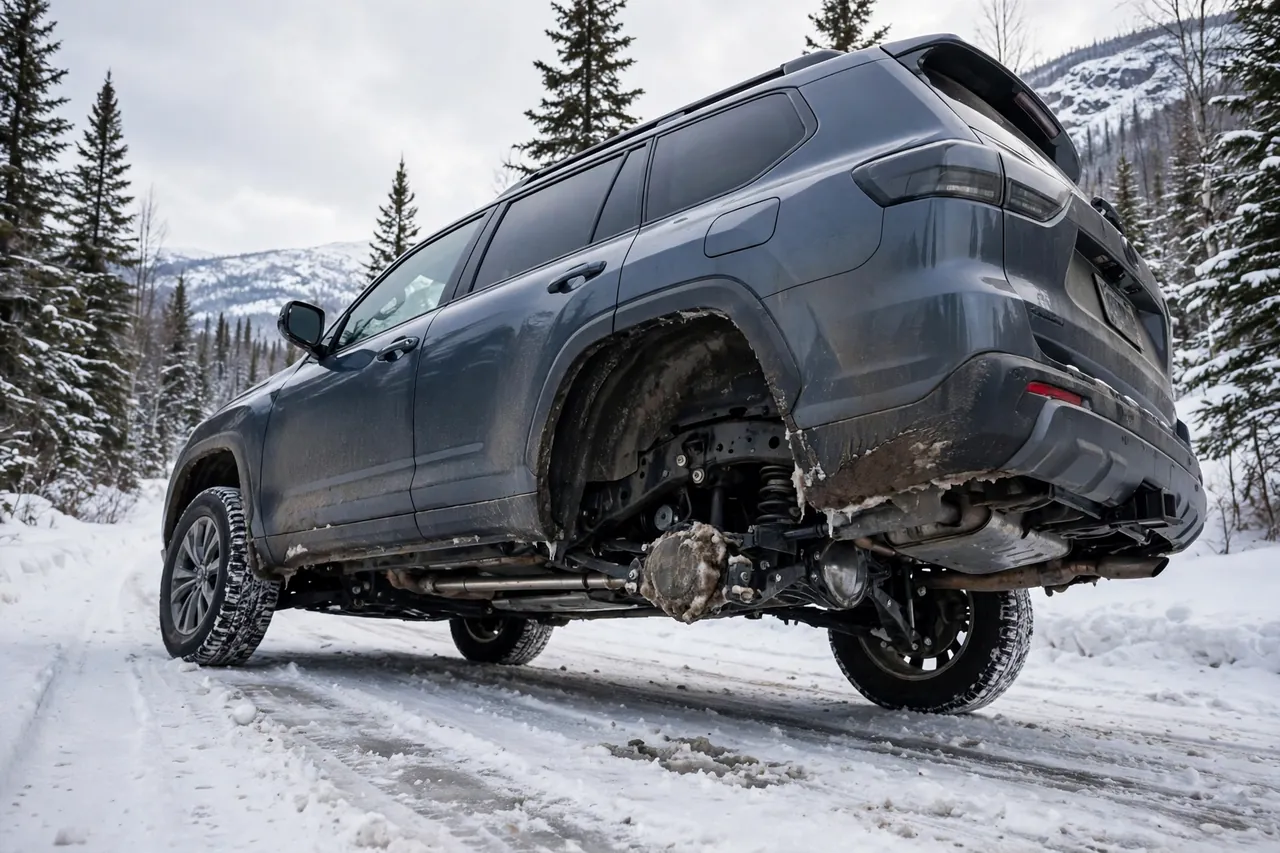
The dashboard says Service All Wheel Drive System. Or AWD System Malfunction. Or, on a Volvo, AWD Disabled, Service Required. The car still drives. The car still stops. And the driver is left with the worst kind of warning: one that sounds expensive, means almost anything, and usually means something cheap.
That last part is the key to this guide. On modern all-wheel-drive cars, the AWD system is a network of sensors, computers, and electronic clutches, and the warning is the computer saying it has detected a fault — not telling you which part failed. CarTipsDaily, writing about the GM Equinox, Terrain, and Durango, reports that about 60 percent of Service All Wheel Drive System warnings trace back to wheel speed sensor issues: small magnetic sensors behind each wheel that count how fast it spins, and that road salt, ice, and corrosion love to attack. The ABS system uses the exact same sensors, which is why the ABS light and the stability control warning often appear alongside the AWD message. A corroded connector at the rear differential control module can look like a $600 differential problem and be a $50 wiring repair. And a weak battery can trigger the whole cascade: AWD control modules are sensitive to voltage, and a battery reading below 12.4 volts can cause the module to brown out. AutoNation Mobile Service lists the same short list of usual suspects — a weak battery, a faulty wheel speed sensor, an engine fault, and only then a problem inside the AWD drivetrain itself.
The cost ladder follows the cause, and it is steep. AutoNation puts a diagnostic inspection at $70 to $200 in US dollars, and in Canada a diagnostic scan runs roughly $95 to $130. A wheel speed sensor or a battery is a few hundred dollars. Advanced Transmission, a Denver AWD specialist, puts minor repairs — seals, bearings, fluid changes — at $200 to $1,000, sensor or control module replacement at $500 to $1,800, and an AWD system rebuild of the differentials or transfer case at $1,500 to $3,500 in US dollars. Volvo owners get a model-specific version of the same ladder from YouCanic: a Haldex fluid and filter service at an independent shop runs $150 to $350, a Haldex pump replacement $500 to $1,200, and an angle gear or bearing repair $900 to $2,200 — and the most common cause is the Haldex rear differential unit whose filter and fluid are a service item most owners never knew about, with a clogged filter starving the pump. The Haldex service interval is every 30,000 to 40,000 miles. And sometimes the cost is zero: mismatched tyre sizes or tread depths make the system disable itself as a protective measure, and the fix is four matched tyres, not a repair at all.
Diagnosis is the whole job, and a cheap OBD-II scanner will not do it. The fault is usually stored as a C-code in the chassis systems, or a U-code in the network, not a P-code in the powertrain — so a $30 scanner from the glovebox shows nothing, and the driver concludes the car is fine or the scanner is broken. A shop needs a tool that can interrogate the ABS module, the rear differential control module, and the transfer case control module. The diagnostic sequence a good shop follows is short and worth knowing, because it tells you whether the shop is guessing. First, battery voltage and charging system. Second, wheel speed sensor data on a road test — all four wheels should agree. Third, tyre sizes and tread depths on all four corners, measured, not eyeballed. Fourth, fluid levels and condition in the transfer case and differentials — covered in our guides Transfer Case Service and Repair Cost in Canada and Differential Fluid Change Cost in Canada. Fifth, the AWD-specific codes. A shop that skips to step five and quotes a differential has not diagnosed your car.
The decision rule is about what the warning does to the car. When the warning activates, the electronic clutch that sends power to the rear wheels usually disengages, and the car becomes two-wheel drive. Electronic stability control may not be working either. In dry summer conditions that is an inconvenience. In a Canadian winter it is a safety problem, and the car should be diagnosed promptly — not because the repair is necessarily expensive, but because you are driving a front-wheel-drive car that you bought as an all-wheel-drive car, in the season when the difference matters most. The other rule is about tyres, and it is the cheapest prevention in this guide: never replace only two tyres on an all-wheel-drive car, and keep tread depths within a few thirty-seconds of an inch across all four. Mismatched tyres force the system to compensate constantly and wear parts well ahead of schedule — a point every transfer case guide makes, because the damage is real and entirely avoidable.
Before you approve a repair, ask for the code, the sensor data, and the fluid condition in writing. Ask whether the quote is for a sensor, a module, or a mechanical repair — those are three different jobs at three different prices, and a vague quote for AWD repair hides which one you are buying. And check the fair price for your exact car on the RepairPrice calculator at calculator.php. If the problem turns out to be mechanical — a differential or a transfer case — the value test applies: compare the repair against the car's value, and remember that a $200 fluid service every 50,000 kilometres is what keeps a $3,500 rebuild off this page.
Common questions:
Q: Can I drive with an AWD system malfunction warning? A: Short distances, carefully. The car usually drops to two-wheel drive and stability control may not work. In winter conditions, get it diagnosed promptly — you are driving without the traction system you bought the car for.
Q: What causes an AWD system malfunction? A: Most often a wheel speed sensor, a weak battery, corroded wiring, or mismatched tyres — about 60 percent of warnings trace to wheel speed sensors on some GM models. Mechanical failures of the differential or transfer case are less common but more expensive.
Q: How much does it cost to fix an AWD system malfunction in Canada? A: It depends on the cause. A diagnostic scan runs about $95 to $130. Minor repairs run $200 to $1,000, sensor or module replacement $500 to $1,800, and a differential or transfer case rebuild $1,500 to $3,500 in US dollars. Many warnings turn out to be a sensor or a battery.
Q: Why does my AWD warning come on in cold weather? A: Cold drops battery voltage, and AWD control modules are sensitive to voltage — a battery below 12.4 volts can trigger the warning. Road salt and ice also attack wheel speed sensors and connectors. Have the battery and charging system tested first.
| Service | Typical range (CAD) | Notes |
|---|---|---|
| Diagnostic scan | $95–$130 | Coupling, sensor, and module faults |
| Wheel alignment | $95–$150 | After suspension work; keeps tires wearing evenly |
| Transmission fluid change, car | $155–$250 | Keeps differentials and coupling lubricated |
| CVT fluid service | $175–$290 | Another fluid service in the same family |
| Wheel bearing / hub assembly | $310–$560 | A hum at speed can be a bearing |
| CV axle, each | $320–$585 | Clicking on turns points here |
| New tires, set of 4, installed | $595–$1,230 | Matched tires protect the centre coupling |


 RepairPrice
