
Antifreeze Change Cost in Canada
By Oleksandr Potapenko · 2026-11-16 · How we research prices
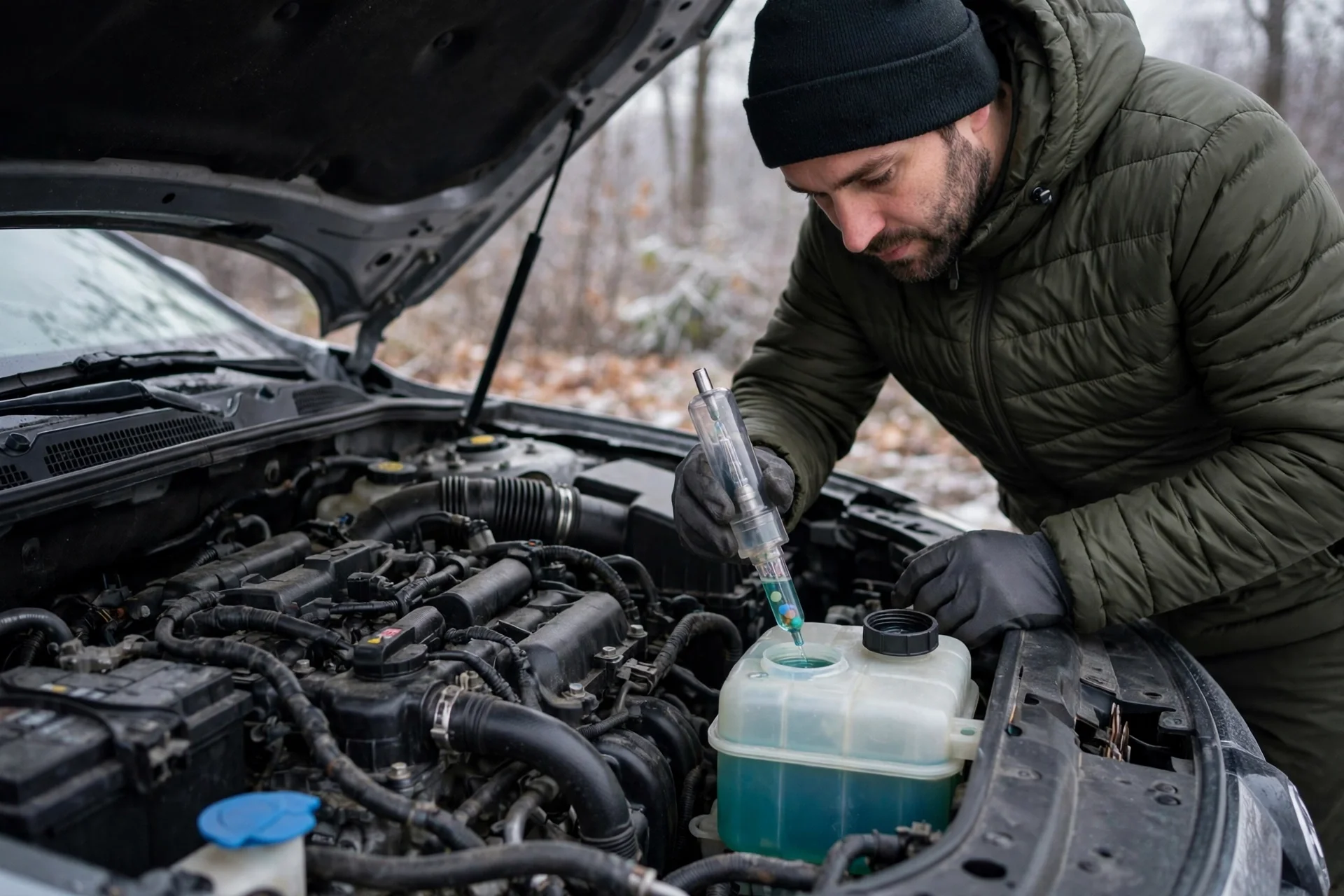
Minus thirty-seven. That is the number that matters on a January night in Edmonton or Winnipeg, because a 50/50 mix of antifreeze and distilled water protects down to about minus 37 degrees Celsius, and anything weaker is gambling with the engine block. Antifreeze does two jobs: it stops the cooling system from freezing in winter, and its additives prevent corrosion and lubricate the water pump. Over time the additives wear out, the coolant turns acidic, and it starts attacking the radiator, the heater core, and the gaskets from the inside. The fluid can look perfectly clean while it does this, which is why the change interval is measured in years and kilometres, not in appearance.
Changing antifreeze in Canada costs roughly $110 to $190 for a drain-and-fill at an independent shop, and $165 to $260 for a full machine flush on a typical car. Those are estimates built from named US benchmarks converted at about 1.38 Canadian dollars to the US dollar: Kelley Blue Book's current national average for a coolant flush is $131 to $209 US, Firestone Complete Auto Care says a radiator fluid exchange typically costs no more than $200 US, Take 5 publishes a coolant exchange range of $90 to $160 US, and Jiffy Lube's range, reported by CarsBibles in 2026, is $70 to $150 US. SUVs and trucks run $185 to $290 for a machine flush because the system holds more coolant, and luxury models run $210 to $330 because of specialty fluid and higher labour rates. A do-it-yourself drain-and-fill costs about $30 to $75 in coolant and distilled water, plus a drain pan, and a top-up jug of the correct coolant costs roughly $20 to $40 at a parts store such as Canadian Tire or NAPA.
The choice between a drain-and-fill and a machine flush is the first decision, and it is a real one. A drain-and-fill empties the radiator and refills it, which replaces most of the fluid but leaves old coolant in the engine block and the heater core. A machine flush pushes fresh coolant through the whole system and replaces nearly all of it. On a car changed on schedule, the drain-and-fill is fine, because the old fluid left behind is still healthy. On a car that is overdue, or whose coolant has gone rusty or sludgy, the flush is the only service that actually resets the system. Our guide "Coolant Flush Cost in Canada" covers the same choice from the flush side, and the rule is the same in both directions: match the service to the condition of the fluid, not to the price on the coupon.
The second decision is which antifreeze to use, and this is where most of the expensive mistakes happen. Coolant is defined by its inhibitor chemistry, not its colour. Inorganic acid technology, the old green formula, lasts about two years or 30,000 miles. Organic acid technology, often orange, red, or pink, lasts five to ten years or 100,000 to 150,000 miles; Toyota's Super Long Life, the pink factory fill, is rated first at 10 years or 100,000 miles, then every 5 years or 60,000 miles. Hybrid organic acid technology, often yellow or blue, sits in between, and Ford's Motorcraft Yellow is rated for a first change at 10 years or 200,000 miles. Honda's blue coolant is due at 5 years or 60,000 miles. Colour is not a reliable guide, because manufacturers dye the same chemistry different colours, and a shop manual will name the specification, Dex-Cool, G12, G13, Toyota Super Long Life, or Honda Type 2, rather than a colour. Mixing incompatible chemistries can gel and clog the narrow passages in the radiator and heater core, and a clogged heater core is a repair our guide "Heater Core Replacement Cost in Canada" prices far above any fluid change.
In Canada the winter angle deserves its own paragraph, because it is the one that kills engines outright. Weak coolant does not just stop protecting against corrosion; it can freeze in the block on a minus 35 night on the Prairies, and frozen coolant cracks engine blocks and cylinder heads. A hydrometer or refractometer test, which most shops do free with a service, measures the actual freeze protection, and it is worth asking for before the first hard frost if the car is more than a few years old. Never top up with straight water in winter, and never use tap water for mixing: the minerals in tap water form scale inside the system, and distilled water costs almost nothing by comparison. If the reservoir keeps dropping, do not just keep topping it up; find the leak, because a leak that empties the system on a highway in January is an overheating engine in the worst possible weather, and our guide "Engine Overheating and Coolant Leaks: Causes" explains what happens next. Check the range for your car with the RepairPrice calculator (calculator.php), and ask the shop to confirm the coolant specification in writing before the work starts.
Common questions:
Q: How much does it cost to change antifreeze in Canada? A: Roughly $110 to $190 for a drain-and-fill and $165 to $260 for a machine flush on a typical car at an independent shop, based on Kelley Blue Book's $131 to $209 US average and Firestone's guidance of no more than $200 US, converted at about 1.38. SUVs and luxury models cost more because of larger systems and specialty fluid.
Q: How often should antifreeze be changed? A: It depends on the chemistry. Toyota Super Long Life is first due at 10 years or 100,000 miles, Honda at 5 years or 60,000 miles, Ford Motorcraft Yellow at 10 years or 200,000 miles for the first change, and conventional green coolant every 2 years or 30,000 miles. The owner's manual is the final word.
Q: Can I mix different colours of antifreeze? A: No. Colour does not reliably identify chemistry, and mixing incompatible types can gel and clog the radiator and heater core. Use exactly the specification in the owner's manual and top up only with the same type.
Q: Is a drain-and-fill enough, or do I need a flush? A: A drain-and-fill is enough when the coolant is changed on schedule, because the old fluid left in the block is still healthy. A machine flush is the right choice when the coolant is overdue, rusty, or sludgy, or after a major cooling repair such as a water pump or radiator.
| Service | Typical range (CAD) | Notes |
|---|---|---|
| Drain-and-fill, independent shop | $110–$190 | Most of the old coolant out |
| Machine flush, car | $165–$260 | Full exchange, all old coolant out; KBB $131–$209 US converted |
| Machine flush, SUV or truck | $185–$290 | Larger cooling system |
| Machine flush, luxury model | $210–$330 | Specialty coolant, larger system |
| DIY coolant + distilled water | $30–$75 | Plus a drain pan and basic tools |
| Top-up jug of coolant | $20–$40 | Match the type already in the car |

 RepairPrice
