
Whole-House Surge Protector Installation Cost in Canada
By Oleksandr Potapenko · 2026-11-16 · How we research prices
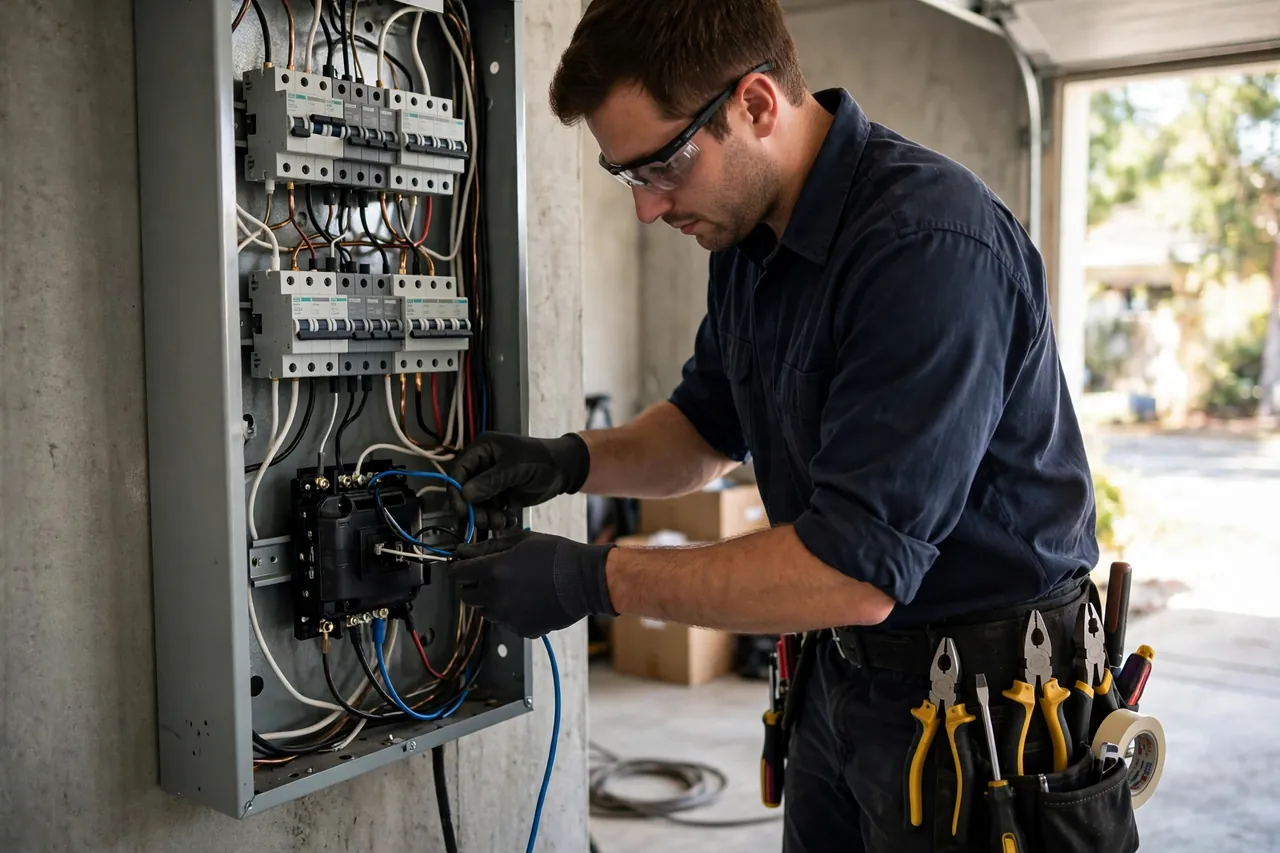
A whole-house surge protector is a small box at your electrical panel that stands between every appliance you own and the voltage spike that can kill them all at once. It does not stop lightning from hitting the house. It stops the surge that follows from reaching the furnace board, the fridge compressor, the television and the EV charger. The device itself is cheap. The labour is one short visit. The value is that a single surge can cost thousands, and the protector costs hundreds. HomeAdvisor's June 2026 estimates put the broader market at $70 to $700 US, averaging approximately $300 US. HomeGuide's installed-cost estimates put a Type 2 device at $200 to $450 US installed, and ThePricer, working from fourteen cited sources in October 2026, puts a whole-house surge protector at $200 to $800 US installed, with a straightforward installation using a standard panel-mounted device at $250 to $450 US. Kankpe Electric in Langley, British Columbia, quotes $800 to $1,500 CAD for a Type 2 installation, which is higher than the American figures because it includes the permit, the panel work and BC labour rates. Converted at about 1.40 Canadian dollars per US dollar, HomeAdvisor's $300 average becomes roughly $420 CAD, which sits between the American installed range and the Langley quote. There is no single Canadian national price series for this work, so the Canadian figures here are estimates built from converted American data and cross-checked against the Langley contractor pricing.
The device types are numbered, and the numbers matter. A Type 1 surge protective device sits at the meter base, before the panel, and handles the big external surge from a lightning strike or a utility switching event; it costs more because it needs utility coordination. A Type 2 device sits at or inside the main panel, on the load side, and handles both external surges and internal surges from motors cycling on and off, such as HVAC compressors and well pumps. A Type 3 device is the power strip at the point of use, and it is the last line of defence rather than the first. For most existing homes the right answer is a Type 2 device at the main panel, and for maximum protection some homeowners add Type 1 at the meter base as well. Quality Type 2 units are typically rated between 40 and 50 kiloamps per mode, and the Eaton CHSPT2ULTRA, a 108-kiloamp Type 2 model, lists at about $137 US at Home Depot. The joule rating is the other number to read: basic units run 1,000 to 2,000 joules at $30 to $80, mid-range units run 2,000 to 4,000 joules at $80 to $150, and high-performance models above 4,000 joules run $150 to $300.
The installation is short but it is not a do-it-yourself job, and the reason is simple: working inside the main electrical panel exposes you to the service entrance conductors, which are always energized even with the main breaker off, and contact with those wires can be fatal. Cost to Renovate puts the labour at $100 to $250 and the total at $150 to $575 US for a Type 2 install, and notes that the service-call fee of $75 to $150 can be a significant part of the total because the work takes only 30 to 60 minutes. A plug-on device that snaps into a compatible Square D, Eaton or Siemens panel is the cheapest to install at $50 to $100 in labour; a hardwired unit works with any panel brand but needs a dedicated two-pole breaker, adding $50 to $150 in labour. If the panel has no free breaker space, or the grounding and bonding need work first, the bill rises, and in Langley that is what pushes the job toward $800 to $1,500 CAD. The device must have a low-impedance path to the service grounding and bonding system, which is Canadian Electrical Code Rule 8-500 territory, and the installation should be done under permit so the panel listing, grounding and bonding are all checked.
The decision rule is to buy the protector when you buy anything else that touches the panel. The best time is during a panel upgrade, because the 2020 National Electrical Code in the US already requires surge protection on new or replaced services, and the marginal cost of adding the device while the panel is open is small. The second-best time is now, if the house has expensive electronics, a heat pump, an EV charger or a home office, because the protector is the cheapest insurance those devices will ever have. Check the indicator lights on the device every few months, because a surge protector sacrifices itself to absorb a surge and the indicator is how you know it is spent. A dead indicator means the device is no longer protecting anything, and it needs replacing. Our guide Electrical Panel Upgrade Cost: 100A to 200A in Canada covers the panel work that usually pairs with this install, and Generator and Transfer Switch Installation Cost in Canada covers the device that protects the generator's electronics when power returns. For a rough number before you call, the RepairPrice home calculator (home-calculator.php) gives a fair range for your city.
Common questions:
Q: How much does a whole-house surge protector cost in Canada? A: HomeAdvisor's June 2026 average is about $300 US installed, which converts to roughly $420 CAD. HomeGuide puts a Type 2 device at $200 to $450 US installed, and Kankpe Electric in Langley quotes $800 to $1,500 CAD for a Type 2 installation including the permit and panel work.
Q: Is a whole-house surge protector worth it? A: Yes if the house has expensive electronics, a heat pump, an EV charger or a home office, because a single surge can cost thousands and the protector costs hundreds. It is cheapest when installed during a panel upgrade, when the marginal cost is small.
Q: What is the difference between Type 1, Type 2 and Type 3 surge protectors? A: Type 1 sits at the meter base and handles big external surges. Type 2 sits at the main panel and handles external and internal surges, and it is the standard choice for existing homes. Type 3 is the power strip at the point of use and is the last line of defence, not the first.
Q: Can I install a whole-house surge protector myself? A: No. Working inside the main panel exposes you to service entrance conductors that are always energized even with the main breaker off, and contact can be fatal. Hire a licensed electrician, and have the work done under permit so the grounding and bonding are checked.
| Item | Typical range (CAD) | Notes |
|---|---|---|
| Type 2 SPD device | 80–300 | 40–108 kA rating, brand dependent |
| Type 2 installed, standard panel | 400–900 total | Device plus 1–2 hours labour |
| Type 2 installed, full panel work | 800–1,500 total | BC contractor pricing with permit |
| Type 1 + Type 2 combination | 700–1,200 total | Meter base plus panel protection |
| Grounding / bonding upgrade | 200–600 extra | If panel grounding needs work first |

 RepairPrice
