
Water Softener Installation Cost in Canada
By Oleksandr Potapenko · 2026-11-16 · How we research prices
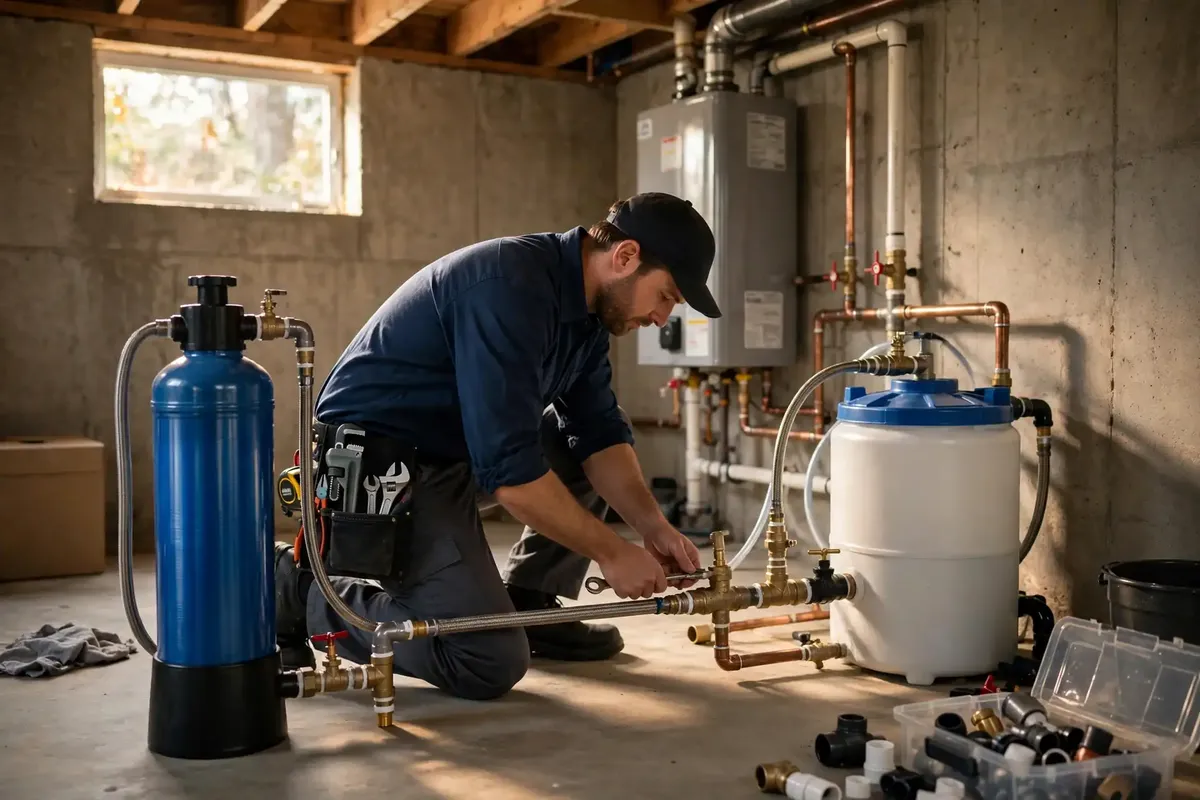
Hard water is not a plumbing emergency. It is a slow tax on everything water touches: the water heater, the dishwasher, the taps, the laundry, and your skin. Fixr puts a whole-house water softener at about 1,100 to 3,000 USD installed, averaging 2,500 USD. HomeGuide puts a salt-based system at 1,200 to 3,800 USD with installation, and a dual-tank system at 1,700 to 5,000 USD. Angi's average across all types is about 1,500 USD, in a wider 200 to 6,000 USD range that runs from a magnetic conditioner to whole-house reverse osmosis. Converted at 1.39, the standard salt-based system lands around 1,670 to 5,280 CAD installed, averaging roughly 3,475 CAD. The two averages differ by 1,000 USD because they measure different things: HomeGuide's 2,500 USD is a salt-based ion exchange system installed, while Angi's 1,500 USD averages every technology called a softener, including devices that do not soften water at all. For a conventional salt-based softener, use HomeGuide's band. There is no Canadian national series for water softeners, so these converted US figures are the planning range, and the Canadian cross-check is the hardness of the water itself: much of the Prairies and southern Ontario sits above 10 grains per gallon, where treatment starts to pay for itself.
The first step is not shopping. It is a test. Hardness is measured in grains per gallon or in milligrams per litre as calcium carbonate, and the US Geological Survey classifies water above about 7 grains per gallon, or 121 milligrams per litre, as hard. A professional hardness test costs 130 to 200 USD, according to HomeGuide, or your municipal utility's annual water quality report will give you the number for free. Capacity is daily water use multiplied by grains per gallon, and it decides the size of the unit: a standard single-tank salt-based softener for a three- to four-person home usually lands between 1,200 and 2,500 USD installed. Buying without the test is how homeowners end up with a unit too small to keep up, regenerating constantly and burning through salt, or a unit so large it regenerates rarely and breeds bacteria in the resin bed. Get the number first.
The technology split is where most of the confusion and most of the overselling lives. A salt-based ion exchange softener is the only common type that actually removes calcium and magnesium from the water. It swaps them for sodium in a resin bed, then flushes the bed with brine and sends the minerals down the drain. A salt-free system, using template-assisted crystallisation, does not technically soften water at all: HomeGuide is explicit on this point. It changes how the minerals crystallise so less scale forms, but the hardness number on the test does not change, and it works best at moderate hardness. A magnetic or electronic descaler, priced by Angi at 200 to 600 USD, is the weakest claim of all: HomeGuide prices magnetic systems at 2,000 to 6,000 USD, a ten-fold disagreement that tells you everything about how settled the evidence is. The rule is blunt. If the test says the water is hard and you want soft water, buy ion exchange. If you want less scale on a moderate-hardness supply and you do not want salt or a drain, a salt-free conditioner is an honest choice, as long as nobody sells it to you as a softener.
The running costs are small but they are not zero, and they belong in the decision. HomeGuide puts salt at 50 to 150 USD a year and maintenance at 100 to 300 USD or more. The resin bed lasts 10 to 15 years and a resin service costs 300 to 600 CAD. The drain line matters too: a softener needs a drain for its regeneration discharge and a bypass valve, and the installation labour runs 150 to 1,000 USD, with most straightforward installs in the 500 to 700 USD band, according to This Old House. If the house has no floor drain near the install location, or no electrical outlet for the control valve, the job gets more expensive. A dedicated circuit costs 250 to 900 USD. Ask whether the quote includes the drain, the bypass, the electrical, and the programming, because a softener that is not programmed to the actual hardness is just an expensive box by the water heater.
The decision rule is a hardness threshold, not a feeling. Above about 10.5 grains per gallon, whole-house treatment starts to pay for itself in appliance life, soap use, and water heater efficiency. Below 7 grains, the case is weaker and a point-of-use filter may be the better spend: see our guide Reverse Osmosis System Installation Cost in Canada for the drinking-water option. Between the two, get the test, price the salt-based system, and compare it against the cost of replacing a water heater five years early, which is what hard water does to one. A softener protects the water heater, the dishwasher, and the fixtures at the same time, and it is the only water treatment purchase that pays for itself in avoided replacements. Check the total in the RepairPrice home calculator (home-calculator.php), and if the water test shows iron or sediment as well, price the pre-filter with the softener rather than as a surprise later.
Common questions:
Q: How much does a water softener cost in Canada?
A: A standard salt-based system runs about 1,670 to 5,280 CAD installed, averaging roughly 3,475 CAD, based on HomeGuide and Fixr figures converted at 1.39. A dual-tank system runs 2,360 to 6,950 CAD, and a salt-free conditioner 2,085 to 6,255 CAD.
Q: Do salt-free water softeners really work?
A: They do not soften water. HomeGuide is explicit: salt-free systems change how minerals crystallise so less scale forms, but they do not remove calcium or magnesium. They work best at moderate hardness. For genuinely hard water, only ion exchange removes the minerals.
Q: How much does it cost to run a water softener?
A: Salt costs 50 to 150 USD a year and maintenance 100 to 300 USD or more, according to HomeGuide. The resin bed needs service after 10 to 15 years at 300 to 600 CAD.
Q: How do I know if I need a water softener?
A: Get a hardness test: above 7 grains per gallon is hard, and above 10.5 grains whole-house treatment starts to pay for itself. Your municipal water quality report gives the number free, or a professional test costs 130 to 200 USD.
| Item | Typical range (CAD) | Notes |
|---|---|---|
| Softener unit (metered) | 800–2,000 | Sized by hardness + household |
| Install all-in | 1,500–3,500 | Plumbing, drain, programming |
| Salt + running costs | 100–200 / year | Family household estimate |
| Resin-bed service | 300–600 | After 10–15 years |

 RepairPrice
