
Wall Insulation Retrofit Cost in Canada (Existing Homes)
By Oleksandr Potapenko · 2026-11-16 · How we research prices
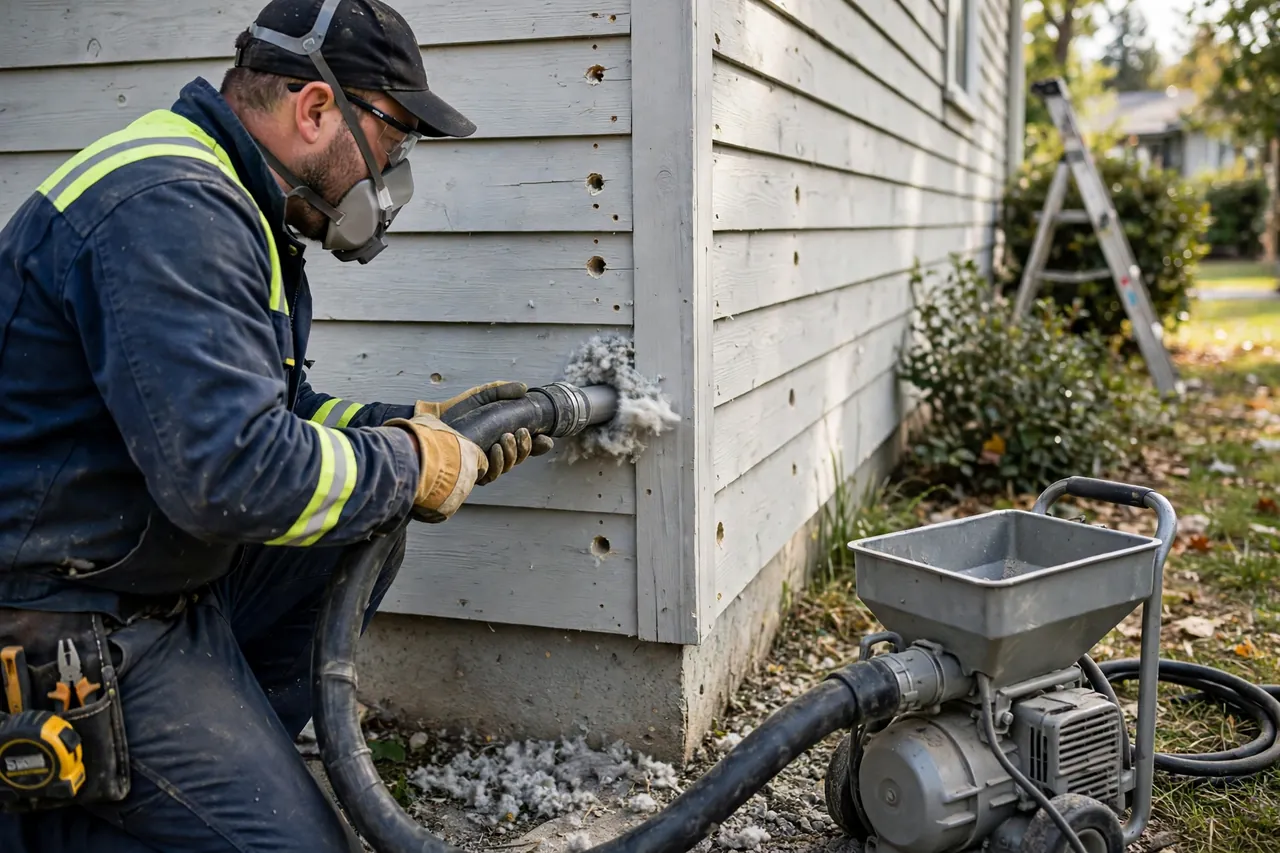
Retrofitting insulation into existing walls is the hardest insulation job in a Canadian house, because the walls are already closed, and every method is a compromise between cost, disruption and performance. The attic can be topped up in an afternoon, the basement can be insulated from the inside, but a finished wall gives you three options, and none of them is as simple as the guides make it sound. Energy Efficiency Ontario, a Canadian source, prices dense-pack cellulose blown into closed wall cavities at 3 to 6 Canadian dollars per square foot of wall, or about 4,500 to 9,000 dollars for 1,500 square feet of wall, and estimates that wall insulation in homes with empty walls can cut heating energy by roughly 10 to 20 percent. Greenfoot Energy, a Canadian installer, quotes dense-pack at 2.00 to 3.50 Canadian dollars per square foot of wall including patching. Exterior rigid insulation, foam boards installed on the outside of the wall under new siding, runs 3,000 to 8,000 dollars as an add-on, and insulated vinyl siding adds R-2 to R-3 for 15,000 to 25,000 dollars for the whole house. The cheapest option is also the least disruptive, and the most effective option is also the most disruptive, which is the tension this whole guide is about.
A note on the numbers: Canada has no single national price series for this work, so the Canadian ranges below are estimates. They start from verified US figures published by HomeAdvisor, Angi, HomeGuide and Fixr, converted at about 1.40 Canadian dollars per US dollar, and are cross-checked against Canadian contractor listings and provincial program figures where those exist.
The two Canadian sources agree on the order of magnitude: dense-pack wall fill lands at roughly 2 to 6 Canadian dollars per square foot of wall, or 4,500 to 9,000 dollars for a typical house, exterior rigid insulation at 4,200 to 11,200 dollars as an add-on, and a full re-side with insulated vinyl at 21,000 to 35,000 dollars. The performance numbers explain why the choice matters. A typical empty 2-by-4 wall in a pre-1980 Canadian house is around R-4 to R-6 once you count the studs, the drywall and the sheathing. Dense-pack cellulose brings that cavity to about R-13 to R-15, which is a real improvement, but it does nothing about the studs themselves, which are thermal bridges that leak heat straight through the wall. Exterior rigid insulation is the only method that covers the studs, and that is why building scientists recommend it whenever the siding is coming off anyway. The rule that follows is simple: if the siding is staying, dense-pack the cavities. If the siding is coming off, add rigid foam while the wall is open.
The details that ruin this job are the ones nobody puts in the quote. Dense-pack only works if the cavity is empty and accessible: knob-and-tube wiring, existing insulation, fire blocking and plumbing in the wall all complicate it, and a house with knob-and-tube wiring must have the wiring dealt with first, because insulation cannot be blown over it. Our guide on knob-and-tube rewiring is the companion read for any pre-1950 house. Air sealing comes before insulation here too, and it is harder in walls than in attics: the leaks are behind the drywall, around the windows, the outlets and the top and bottom plates, and a blower-door test before and after the work is the only way to know whether the sealing actually happened. Our guide "Weatherstripping and Draftproofing Cost in Canada" prices the sealing work, and "Home Energy Audit Cost in Canada (EnerGuide)" explains the test. The attic first rule applies with full force: in most houses the attic loses more heat than the walls, it costs less to fix, and it should be done before a dollar goes into the walls, which is why our guide "Attic Insulation Cost in Canada" is the first stop, not the last.
The decision rule is a sequence, and it saves people from the most common expensive mistake in Canadian retrofits, which is insulating the walls of a house that still leaks air through the attic. Step one, the EnerGuide audit and the blower-door test. Step two, air sealing and the attic. Step three, the walls, dense-pack if the siding stays, rigid foam if it goes. Step four, the basement, priced in "Basement Insulation Cost in Canada". Get two quotes for the same method and the same wall area, ask whether the price includes patching the drill holes and repainting, because a dense-pack job leaves a hole in every stud bay, and confirm the installer is certified for the material. Price the sequence with the RepairPrice home calculator (home-calculator.php) before you commit to any single step, because the payback on wall insulation alone is long, ten to twenty years in most houses, and it only makes sense as part of a whole-house plan.
Common questions:
How much does it cost to insulate existing walls in Canada? Dense-pack cellulose or fibreglass runs about 2,800 to 8,400 Canadian dollars for a typical house, converted from HomeGuide US figures at about 1.40. Exterior rigid insulation as an add-on runs 4,200 to 11,200 dollars, and a full re-side with insulated vinyl runs 21,000 to 35,000 dollars.
Is blown-in wall insulation worth it? Yes, if the cavities are empty and the siding is staying. It brings a bare 2-by-4 wall from about R-4 to R-6 up to about R-13 to R-15. It does not cover the studs, so exterior rigid foam is better when the siding is coming off anyway.
Should I insulate the walls or the attic first? The attic, almost always. It loses more heat, costs less to fix, and should be done before any money goes into the walls.
Can you blow insulation into walls with knob-and-tube wiring? No, not until the wiring is dealt with. Insulation cannot be blown over knob-and-tube wiring, and the wiring has to be replaced or properly addressed first.
| Job | Typical range (CAD) | Notes |
|---|---|---|
| Dense-pack wall fill, typical house | $4,500–$9,000 | Cavities must be empty |
| Dense-pack, per sq ft of wall | $3.00–$6.00 | Cellulose or fibreglass |
| Exterior rigid insulation (add-on) | $4,200–$11,200 | Covers the studs — real upgrade |
| Insulated vinyl siding, whole house | $21,000–$35,000 | Foam backing, R-2 to R-3 |
| Whole-house air sealing | $1,100–$3,500 | Do this before insulating |
| Blower-door test | $300–$500 | Before and after the work |

 RepairPrice
