
Transmission Mount and Cooler Line Repair Cost
By Oleksandr Potapenko · 2026-11-16 · How we research prices
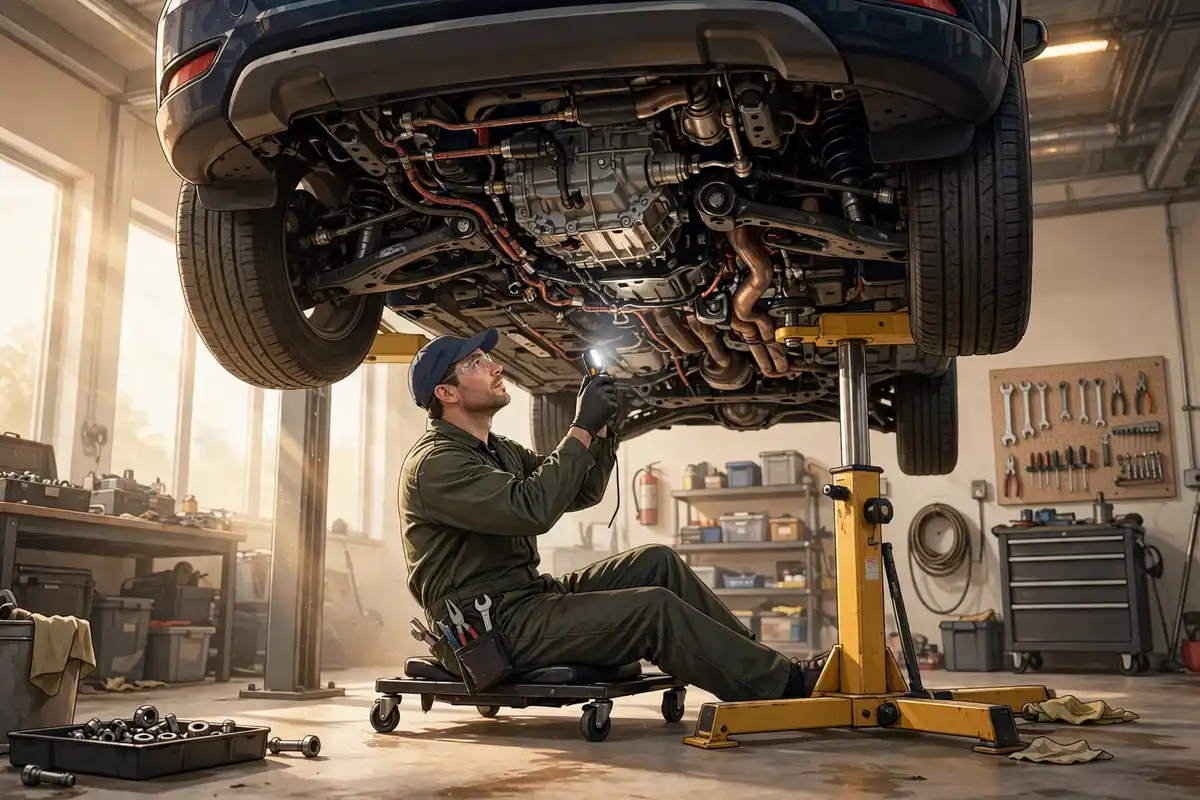
Two small parts, two very different failures, one shared lesson: the transmission does not fail alone. A mount is a rubber-and-metal cushion that holds the transmission in place. A cooler line is a hose or metal tube that carries transmission fluid to the radiator or a separate cooler and back. When either one fails, the symptoms look like a dying transmission — clunks, vibration, slipping, overheating — and the repair costs a fraction of what a transmission job costs. Knowing which one you have is worth hundreds of dollars.
Start with the mount, because its symptoms are the most often misread. A transmission mount replacement on a typical car runs roughly $220 to $395 at an independent shop, based on $80 to $200 for the mount plus about 1.5 hours of labour at $95 to $130 an hour. SUVs run about 15 percent higher and luxury models about 35 percent higher. RepairPal's US estimator runs higher: its generic trans-mount average, updated September 3, 2026, is $359 to $433 in US dollars — about $490 to $590 Canadian at 1.37 Canadian dollars per US dollar — with parts around $199 and labour at $160 to $234, and its model figures span $179 to $218 for a Chevrolet SSR, $227 to $255 for a GMC Sierra 1500 HD, and $448 to $551 for a 2022 Hyundai Tucson. The gap is mostly the part: RepairPal's typical mount alone costs about $199 in US dollars (about $273 Canadian), above this guide's $80 to $200 Canadian part band, because its figures skew toward newer cars with fluid-filled mounts. For an older car with a simple rubber mount, the Canadian range in this guide stands; for a newer car with a fluid-filled mount, budget toward RepairPal's end. The mount itself is simple — rubber bonded to steel, sometimes fluid-filled on newer cars — and it fails the way rubber fails: it cracks, sags, and hardens with age, heat, and oil contamination. The symptoms are a clunk when you shift into drive or reverse, a thud on acceleration, vibration at idle that disappears when you shift into neutral, and on some cars a visible tilt of the engine. The trap is that a worn mount lets the transmission move, and that movement stresses the cooler lines, the shift linkage, and the axle seals — so a mount left alone becomes a leak, and a leak left alone becomes a burnt transmission. Replace the mount when it is diagnosed, and ask the shop to check the engine mounts at the same time, because they age together and the labour overlaps.
Cooler lines are the more urgent half of this guide. A transmission cooler line replacement runs roughly $290 to $510 on a typical car, from $100 to $250 for the lines plus about two hours of labour. American cross-checks agree on the shape of the number: EngineerFix puts professional cooler line replacement at $228 to $790, with most jobs at $300 to $600, parts from $18 for a simple rubber hose section to $450 for complex pre-bent assemblies, and labour at $110 to $170 an hour for a job that typically takes two hours. RepairPal's model figures show a far wider spread than the Canadian range: $190 to $247 in US dollars for a 1994 GMC Yukon and $210 to $255 for a Mercedes-AMG GT 53, but $332 to $377 for a GMC Sierra 2500 HD, $582 to $742 for a 2020 Chevrolet Tahoe, and $1,362 to $1,915 for a 2021 GMC Yukon XL. The simple-car figures sit inside this guide's $290 to $510 Canadian range once converted; trucks and newer SUVs with complex pre-bent assemblies run well above it, so the Canadian range here is a car figure, not a truck figure. Rusted fittings and lines that snake around the radiator and subframe push the labour toward three or four hours. The lines fail from corrosion, road debris, and the slow hardening of their rubber sections — a Canadian problem in particular, because road salt attacks the metal fittings and freeze-thaw cycles age the rubber. The symptom is a leak, and the leak is the emergency: transmission fluid is the transmission's coolant and lubricant, and a car that loses it will shift poorly, overheat, and then slip, all within a short drive. A red puddle under the car, fluid on the underside near the radiator, or a burning smell after driving all mean the same thing — stop topping up and find the leak.
That last point deserves emphasis, because topping up is the most common and most expensive mistake with cooler lines. A topped-up leak returns in days, and every kilometre driven low on fluid wears the clutches. The correct repair is to find the leak, replace the line, and then set the fluid level properly — by the temperature procedure on many modern cars, which have no dipstick — with fresh fluid included in the job. Our guide Transmission Fluid Change and CVT Service Cost in Canada explains why the level-setting procedure matters. A shop that replaces a cooler line without checking the fluid level afterwards has done half the job.
The decision rule here is about pairing work. A mount is cheap to do while the transmission is out for any other reason, and a cooler line is cheap to do while the radiator or front-end work is already happening. If you are already paying for a torque converter or a clutch — covered in our guides Torque Converter Replacement Cost in Canada and Clutch Kit and Flywheel Replacement Cost in Canada — ask for the mount and a cooler-line inspection to be added, because the labour is mostly already paid. If the car is only in for a mount, do not authorise a transmission service you do not need; a mount does not require a fluid change. And if the car is in for a leak, do not authorise the line replacement until the shop has shown you where the leak is: a pan gasket, an axle seal, and a cooler line all leak in the same neighbourhood, and they cost very different amounts.
Before you approve the work, ask the shop to put the car on the hoist and show you. A cracked mount is visible. A wet cooler line is visible. A quote written from the driver's seat, without the car in the air, is a guess. Get the fair range for your exact car from the RepairPrice calculator at calculator.php, and ask whether the cooler-line quote includes fresh fluid and the level-setting procedure — if it does not, the real price is higher than the number on the page.
Common questions:
Q: How much does a transmission mount replacement cost in Canada? A: Roughly $220 to $395 for a car at an independent shop, based on an $80 to $200 mount plus about 1.5 hours of labour. SUVs run about 15 percent higher, luxury models about 35 percent higher. RepairPal's US generic average is $359 to $433, about $490 to $590 Canadian, with model figures from $179 to $773 — newer cars with fluid-filled mounts run above the Canadian range.
Q: How much does it cost to replace transmission cooler lines? A: Roughly $290 to $510 in Canada for a car, and $300 to $600 in American published guides. RepairPal's US model figures run $190 to over $1,900 depending on the vehicle — simple cars sit inside the Canadian range, trucks and newer SUVs well above it. Parts range from $18 for a simple hose section to $450 for complex assemblies, and labour is typically about two hours.
Q: What happens if a transmission cooler line leaks? A: The transmission loses fluid, shifts poorly, overheats, and then slips. Driving low on fluid wears the clutches quickly and can turn a $400 line repair into a rebuild. Fix the leak, do not just top up the fluid.
Q: Can a bad transmission mount cause vibration? A: Yes. A worn mount commonly causes vibration at idle that disappears in neutral, a clunk when shifting into drive or reverse, and a thud on acceleration. It is often mistaken for an engine or transmission problem.
| Job | Typical range, independent shop | Symptoms it explains |
|---|---|---|
| Transmission mount, car | $220–$395 | Clunk on shifting, vibration at idle |
| Cooler lines, car | $290–$510 | Fluid leaks, overheating, poor shifting |
| SUV/truck or luxury | +15% / +35% | Routing and labour rate |
| Fresh fluid after line work | Should be included | Level set by temperature procedure |
| Find the leak, do not just top up | — | A topped-up leak returns in days |


 RepairPrice
