
Shock and Strut Replacement Cost in Canada
By Oleksandr Potapenko · 2026-11-16 · How we research prices
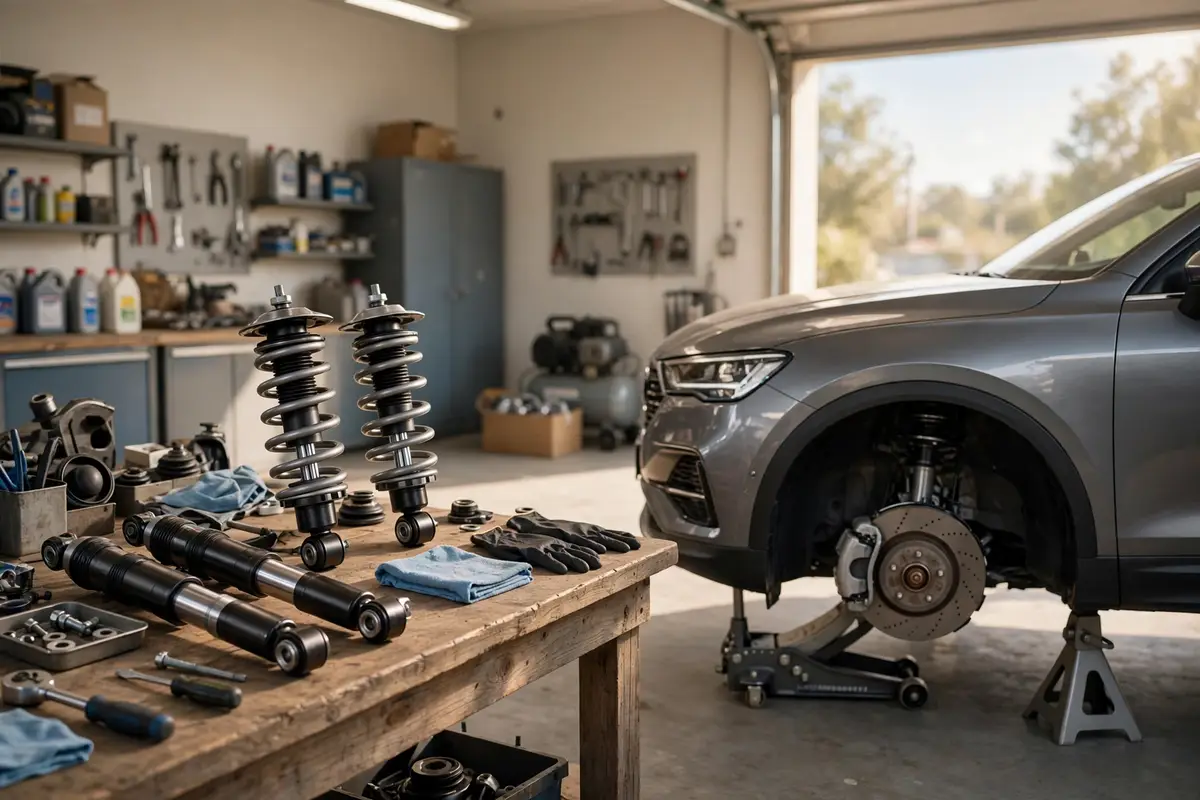
Here is the short answer first: on a typical Canadian car, a pair of shock absorbers now runs about $600 to $900 installed at an independent shop, and a pair of front struts runs about $1,000 to $1,600. Those numbers are higher than the figures that used to circulate online, and the gap is worth understanding before you approve a quote. Simplicity Car Care's 2026 Canadian guide puts shock replacement at $600 or more per axle and a complete strut assembly at $1,000 or more per axle. RepairPal's September 2026 United States estimate for its shock-or-strut job is $1,144 to $1,348 USD, with $812 to $862 of that in parts and $332 to $487 in labour — roughly $1,590 to $1,875 CAD at a rough 1.39 exchange rate. The two sources are not really disagreeing: RepairPal prices original-equipment parts, while a Canadian independent shop fitting quality aftermarket assemblies lands lower. If your quote is near the RepairPal figure, ask whether it is built on OEM parts; if it is far below the Simplicity floor, ask what brand of damper is going in.
Shocks and struts do the same basic job — damping the springs so the wheels stay planted — but they are built differently, and that changes the bill. A shock absorber is a standalone damper. A strut is a damper built into a structural assembly that also locates the wheel, with the coil spring mounted around it, which is why strut work takes longer and costs more. Both wear gradually, which is why drivers adapt to the decline and do not notice it: longer stopping distances, a car that floats over highway dips, nose-dives under braking, leans hard in corners, or bounces more than once after a bump. Worn dampers are a safety item, not a comfort one. Monroe and other damper makers note that worn shocks lengthen braking distances, and on a Canadian winter road — ice ruts, potholes, frost heaves — that lost grip is exactly when you need it most.
The numbers split by vehicle in a predictable way. RepairPal's model pages put a 2026 Toyota Corolla at $1,006 to $1,246 USD for its shock-or-strut job and a 2026 Toyota Camry at $1,019 to $1,201 USD, while a 2026 Toyota Tundra runs $1,137 to $1,468 USD and a BMW 328i reaches $2,301 to $2,584 USD according to ThePricer's review of the same RepairPal data. A small car like a 2008 Toyota Yaris sits at $311 to $396 USD. The pattern is consistent: mainstream sedans cluster in the middle, trucks run higher, and European luxury cars can double the bill, mostly on parts. SUVs and trucks generally land about 15 percent higher than a car at a Canadian shop, luxury models about 35 percent higher, and cars with electronic or adaptive dampers cost far more per unit — sometimes more than the whole job on a mainstream car.
When should they be replaced? Most manufacturers suggest inspection around 80,000 km and replacement somewhere between 80,000 and 160,000 km depending on roads, and Canadian potholes, frost heaves and gravel push cars toward the early end of that range. The bounce test you may remember — push down on a corner and count the bounces — is a rough screen, not a diagnosis. A better check is visual: fluid leaking down the damper body, a dented or corroded rod, or a spring that is cracked or sagging. Uneven tire wear, especially cupping, also points to worn dampers. If you are already reading our guide on Broken Coil Spring: Replacement Cost in Canada, the same inspection applies — springs and dampers live in the same corner and fail on the same roads.
The decision rule is simple and it saves real money: replace dampers in axle pairs, left and right together, so the car handles evenly — one new damper and one worn one makes the car pull and dive unevenly — but do not automatically replace all four corners. Monroe's own guidance is to replace in left-right pairs, and a shop that insists on all four when only the front is worn is selling you two dampers you do not need yet. The other decision is complete assembly versus damper alone. A complete strut assembly — damper, spring and mount together — costs more in parts but saves labour and replaces the worn mount and bearing at the same time, which is usually the better value on a car over 120,000 km. On a newer car with a good spring and mount, the damper alone is fine.
After strut replacement, a wheel alignment is not optional — it is part of the job. The strut locates the wheel, so removing it changes camber and toe, and skipping the alignment eats the new tires you just tried to protect. Our guide Wheel Alignment Cost in Canada has the current alignment prices; confirm the alignment is included in the quote or budgeted separately. Before you approve anything, ask three questions: is the quote for one axle or all four, does it cover a complete assembly or the damper alone, and is the alignment included? Then check the fair price on the RepairPrice calculator (calculator.php) for your own car and compare. A quote that is hundreds above the range with aftermarket parts deserves a second quote; a quote far below the range deserves a question about the part brand.
Common questions: Q: How long do shocks and struts last in Canada? A: Plan on inspection at 80,000 km and replacement between 80,000 and 160,000 km. Salt, potholes and frost heaves push most Canadian cars toward the early end, and a car that regularly drives gravel or rough city streets will wear dampers faster than a highway car. Q: Can I replace just one strut? A: You can, but you should not. Dampers must be replaced in axle pairs so both sides damp identically; a single new strut next to a worn one makes braking and cornering uneven. Q: Do I need an alignment after struts? A: Yes, always after front strut work, because the strut sets the wheel angles. Rear shocks alone usually do not need one, but ask the shop — it depends on the design. Q: Are expensive adaptive dampers worth repairing? A: On a car worth keeping, usually yes, but get the price first: adaptive units can cost several times a conventional damper, and on an older car a conversion to conventional dampers is sometimes the cheaper path.
| Job | Typical range, independent shop | Notes |
|---|---|---|
| Shock absorbers, pair, car | $600–$900 | Simplicity Car Care 2026: $600+ per axle in Canada |
| Strut assembly, each, car | $500–$800 | Assembly $300–$550 + ~1.5 h labour |
| Struts, one axle (pair) | $1,000–$1,600 | Simplicity: $1,000+ per axle; always replace in axle pairs |
| SUV/truck or luxury | +15% / +35% | Size and labour rate |
| Alignment after struts | Required, may be separate | Struts set wheel angles |




 RepairPrice
