
Sewer Line Repair and Replacement Cost in Canada: Trenchless vs Digging
By Oleksandr Potapenko · 2026-11-16 · How we research prices
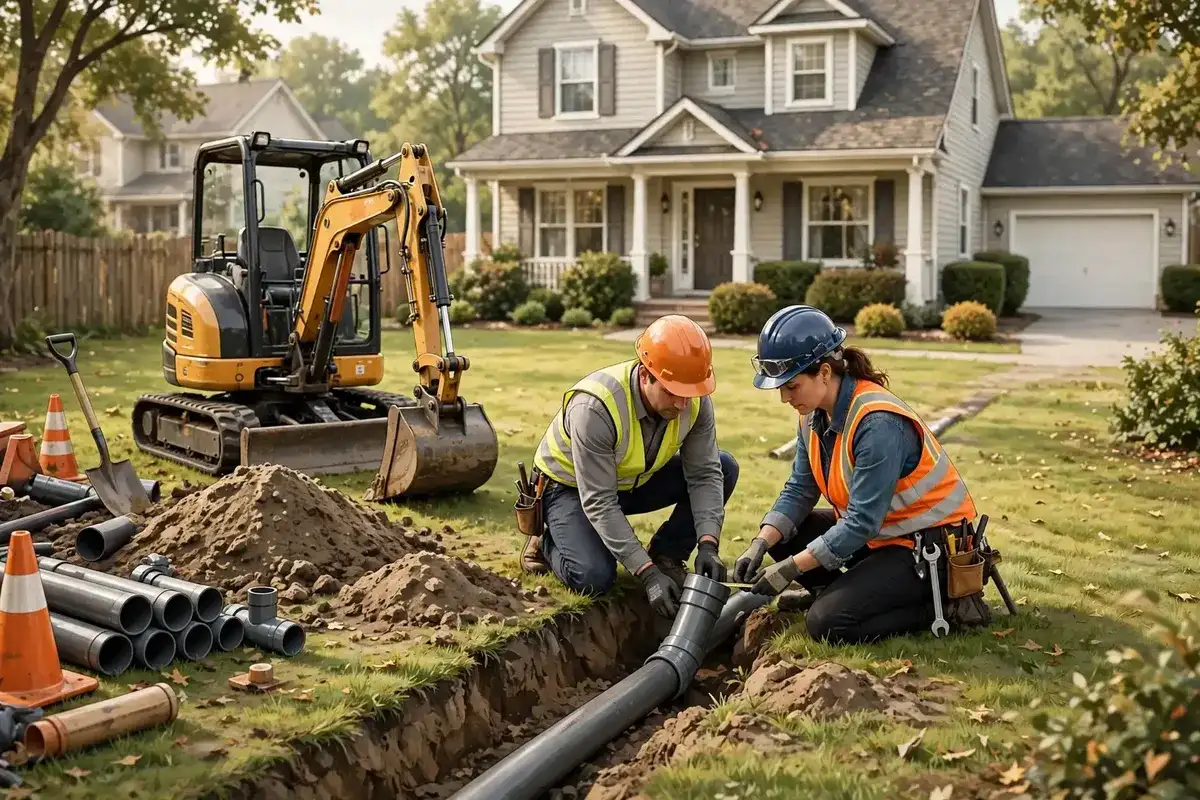
Nothing in a house produces a bigger bill from a smaller symptom than a sewer line. A slow drain, a gurgling toilet, a damp patch on the lawn: any of them can mean the pipe from your house to the street is failing. Angi and HomeAdvisor put the typical full replacement at 1,388 to 5,323 USD, averaging 3,319 USD. Converted at 1.39, that is roughly 1,930 to 7,400 CAD, averaging about 4,600 CAD. Forbes Home, working from a 30-foot line, quotes about 4,000 USD, or roughly 5,560 CAD. HomeGuide, assuming a longer 40-foot run, averages 6,000 USD, or about 8,340 CAD. The sources disagree on the total because they assume different line lengths, not because any of them is wrong. Per foot, they agree closely: 50 to 250 USD per linear foot installed, or about 70 to 350 CAD. Multiply by your own line length and you have a better estimate than any national average.
There is no Canadian national price series for sewer work, so these are converted US figures with Canadian cross-checks: Toronto-area contractors report full lateral replacements commonly reaching 8,000 to 25,000 CAD once deep excavation and surface restoration are included, which is consistent with the converted per-foot math on a long, deep, or under-driveway line. Canadian frost depth pushes lines deeper than in much of the US, and deeper means more excavation, which is why Canadian totals run high even when the per-foot rate is similar. Get the length of your line in writing before you compare quotes. A 25-foot line and a 70-foot line are different jobs at different prices, and a quote that does not state the length is not a quote you can compare.
The pipe itself matters as much as the price. Clay tile, common in homes built before the 1970s, lasts 50 to 60 years and fails at the joints, where roots get in. Cast iron lasts 75 to 100 years but corrodes from the inside until it scales shut or cracks. Orangeburg, a tar-paper pipe used from the 1940s to the 1970s, lasts about 50 years and then deforms and collapses; if your home has it, replacement is a matter of when, not if. PVC, the modern standard, lasts 100 years or more. The material tells you the urgency. A clay line with root intrusion can often be lined and kept. An Orangeburg line that has gone oval cannot be lined at all and has to come out.
Three methods compete for the job, and the choice is the real decision. Traditional open-trench excavation costs 50 to 200 USD per foot, or about 70 to 280 CAD, and it is the cheapest per foot. But it is not the cheapest job, because it destroys whatever is above the pipe: lawn, driveway, walkway, deck. Restoration is where the bill doubles, and a Rhino Rooter analysis of national data found traditional excavation running 3,000 to 10,000 USD more than trenchless once restoration was counted. Trenchless pipe bursting runs 60 to 200 USD per foot, about 85 to 280 CAD, and pulls a new HDPE pipe through the old one, cracking it outward. Cured-in-place lining, or CIPP, runs 90 to 250 USD per foot, about 125 to 350 CAD, and builds a resin pipe inside the old one. Both need only one or two small access pits, both usually finish in one to two days, and neither tears up the yard. The catch is condition: lining needs a pipe that still holds its shape, and bursting needs room for the new pipe to expand. A collapsed line leaves you with the trench.
The rule that saves the most money is the simplest: never approve a replacement without a camera inspection first. HomeGuide puts a camera inspection at 125 to 500 USD, averaging 280 USD, or about 175 to 700 CAD, and it answers the only questions that matter: where is the damage, how long is it, and is the pipe a candidate for lining. A contractor who quotes a full replacement without scoping the line is selling a guess. Ask for the video file and the distance to each defect, in writing. Then get three quotes, one of them trenchless, and make sure each one states the length, the method, the pipe material, the permit, and the restoration. If the line is under a municipal road or sidewalk, ask who pays for that portion: in many cities the homeowner owns the lateral to the property line and the city owns the rest, and the split changes the bill. Our guide Drain Camera Inspection Cost in Canada explains what the inspection should include, and How Much Does Drain Cleaning Cost in Canada? covers the cheaper fixes to rule out first. Price the options in the RepairPrice home calculator (home-calculator.php) before you sign.
Common questions:
Q: How much does it cost to replace a sewer line in Canada?
A: Converted US averages run about 4,600 CAD, with a typical range of roughly 1,900 to 7,400 CAD for a standard run. Canadian totals often reach 8,000 to 25,000 CAD on long, deep, or under-driveway lines once excavation and restoration are included. Price it per foot: about 70 to 350 CAD installed.
Q: How long does a sewer line last?
A: Clay tile 50 to 60 years, cast iron 75 to 100 years, Orangeburg about 50 years, PVC 100 years or more. The joints fail first on clay, and Orangeburg deforms and collapses rather than cracking.
Q: Does homeowners insurance cover sewer line replacement?
A: Usually not for wear, age, or root damage. Most policies cover sudden and accidental water damage from a burst pipe, but not the pipe replacement itself, and not gradual deterioration. A sewer backup endorsement covers cleanup, not the line. Check your policy wording before you assume.
Q: What are the signs of a broken sewer line?
A: Multiple slow drains at once, gurgling toilets, sewage smells, unusually green patches on the lawn, or a sinkhole forming above the line. Any two together mean get a camera inspection, not another round of snaking.
| Job | Typical range (CAD) | What moves the price |
|---|---|---|
| Camera inspection + diagnosis | 200–700 | Depth, access points; often credited toward repair |
| Spot repair (short section) | 2,800–8,000 | Depth, location, restoration |
| Traditional dig replacement | 8,000–25,000 | Length, depth, driveway and lawn restoration |
| Trenchless lining or bursting | 7,000–20,000 | Length, pipe condition, access pits |

 RepairPrice
