
Fuel Injector Replacement and Fuel System Cleaning Cost
By Oleksandr Potapenko · 2026-11-16 · How we research prices
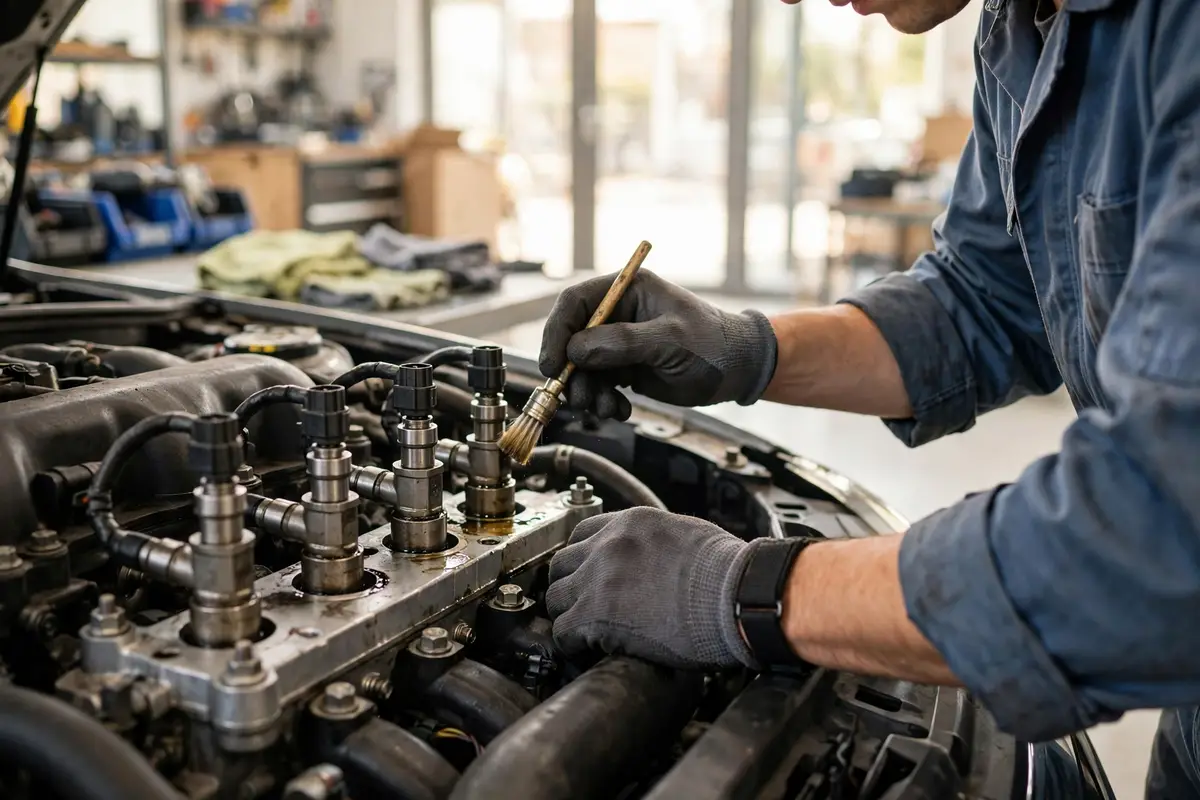
Two cars, same job, wildly different bills — that is the first thing to understand about fuel injectors. RepairPal's September 2026 estimates put a fuel injector replacement on a 2018 Honda Civic at $304 to $378 USD, and on a 2018 Toyota Camry at $1,023 to $1,251 USD. The Civic's injectors sit on top of the engine where a technician can reach them in minutes; the Camry's are buried under the intake manifold, and the parts cost far more. Before you compare any two injector quotes, you need to know which car the quote is for, how many injectors it covers, and whether the engine is port-injected or direct-injected — because those three facts decide almost the entire bill.
The national picture, from RepairPal's September 2026 estimate as reported by ThePricer and InsurancePanda, is $764 to $947 USD for a typical fuel injector replacement job, with parts of $464 to $507 and labour of $304 to $446. Converted at roughly 1.40 Canadian dollars to the US dollar, that is about $1,070 to $1,325 CAD for the average job. A second reading of the same RepairPal data, published by Accelerate Auto Repair in October 2026, gives $768 to $953 USD with parts of $464 to $507 and labour of $304 to $446 — the same estimate, a few dollars of rounding apart, which is reassuring rather than confusing. But the national average hides the real spread. MechanicRank, working from posted independent-shop prices in October 2026, puts one injector on a compact car at $220 to $930 USD and on a midsize sedan or small SUV at $245 to $1,020 USD, and notes that a V6 often buries its rear injectors under the intake manifold, which can double the labour. The per-injector rule of thumb from FuelInjectorReplacementCost.com is $150 to $350 USD for a port-injection injector, parts and labour included, and $350 to $700 USD for a direct-injection injector, because direct injectors work at far higher pressures and are built to tighter tolerances. Diesel injectors are a different class of part again, often $300 to $800 USD each, and many need coding or calibration after fitting.
Cleaning is where the money is usually saved — or wasted. CARFAX puts a typical professional injector cleaning at around $100 USD, ThePricer puts the 2026 professional range at $100 to $300 USD, and GarageMap's Calgary guide, working from published Canadian shop pricing, puts a standard professional cleaning at $120 to $200 CAD. A bottle of pour-in cleaner costs $5 to $15, and Fuel Injector Clinic charges $25 USD per port injector for off-car ultrasonic cleaning with a flow test, before removal, refitting and shipping. The decision rule is a test, not a guess: cleaning earns its money when the problem is deposits — a clogged or unevenly flowing injector that a flow test can prove — and it cannot fix a dead electrical coil, a cracked body, a leaking seal or an injector that failed its flow test after cleaning. Bosch's own gasoline-system documentation makes the same distinction: its ultrasonic cleaning process removes combustion residues from high-pressure injectors, but it is a service process, not a promise that a tank additive repairs a failing injector. If a shop recommends cleaning without a flow test, a misfire code or a symptom you can feel, it is selling maintenance, not a repair.
There is also a middle option most drivers never hear about: off-car ultrasonic cleaning with a flow test. The injectors come out, are cleaned ultrasonically, and are tested before and after so you can see the flow numbers improve. It costs more than an on-car flush and less than a new injector, and it makes the most sense on older engines with expensive injectors — a direct-injection set, for example, where replacement runs into four figures. On a port-injected four-cylinder with cheap injectors, replacement of the single bad one is often the simpler call.
If replacement is the answer, the quote needs to be read carefully. Ask whether it covers one injector or the full set, and whether the seals and O-rings are included. A full set multiplies the per-injector part cost by four, six or eight, but the labour barely moves, because the fuel rail is already off — so if two injectors are marginal, doing the set while the rail is off is often cheaper than coming back for the second one later. Reusing hardened O-rings on a new injector is a known cause of a fresh fuel leak, and a leak near a hot engine is a safety issue, not a nuisance. Direct-injection injectors may also need coding to the engine computer after fitting; Bosch's service documentation describes injector coding where required, and a quote that omits it is a quote that will grow. Finally, confirm the shop clears the codes and road-tests the car — a misfire that returns on the drive home means the diagnosis was incomplete, and the most expensive injector job is the one you pay for twice. For a model-specific price before you authorise anything, run your car through the RepairPrice calculator (calculator.php). And if the misfire turns out to be ignition rather than fuel, the companion guide Spark Plug Replacement Cost in Canada covers the other half of the misfire story, while Fuel Pump and Fuel Filter Replacement Cost covers the pump that feeds the injectors in the first place.
Common questions:
Q: Can fuel injectors be cleaned instead of replaced? A: Sometimes. ThePricer and RepairPal both draw the same line: if injectors are dirty or partially clogged, professional cleaning or a targeted fuel-system service may improve performance, and CARFAX puts that cleaning at around $100 USD. If an injector is leaking, electrically failing or mechanically damaged, cleaning usually will not fix it and replacement is more likely — RepairPal's September 2026 average for replacement is $764 to $947 USD.
Q: How much does it cost to replace one fuel injector? A: It depends heavily on the car. RepairPal's September 2026 figures are $304 to $378 USD for a 2018 Honda Civic and $1,023 to $1,251 USD for a 2018 Toyota Camry. The national average job is $764 to $947 USD, or roughly $1,070 to $1,325 CAD. Direct-injection injectors run $350 to $700 USD each, against $150 to $350 USD for port injection.
Q: How do I know if my injectors need cleaning or replacing? A: A flow test and an electrical test. The flow test shows whether an injector delivers fuel evenly, and the electrical test shows whether its coil is healthy. Cleaning is the answer for deposits proven by a flow test; replacement is the answer for a dead coil, an internal leak or a failed flow test after cleaning.
Q: Does fuel injector cleaner in the tank actually work? A: For mild deposits on port injectors, a $5 to $15 bottle of cleaner can help, and FuelInjectorReplacementCost.com credits cleaning with fixing about 60% of simple clogs. It will not fix a stuck injector, an electrical fault or a cracked body, and on direct-injection engines the fuel never washes the intake valves, so a tank additive has less to work with.
| Job | Typical range, independent shop | When it is the right fix |
|---|---|---|
| Fuel system cleaning, car | $120–$200 CAD | GarageMap Calgary; CARFAX ~$100 USD; ThePricer $100–$300 USD |
| Pour-in cleaner (DIY) | $5–$15 CAD | Mild deposits only; will not fix a dead coil or leak |
| Off-car ultrasonic cleaning + flow test | $25 USD per injector + labour | Fuel Injector Clinic; best on costly DI injectors |
| One injector, port injection | $210–$490 CAD | $150–$350 USD per injector, parts + labour |
| One injector, direct injection | $490–$980 CAD | $350–$700 USD per injector; may need coding |
| Average injector job (RepairPal) | $1,070–$1,325 CAD | RepairPal Sept 2026: $764–$947 USD; Civic $304–$378, Camry $1,023–$1,251 USD |
| Full set of injectors | Per-injector cost × count | Labour overlaps across the set; seals included? |




 RepairPrice
