
Fuel Pump and Fuel Filter Replacement Cost
By Oleksandr Potapenko · 2026-11-16 · How we research prices
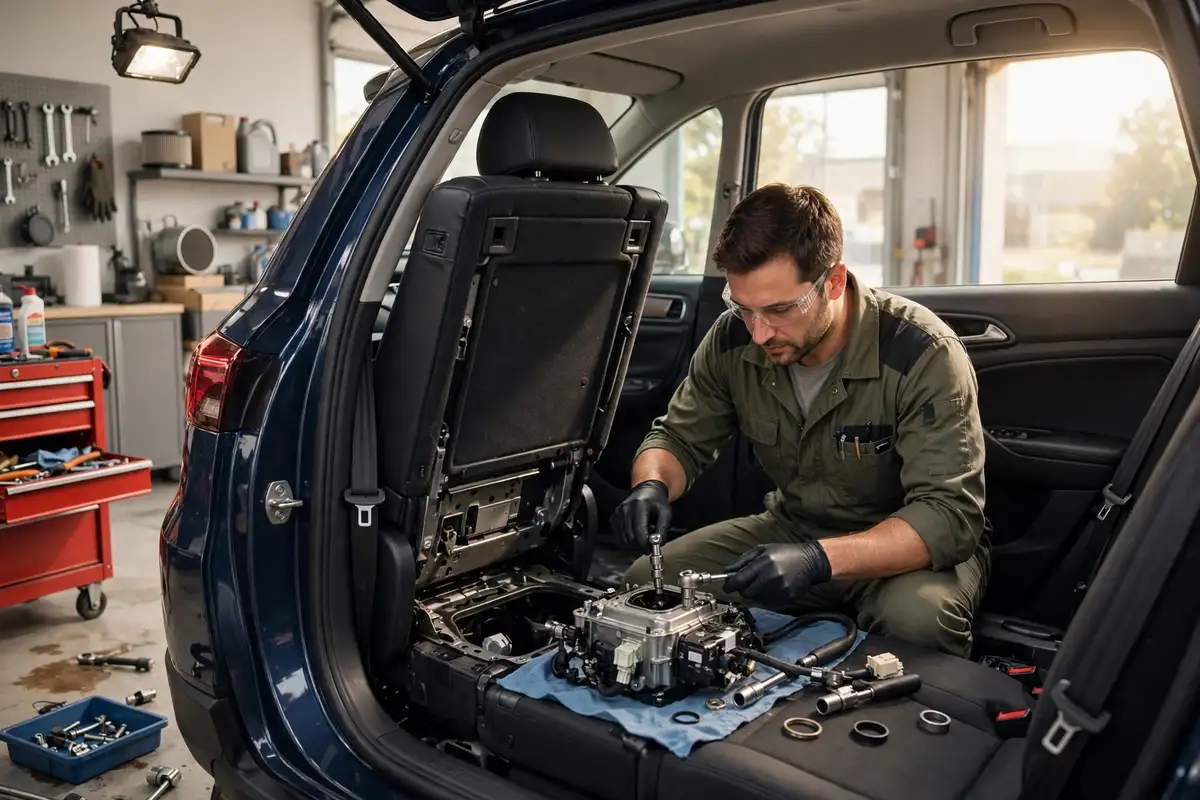
Before you approve a fuel pump replacement, ask the shop one question that can save you hundreds of dollars: did you check the relay? A fuel pump relay costs $30 to $120, according to the 2026 price survey published by Pulscar, and a failed relay makes a car behave exactly like a car with a dead pump — it cranks, it never catches, and nothing else looks wrong. The same survey puts a pump motor alone at $75 to $250 at AutoZone, which is why two quotes for the same job can sit hundreds of dollars apart: one shop is pricing a pump motor, the other a complete module. Knowing which one is on your quote is the single most useful thing you can do before you sign anything.
The honest answer to what a fuel pump costs in Canada is that the sources disagree, and the disagreement is informative rather than sloppy. RepairPal's national estimate, updated September 3, 2026, puts a complete fuel pump module job at $1,344 to $1,513 USD, with parts of $1,104 to $1,160 and labour of $241 to $353 — at roughly 1.40 Canadian dollars to the US dollar, that is about $1,880 to $2,120 CAD. Kelley Blue Book, by contrast, puts the same job at $390 to $900 USD, and AutoZone's professional-install figure is $400 to $600 USD. AAA, citing Consumer Affairs data, lands in the middle at $1,150 to $1,400 USD. The gap is not an error: RepairPal prices a complete original-equipment module with the sender and strainer, while KBB and AutoZone reflect aftermarket pump-only work on simpler cars. A 2002 Toyota Camry, for example, is $416 to $756 USD on RepairPal, while a 2017 Toyota Highlander is $1,549 to $1,703 USD — same job, different part, different decade. At a Canadian independent shop, a mainstream car with an aftermarket pump typically lands around $600 to $1,200 CAD, and a newer vehicle that needs the full original-equipment module lands around $1,800 to $2,300 CAD. Luxury and European cars run higher still; Pulscar's survey puts them at $1,400 to $2,500 USD.
Access is what moves the labour half of the bill. Many cars have an access panel under the rear seat, and the pump swaps out in about an hour. Others need the whole fuel tank drained, supported and lowered, which can double or triple the labour. That is why the same pump can cost $400 on one car and $1,500 on another, and why a shop that has done your exact model before can quote tighter than one that has not. The other half of the bill is the part itself: a full module assembly that bundles the pump with the fuel-level sender and strainer costs $400 to $900 USD on its own, per Pulscar, while a bare pump motor is far cheaper. Direct-injection cars add a second wrinkle — they have an engine-mounted high-pressure pump as well, and WarrantyChick.ca puts a high-pressure direct-injection pump replacement in Canada at $1,100 to $2,800 CAD, warning that if the pump sheds metal debris into the system the bill can pass $8,000 to $12,000 CAD for injectors, rails, lines and the tank. That is the nightmare scenario, and it is why a failing high-pressure pump is not a job to postpone.
The fuel filter is the quieter half of this guide, and its story is mostly about how cars changed. Older cars have a serviceable in-line filter, and a filter replacement at a Canadian independent shop runs roughly $105 to $185 CAD — the filter itself is $30 to $80 and the job takes under an hour. Auto Service Kingston, a Kingston, Ontario shop, recommends changing it every 48,000 kilometres or every two years, whichever comes first, and Honda's own owner's manual for older models specifies every four years or 96,000 km. Most modern cars, though, have the filter inside the tank as part of the pump module, where it is effectively a lifetime part — Autodiagly's 2026 guide puts in-tank filter life at 100,000 miles or more, with an inspection at 60,000 to 80,000 miles if fuel quality is suspect. The rule that follows from all of that is simple: if your car has a serviceable filter, change it on schedule, because a clogged filter starves the pump and can kill a $1,000 part to save a $50 one; if your filter lives in the tank, replace it whenever the pump comes out, because the labour is already paid for and a new filter costs almost nothing while the tank is open.
The decision rule for the pump itself is a pressure test, not a symptom list. Long cranking, sputtering under load, a whining noise from the rear and stalling at speed all point at the pump, but a clogged filter, a weak relay and a dying pump feel almost identical from the driver's seat. A good shop checks fuel pressure with a gauge, tests the relay and wiring first, and gives you the pressure reading against the factory specification for your model. Pulscar's survey puts typical pump service life at 100,000 to 150,000 miles, so on a car past that mileage a weak pump is a plausible diagnosis rather than a surprise. If the quote comes back, ask whether it includes a new tank seal and a new filter — both are cheap while the tank is open, and a reused seal is a leak waiting to happen. And if the car is a mainstream sedan and the quote is at the top of the module range, get a second opinion: the difference between an aftermarket pump and an original-equipment module is real, but so is the difference between a fair price and a padded one. For a model-specific check, run your car through the RepairPrice calculator (calculator.php) and compare the result with the written quote before you authorise the work. If the pump is only one of several fuel-system problems, the companion guide Fuel Injector Replacement and Fuel System Cleaning Cost covers the next most common repair, and EVAP System Leak: Repair Cost in Canada covers the vapour-system faults that often share the same symptoms.
Common questions:
Q: How long does a fuel pump last? A: Pulscar's 2026 survey of service data puts typical fuel pump life at 100,000 to 150,000 miles. Pumps cooled by the fuel around them last longer, which is why keeping the tank above a quarter full is the cheapest pump maintenance there is — running near empty regularly lets the pump overheat.
Q: Can a bad fuel filter cause the same symptoms as a bad fuel pump? A: Yes, and that is exactly why the two are diagnosed together. A clogged filter causes hesitation under acceleration and stumbling at high speed, just like a weak pump. A fuel pressure test separates them: a filter problem shows up as low pressure under load, and a filter costs $105 to $185 CAD to replace where it is serviceable, against $600 to $2,300 CAD for a pump.
Q: Is it worth replacing the fuel filter when the pump is replaced? A: Yes, every time. If the filter is in the tank with the pump, the labour is already paid for, and the filter itself is a small part of the bill. If the filter is a separate in-line part, it is still cheap insurance against debris reaching a brand-new pump.
Q: Why is my fuel pump quote so much higher than the one my friend got? A: Usually one of three things: your car needs the tank dropped while theirs has an access panel under the rear seat, your quote is for a complete original-equipment module while theirs was an aftermarket pump motor, or your car is a direct-injection model with a second high-pressure pump. Ask the shop which of those applies — the answer should be specific, not vague.
| Job | Typical range, independent shop | What moves the price |
|---|---|---|
| Fuel pump, aftermarket, car | $600–$1,200 CAD | Access panel vs tank drop; KBB $390–$900 USD |
| Fuel pump, OEM module, newer car | $1,800–$2,300 CAD | RepairPal $1,344–$1,513 USD; parts $1,104–$1,160 USD |
| Fuel pump, SUV/truck | $700–$1,500 CAD | Tank size and access; RepairPal Highlander $1,549–$1,703 USD |
| Fuel pump, luxury / European | $1,900–$3,400 CAD | Pulscar $1,400–$2,500 USD; dealer adds 20–40% |
| High-pressure DI pump | $1,100–$2,800 CAD | WarrantyChick.ca; debris damage can exceed $8,000 CAD |
| Fuel filter (where serviceable), car | $105–$185 CAD | Filter $30–$80 + ~0.8 h; every 48,000 km / 2 years |
| Pump relay (the cheap mimic) | $30–$120 USD part | Check first — a dead relay fakes a dead pump |


 RepairPrice
