
EV Battery Degradation: What It Costs and How to Slow It
By Oleksandr Potapenko · 2026-11-16 · How we research prices
The number that should calm every EV owner down is 2.3 percent. Geotab's 2025 battery health study, the largest real-world dataset ever published, tracked more than 22,700 electric vehicles across 21 models and found an average capacity loss of 2.3 percent per year. At that rate, the average battery retains about 81.6 percent of its original capacity after eight years, comfortably above the 70 percent threshold most warranties use. The study also found that the rate is not fixed. Cars that charged mostly on low-power AC chargers degraded at around 1.5 percent a year. Cars that used DC fast charging for more than 12 percent of their sessions degraded at around 2.5 percent a year, and cars that frequently fast-charged above 100 kilowatts degraded at up to 3.0 percent a year. Hot climates added about 0.4 percentage points a year. In other words, degradation is real, it is slow, and your charging habits move it more than your car's age does.
The first distinction to make is between degradation and winter range loss, because they feel identical from the driver's seat and they are not the same thing. Cold weather cuts range temporarily: Recurrent's analysis of more than 30,000 vehicles found that at 0 degrees Celsius, EVs retain about 78 percent of their maximum range on average, and at minus 7 degrees that drops to roughly 70 percent. That range comes back when the battery warms up. Degradation is permanent capacity loss over years, and it does not come back. A car that loses 30 percent of its range on a minus 20 morning in Edmonton has not lost 30 percent of its battery; it has a cold battery. If you are shopping for a used EV in Canada, that distinction is worth money, because sellers sometimes present a cold-weather range reading as a degraded battery, and buyers sometimes walk away from a healthy car for the same reason. Get a proper state-of-health reading before you judge any pack.
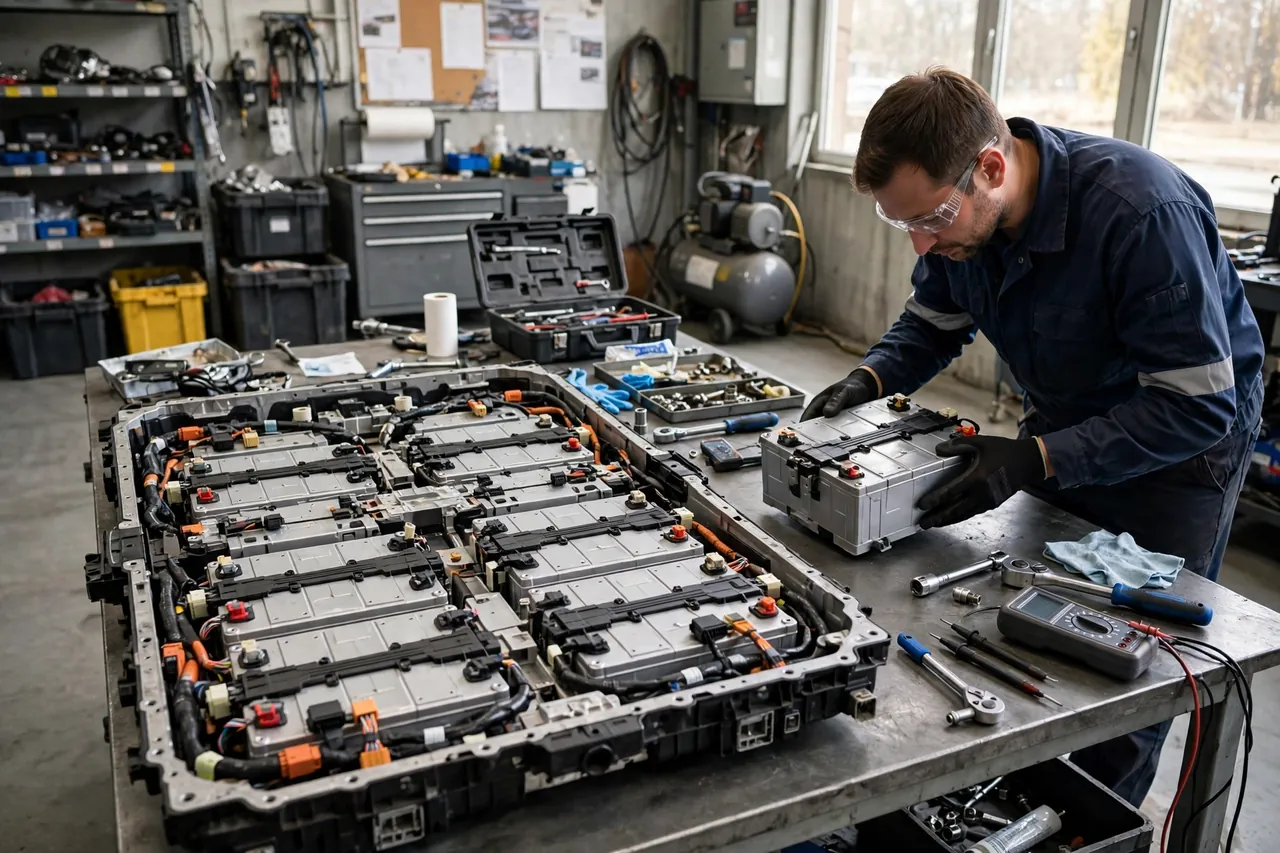
What does degradation actually cost? For most owners, nothing, for a long time. Most EV batteries are warranted for eight years or 160,000 kilometres against falling below about 70 percent capacity, and Geotab's data says the average pack is still at about 82 percent after eight years, well inside warranty. The routine costs of owning an EV are small: $150 to $400 a year for tire rotations, cabin filter, brake fluid, and inspection. The one battery most EV owners actually replace is the 12-volt battery, $170 to $305 installed in Canada, which is the most common cause of an EV that will not start. A diagnostic scan that reads battery health data costs $95 to $150. If a pack does fail outside warranty, the options are a single failed module at $2,000 to $6,000, a used or rebuilt pack for under $10,000 in suitable cases, or a new automaker pack at $15,000 to $45,000 Canadian at a dealership, depending on the model, according to Canadian reporting in The Province summarised by a 2026 Canadian guide. A full pack is the worst realistic case, not the typical one, and module-level repair is the option to ask about first.
Chemistry matters more than most buyers realise. LFP, or lithium iron phosphate, packs tolerate more than 2,000 full charge cycles before reaching 80 percent capacity, which translates to well over 500,000 kilometres for most packs, and they tolerate being charged to 100 percent far better than NMC or NCA packs. That is why the Tesla Model 3 rear-wheel-drive, the Ford Mustang Mach-E Select, and the base Chevrolet Equinox EV use LFP: the manufacturer can tell owners to charge to 100 percent without the usual warning. NMC and NCA packs, used in most long-range models, prefer a daily charge limit of 80 percent and degrade faster when parked at 100 percent for long periods. Geotab's data adds a nuance that surprises people: wide daily state-of-charge swings made little practical difference, and degradation only accelerated meaningfully when a vehicle spent more than 80 percent of its total time at extreme states of charge, below 20 percent or above 80 percent. The habit that hurts is not driving from 20 to 80 percent; it is leaving the car parked at 100 percent for days, or parked near empty for weeks.
Slowing degradation is mostly a matter of charging habits, and the habits are free. Charge at home on Level 2 AC power for daily use, and save DC fast charging for road trips; the difference between 1.5 and 2.5 percent a year is the difference between a pack at 88 percent and a pack at 82 percent after eight years. Set the daily charge limit to 80 percent on NMC and NCA cars, and charge to 100 percent only before a long trip, then drive soon after. Avoid parking at 100 percent or near zero for days at a time. In summer heat, park in shade where you can, since hot climates add about 0.4 percentage points a year. None of this requires spending money. What does cost money is the check that matters when buying used: a battery state-of-health reading and an independent inspection before you buy, which is the cheapest insurance against a degraded pack. For the charging costs behind these habits, see EV Charging Costs in Canada: Home vs Public, and for the maintenance schedule, Electric Car Maintenance Cost in Canada. For what a full pack replacement would cost if you ever needed one, see EV Battery Replacement Cost in the USA, and run any quote through the RepairPrice calculator (calculator.php).
Common questions:
Q: How fast does an EV battery degrade? A: About 2.3 percent of capacity per year on average, according to Geotab's 2025 study of more than 22,700 vehicles. That implies roughly 82 percent capacity remaining after eight years. Cars charged mostly on AC power degrade at around 1.5 percent a year, while frequent high-power DC fast charging pushes the rate to around 3.0 percent.
Q: How long will an EV battery last? A: Modern packs are engineered to last 15 to 20 years before reaching end-of-useful-life thresholds, and most retain 80 to 90 percent of capacity at 160,000 kilometres. LFP packs tolerate more than 2,000 full cycles, or well over 500,000 kilometres.
Q: Does cold weather permanently damage an EV battery? A: No. Cold weather cuts range temporarily, about 22 percent at 0 degrees and 30 percent at minus 7 degrees according to Recurrent's 30,000-vehicle analysis, but the range returns when the battery warms. Permanent degradation is a separate, much slower process driven mainly by fast charging, heat, and time spent at extreme charge levels.
Q: What does EV battery degradation cost to fix? A: Usually nothing, since most packs are warranted for 8 years or 160,000 kilometres against falling below 70 percent capacity. Outside warranty, a single failed module costs $2,000 to $6,000 Canadian, a used or rebuilt pack under $10,000 in suitable cases, and a new dealer pack $15,000 to $45,000 depending on the model.
| Item | Typical range (CAD) | Notes |
|---|---|---|
| Routine EV maintenance, per year | $150–$400 | Rotations, cabin filter, brake fluid, inspection |
| Battery health (SOH) diagnostic scan | $95–$150 | Reads battery health data; essential before buying used |
| 12-volt battery replacement, car | $170–$305 | The most common EV no-start cause |
| Single failed module repair | $2,000–$6,000 | When only one module has failed |
| Used or rebuilt pack, installed | Under $10,000 | In suitable cases; far below a new dealer pack |
| New dealer pack, full replacement | $15,000–$45,000 | Depends on model; worst realistic case, not typical |




 RepairPrice
