
High Oil Consumption: Causes and Repair Cost in Canada
By Oleksandr Potapenko · 2026-11-16 · How we research prices
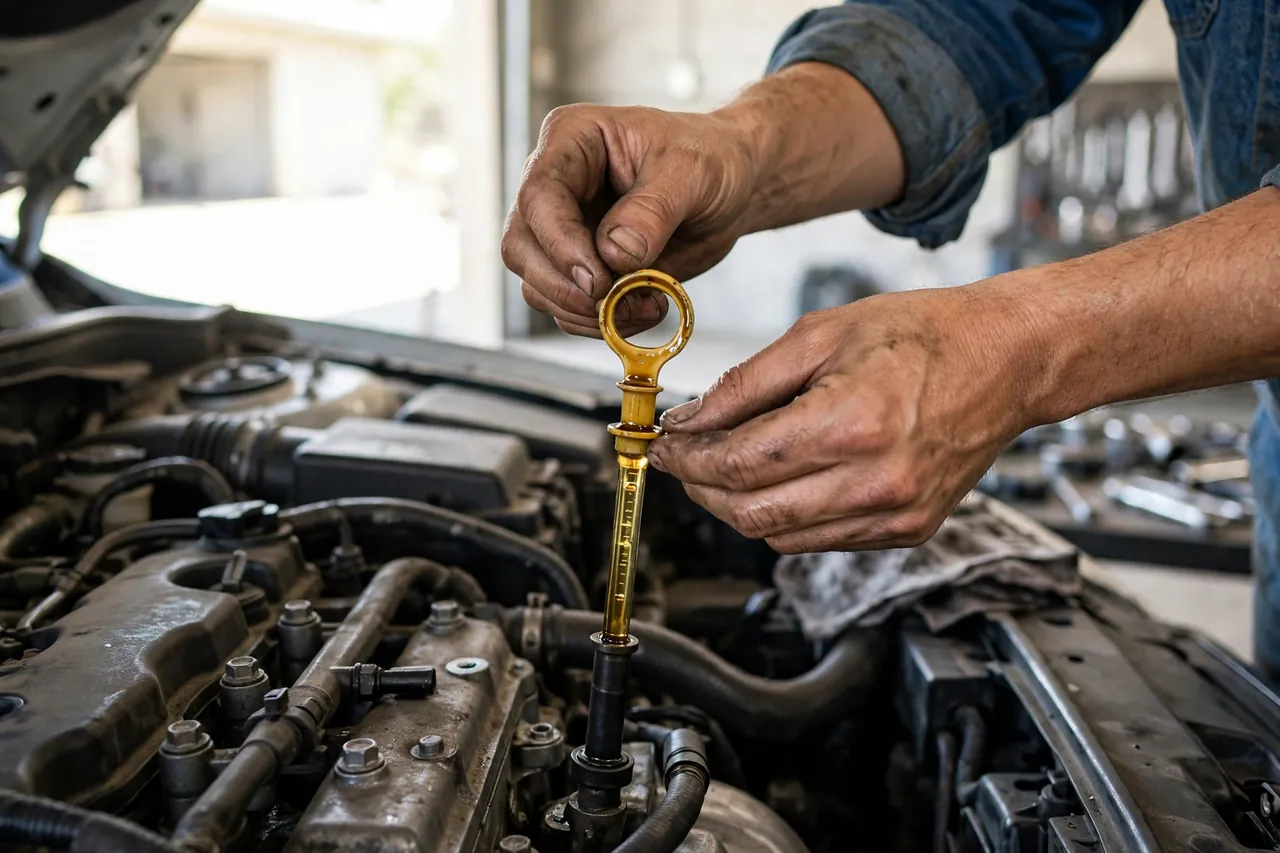
Start with a number, because everything about oil consumption is a number. Most manufacturers consider up to one quart, about one litre, of oil every 1,500 to 2,000 miles acceptable. More than a quart every 1,000 miles is excessive, and more than a quart every 750 miles is a red flag that needs a diagnosis, not another litre of top-up oil. The first job is to work out whether the engine is burning oil or leaking it, because the two have different evidence and very different prices. A leak leaves evidence: dark spots under the car, a wet and grimy engine, or the smell of oil cooking on a hot exhaust manifold. Burning oil leaves different evidence: blue-grey smoke from the tailpipe on startup or under acceleration, and a dipstick that drops steadily with no puddle underneath. In Canadian winters the problem often shows up first in January, when cold starts are hardest on seals and short trips never let the engine fully warm up.
The common causes split into cheap and expensive, and the order you check them in is the whole game. A stuck PCV valve, the small valve that vents crankcase fumes, can push oil past seals and into the intake, and replacing it runs $70 to $125 in Canada for an easy-access valve; TheMotorGuy puts a straightforward valve at $50 to $150 US installed, $100 to $250 US with hoses, and $200 to $450 US when the valve is buried under the intake manifold. Leaking gaskets are the next step up: a valve cover gasket costs $400 to $650 to replace, and an oil pan gasket runs $550 to $900. The expensive causes live inside the engine itself: worn piston rings, worn valve stem seals, or scored cylinder walls, all of which let oil into the combustion chamber. CarTreatments puts valve stem seal replacement at $700 to $1,500 US and piston ring repair at $1,800 to $5,000 US on a typical domestic car, with European and luxury cars higher, which converts to roughly $1,000 to $2,150 Canadian for valve seals and $2,575 to $7,150 Canadian for rings at 1.43 Canadian dollars per US dollar; the Canadian working ranges are $800 to $2,500 for valve seals, $3,000 to $8,000 for piston rings, and $5,000 to $15,000 or more for an engine replacement. AutoChimps puts valve seals at $1,000 to $1,500 US and a rebuild at $3,000 or more, which sits inside the same bands. Turbocharged engines add one more suspect, a worn turbo seal, which can drink oil quickly and without much warning, and that job is covered in Turbocharger Replacement Cost in Canada. The symptom pattern narrows the cause before any wrench turns: a puff of blue smoke on cold start that clears after a few seconds points to valve stem seals, because oil drips down the valve guides while the car sits. Blue smoke on acceleration points to piston rings, because the rings cannot seal under load. Constant blue smoke points to a bigger internal problem, and oil in the intake points to the PCV valve or the turbo.
Diagnosis should come before parts, and the most useful diagnostic tool costs nothing: a log. Keep a simple log for two weeks: date, kilometres, and how much oil you added. That log tells a mechanic more than a vague description, and it protects you from a quote for work the car does not need. A shop should also do a diagnostic scan at $95 to $130, which shows misfires or sensor faults that point at where the oil is going, and a compression or leak-down test before quoting internal work; FIXD puts that diagnostic test at $120 to $200 US. Ask the shop to clean the engine and add UV dye if a leak is suspected. A dye test makes a slow seep visible in one visit instead of three. Check for open recalls or goodwill repair programs before you pay anything: several manufacturers have extended coverage for known oil consumption faults, including carbon on piston rings and oil separator failures, and a documented oil consumption test from the main dealer is the basis for any claim. That test is usually a measured top-up over 1,000 km, and it is worth doing before authorizing a $3,000 ring job.
The honest math is that topping up is often the right answer for an older car. A full synthetic oil change costs $100 to $150, a conventional change $80 to $120, and a litre of top-up oil between changes is far cheaper than opening an engine. But there is a line: if the car burns through oil fast enough that the low-oil light ever comes on, or if blue smoke is constant rather than a puff at startup, the engine is heading for damage that costs far more than the oil. At the far end, a major engine rebuild runs $3,875 to $6,750, which is the number to keep in mind when deciding whether to repair, keep topping up, or move the car on. The same decision framework is laid out in Engine Rebuild vs Replace: The Decision in Canada. Check the dipstick every second fuel fill, use the viscosity in the owner's manual, and never let the level fall below the minimum mark. The RepairPrice calculator (calculator.php) will price the likely repair for your exact car once you know which cause you are dealing with.
Common questions:
Q: How much oil consumption is normal? A: Up to about one litre every 1,500 to 2,000 miles is considered acceptable by most manufacturers. More than a litre every 1,000 miles is excessive and should be investigated.
Q: What causes an engine to burn oil? A: The common causes are a stuck PCV valve, worn valve stem seals, worn or stuck piston rings, scored cylinder walls, and worn turbo seals. Blue smoke on startup points to valve seals, blue smoke on acceleration points to rings.
Q: How much does it cost to fix an oil-burning engine? A: It depends on the cause: $70 to $125 for a PCV valve, $400 to $650 for a valve cover gasket, $550 to $900 for an oil pan gasket, $800 to $2,500 for valve stem seals, $3,000 to $8,000 for piston rings, and $5,000 to $15,000 or more for an engine replacement in Canada (CarTreatments: valve seals $700 to $1,500 US, rings $1,800 to $5,000 US).
Q: Is it cheaper to keep topping up oil than to repair it? A: Often, yes, on an older car. A litre of top-up oil is far cheaper than opening an engine. But if the low-oil light ever comes on, or blue smoke is constant, the engine is heading for damage that costs far more than the oil.
| Service | Typical range (CAD) | Notes |
|---|---|---|
| Diagnostic scan | $95–$130 | Misfires and sensor faults point at the cause |
| PCV valve replacement | $70–$125 | Cheap fix — check this first |
| Valve cover gasket | $400–$650 | Common external leak |
| Oil pan gasket | $550–$900 | Leak underneath the engine |
| Valve stem seal replacement | $800–$2,500 | Blue smoke on cold start |
| Piston ring repair | $3,000–$8,000 | Blue smoke on acceleration |
| Oil change, full synthetic | $100–$150 | Required by most cars built in the last decade |
| Major engine rebuild | $3,875–$6,750 | Worn rings or scored cylinders — the far end |


 RepairPrice
