
Diesel DPF: Regeneration, Cleaning and Replacement Cost
By Oleksandr Potapenko · 2026-11-16 · How we research prices
The first fix for a diesel particulate filter is free, and it is driving. When the DPF warning light comes on, take the car for a steady 30 to 40 minute highway run at highway speed, and in many cases the filter cleans itself: the exhaust gets hot enough to burn the trapped soot to ash, the light goes out, and the bill is zero. That is not folk wisdom. HD Diesel Supply, a Canadian diesel specialist, gives exactly the same advice, and every source we checked agrees that a diesel that regularly sees the highway keeps its filter clean by itself. The whole guide below is an escalation ladder, and the point of the ladder is that each step up costs roughly ten times the one before it, so the cheapest DPF repair is the one you do with your right foot.
If the light stays on, or the car is already in limp mode with almost no power, the next step is a forced regeneration at a shop, where a scan tool tells the engine to run a cleaning cycle. HD Diesel Supply puts a forced regen at about $250 in Canada, and SuncentAuto's 2026 cost guide puts forced regeneration at $200 to $450 in Canadian dollars. A diagnostic scan to read the soot load and fault codes runs $95 to $150. The scan matters, because the numbers tell the shop whether the filter can still be saved: AnswersByExpert reports that a clean filter reads 15 to 25 millibars of back-pressure, a clogged one reads 100 millibars or more, and a filter reading over 200 millibars at load is a strong candidate for cleaning, while a filter still below 100 millibars may not warrant the cost at all. Ask the shop for the reading, not just a verdict, because it is the difference between a $250 regen and a $3,000 replacement.
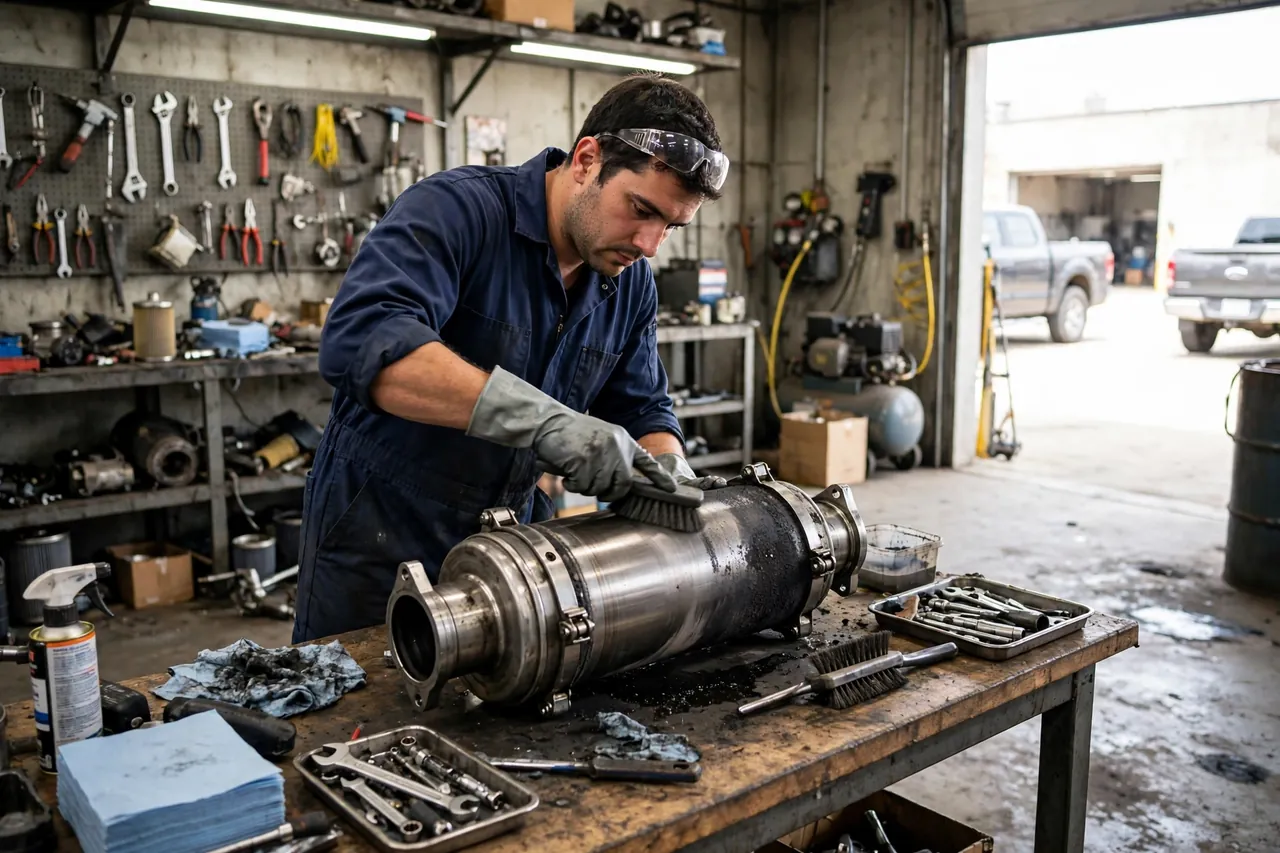
That $250 to $3,000 jump is the cost cliff this guide exists to warn you about. HD Diesel Supply puts it bluntly: ignoring the light turns a $250 forced regen into a $3,000 filter replacement, and the number one cause of DPF replacements it sees is people doing nothing for weeks after the warning light. Once the filter is beyond regeneration, it needs professional off-vehicle cleaning, where the filter is removed, baked in a thermal oven or ultrasonically cleaned, and flow-tested. Axle Spindle Repair in Mississauga, Ontario, prices professional DOC and DPF cleaning at $350 to $500. HD Diesel Supply puts thermal cleaning at $300 to $500 in Canada. Express Truck Lube in Cornwall, Ontario, charges $350 to $650 per filter for off-vehicle cleaning with flow testing. SuncentAuto's 2026 guide puts professional cleaning at $500 to $1,100 in Canadian dollars, with $400 to $600 as the median to budget for, and the higher end covering removal and reinstallation on larger vehicles. The differences between those sources come down to what is included: cleaning alone is $300 to $500, while cleaning plus removal, gaskets and refitting pushes the total toward $600 or more, so always ask whether the quote includes removal and reinstallation.
If the filter is cracked, melted or its substrate is damaged, no cleaning saves it, and the bill gets serious. Axle Spindle Repair puts a full DPF replacement at $2,500 to $10,000 or more depending on the truck, its make and model and the filter type. HD Diesel Supply puts OEM filters at $2,000 to $4,000 depending on the truck. SuncentAuto puts replacement at $2,500 to $8,000 or more, with heavy-duty trucks at the top. On a passenger diesel car the replacement usually lands at the bottom of that range, $2,500 to $4,500, and on a heavy truck it can pass $10,000. At that point the decision is no longer about the filter, it is about the vehicle: on an older diesel worth less than the repair, a replacement filter can cost more than the car is worth, and that is a conversation to have before approving the work, not after. Use the RepairPrice calculator (calculator.php) to check the total against the fair range for your vehicle before you commit.
Prevention is mostly about driving pattern and oil. A diesel that only does short city trips will keep coming back with the same light, because the exhaust never gets hot enough to regenerate, and if your driving is all short trips, a diesel was probably the wrong choice, a decision to make before buying, not after the light comes on. Heavy-duty trucks need cleaning every 200,000 to 250,000 kilometres, according to Axle Spindle Repair, and every 200,000 to 300,000 kilometres according to Express Truck Lube, with severe service needing it as early as 100,000 to 150,000 kilometres. The wrong engine oil also matters more on a diesel than on a gas car: oil that is not low-ash creates ash the filter cannot burn off, and ash is what eventually kills a DPF for good. Two related parts are worth knowing about, because they feed the filter: worn glow plugs make cold starts harder and regeneration less reliable, covered in Diesel Glow Plug Replacement Cost in Canada, and a stuck EGR valve fills the filter faster than it can clean itself, covered in EGR and PCV Valve Replacement Cost. A clogged filter also strains the turbo, and a turbocharger replacement on an SUV or truck is a bill of its own, covered in Turbocharger Replacement Cost in Canada.
One warning that needs to be said plainly: removing or deleting the DPF is illegal in Canada. Express Truck Lube states it directly, that removing or disabling emissions aftertreatment is illegal under federal environmental law and provincial highway safety regulations, and non-compliant vehicles can be fined and taken out of service. Fuel additives can help with light buildup only, according to HD Diesel Supply, and they cannot fix a clogged filter. If a shop offers you a delete, walk away, because the fine and the failed inspection will cost more than the cleaning ever would.
Common questions:
Q: How often does a DPF need cleaning? A: Heavy-duty trucks typically need cleaning every 200,000 to 250,000 kilometres, according to Axle Spindle Repair in Mississauga, and every 200,000 to 300,000 kilometres according to Express Truck Lube in Cornwall. Severe-service trucks may need it every 100,000 to 150,000 kilometres. Passenger diesels vary more, and the warning light and soot-load reading matter more than the odometer.
Q: Can I clean a DPF myself? A: You can help it with a highway drive and, for light buildup only, with fuel additives, according to HD Diesel Supply. Proper cleaning is thermal baking or ultrasonic cleaning off the vehicle, followed by flow testing, which needs specialist equipment, and additives cannot fix a clogged filter.
Q: Is DPF delete legal in Canada? A: No. Removing or disabling emissions aftertreatment is illegal under federal environmental law and provincial highway safety regulations, according to Express Truck Lube, and non-compliant vehicles can be fined and taken out of service.
Q: What happens if I ignore the DPF warning light? A: The filter keeps filling, the car eventually goes into limp mode with almost no power, and the repair escalates from a $250 forced regeneration to a $3,000 replacement, according to HD Diesel Supply. A clogged filter also strains the turbo and the engine, so ignoring the light is the most expensive option.
| Service | Typical range (CAD) | Notes |
|---|---|---|
| Highway regeneration drive | $0 | 30–40 minutes at highway speed |
| Forced regeneration | $200–$450 | Scan tool at a shop; about $250 per HD Diesel Supply |
| Diagnostic scan | $95–$150 | Reads DPF soot load and fault codes |
| Professional thermal cleaning | $350–$650 | Off-vehicle, with flow test |
| DPF replacement, car | $2,500–$4,500 | OEM filter; cracked substrate cannot be cleaned |
| DPF replacement, truck | $2,500–$10,000+ | Axle Spindle Repair, Mississauga ON |


 RepairPrice
