
Buying a Used EV in Canada: The Checklist
By Oleksandr Potapenko · 2026-11-16 · How we research prices
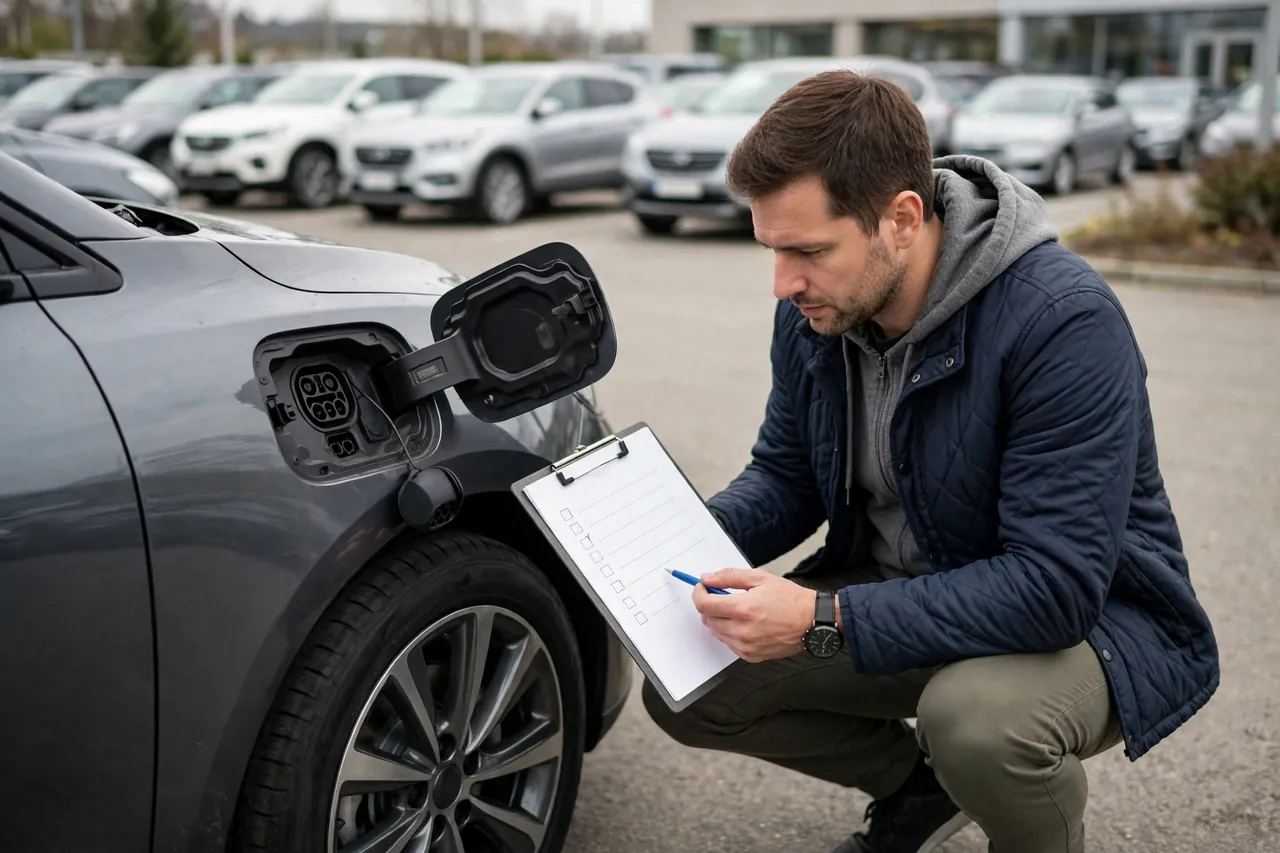
Here is the number that decides whether a used EV is a bargain or a bill: the battery's state of health, the share of its original usable capacity that is left. Everything else about a used EV is simple — no engine, no transmission, no exhaust, and routine EV maintenance runs only $150 to $400 a year. The battery is the one component that decides the car's real value, and the data on how batteries age is better than the horror stories suggest. Geotab's April 2026 telematics study of about 22,700 EVs across 21 models found average capacity loss of about 2.3% a year, projecting to about 81.6% of original capacity after eight years. Cars charged mostly on low-power AC degraded at about 1.5% a year; cars that used DC fast charging for more than 12% of sessions degraded at about 2.5% a year, and frequent high-power charging above 100 kW pushed that to about 3.0%. Hot climates added about 0.4 points a year. And the chemistry matters more than most buyers realize: ThinkEV's 2026 analysis puts LFP packs at 1% to 1.5% degradation a year against 2% to 3% for NMC packs, making a used LFP car — a standard-range Model 3, for example — the most underpriced variable in the Canadian used-EV market.
The first rule follows directly from those numbers: never buy a used EV without a battery health reading, and never trust the range number on the dashboard. The dashboard range is an estimate that moves with temperature, driving style and software. State of health is the underlying truth about the cells. Ask the seller for a state-of-health report — Recurrent generates one from the VIN, comparing the car against thousands of similar vehicles — and verify it yourself with a diagnostic scan, which runs $95 to $130 and reads the battery data directly from the car. As a yardstick, UK tester Generational's data from more than 8,000 used EV tests puts the median state of health at 93.5% for four-to-five-year-old cars and 85% for eight-to-nine-year-old cars. A three-year-old car in the low 90s is normal. A five-year-old car at 78% is not normal, and it should be priced like a car with a worn-out engine — because that is what it is. If the seller cannot show you a battery health report, budget for the scan and a pre-purchase inspection before you agree on a price: $95 to $130 plus $140 to $195 is cheap compared with buying a car whose battery is already done.
The second rule is to know what a bad battery actually costs, because the headline number is the ceiling, not the median. The Province's Canadian reporting puts new automaker battery modules at about $15,000 for some Nissan Leaf models, just under $30,000 for Chevrolet Bolt and Tesla Model S and X, and about $45,000 for some Hyundai and Kia models. Those are the worst realistic cases for a car with no warranty left. The realistic cases are far smaller: a single failed module costs $2,000 to $6,000 at an independent shop or dealer, according to Charge News Canada, and ThinkEV puts a module swap on a Bolt-class pack at roughly $2,000 to $4,000. A used pack from a recycler runs about $6,500 installed, per The Province. Recurrent's invoice-based data puts a Tesla Model 3 pack replacement at roughly $15,800 all-in, and a standard-range Model 3 with the cheaper LFP chemistry at $9,000 to $12,000. And outright failure is rare: Recurrent's data from more than 30,000 connected vehicles puts battery replacement at under 4% of EVs across all years and models — about 8.5% for first-generation cars, about 2% for second-generation, and just 0.3% for modern EVs from 2022 onward. The fear is priced into used EVs; the failure rate is not.
The third rule is to check the warranty clock, because it is the safety net that makes the whole purchase work. Every EV sold new in Canada carries a traction-battery warranty of at least 8 years or 160,000 km, and most manufacturers cover replacement only if the pack falls below a stated capacity threshold, typically 70% of original. A pack at 71% is technically within spec even if it ruins your Vancouver-to-Kelowna trip, so do not count on the warranty for gradual degradation — count on it for defects and sudden failure. Recall replacements reset the clock: Chevrolet Bolt vehicles that received a recall battery get a fresh 8-year, 160,000 km warranty from the installation date, so a 2019 Bolt with a 2022 recall pack is effectively warranted on that pack until 2030 — one of the best used-EV warranty propositions on the market. Ask whether the car has had any battery-related recalls or software updates, and confirm the warranty transfers to you.
Then do the normal used-car checks, which still matter. A pre-purchase inspection runs $140 to $195 and covers the suspension, brakes, tires and body — all the parts an EV shares with a gas car — and our guide "How Much Does a Pre-Purchase Inspection Cost in Canada?" explains what it should include. Look at the tires: a set of four new tires installed runs $595 to $1,230, and EVs wear them faster, so worn tires are a real negotiating point — see "Why EVs Wear Tires Faster (and What It Costs)". Check the 12-volt battery: replacing it runs $170 to $305, and it is the most common EV no-start cause. And budget for the non-battery failures that actually happen out of warranty: documented Tesla owner invoices put heat pump and air conditioning compressor replacements at $2,400 to $4,500, and a main screen at $1,000 to $2,200. One piece of good news for Canadian buyers: cold is kind to batteries. Geotab's data shows hot climates age packs faster, so a car that spent its life in Edmonton or Winnipeg is a better battery bet than the same car from Phoenix — the winter range loss you feel on a test drive is temporary, not degradation. Check the charging cables and both charge-port covers are present, confirm the home-charging setup cost in "EV Charger (Level 2) Installation Cost in Canada" and the running costs in "EV Charging Costs in Canada: Home vs Public", and if the battery checks out, the rest of the car is the easy part.
Common questions:
Q: How much battery degradation is normal on a used EV? A: Geotab's 2026 study of about 22,700 EVs found average loss of about 2.3% a year, projecting to about 81.6% of original capacity after eight years. Cars charged mostly at home on AC degraded at about 1.5% a year, while heavy DC fast charging pushed it to 2.5% to 3.0%. A three-year-old car in the low 90s is normal; below 80% on a five-year-old car is a red flag.
Q: What does it cost to replace an EV battery in Canada? A: A full new pack at a dealer runs $15,000 to $45,000 CAD depending on the model (The Province): about $15,000 for some Leafs, just under $30,000 for Bolt and Model S/X, about $45,000 for some Hyundai and Kia models. But most failed packs are repaired, not replaced — a single module costs $2,000 to $6,000 (Charge News Canada), and a used pack runs about $6,500 installed.
Q: How long is the EV battery warranty in Canada? A: At least 8 years or 160,000 km on every EV sold new in Canada, covering replacement if the pack falls below a stated capacity threshold, typically 70% of original. Recall replacements reset the clock — a 2019 Bolt with a 2022 recall pack is warranted until 2030.
Q: Should I get a pre-purchase inspection on a used EV? A: Yes, and it must include a battery state-of-health reading. A diagnostic scan runs $95 to $130 and a pre-purchase inspection $140 to $195. An inspection that skips the battery is not an EV inspection.
| Check | Typical range (CAD) | Notes |
|---|---|---|
| Pre-purchase inspection, car | $140–$195 | Suspension, brakes, tires, body |
| Diagnostic scan (battery state of health), car | $95–$130 | Reads battery health data — never skip this |
| 12-volt battery replacement, car | $170–$305 | The most common EV no-start cause |
| New tires, set of 4 (installed), car | $595–$1,230 | EVs wear tires faster — a negotiating point |
| Cabin air filter, car | $55–$95 | Neglect tells you how the car was treated |
| Routine EV maintenance, per year | $150–$400 | Rotations, cabin filter, brake fluid, inspection |
| Single battery module repair (independent shop) | $2,000–$6,000 | Charge News Canada — most failed packs are repaired, not replaced |
| Used battery pack, installed (recycler) | ~$6,500 | The Province — warranty typically 90 days to 1 year |
| Full new pack, dealer (worst case) | $15,000–$45,000 | The Province — Leaf ~$15,000; Bolt and Model S/X just under $30,000; some Hyundai/Kia ~$45,000 |


 RepairPrice
