
Car Won't Start in the Cold: Winter Causes and Fixes
By Oleksandr Potapenko · 2026-11-16 · How we research prices
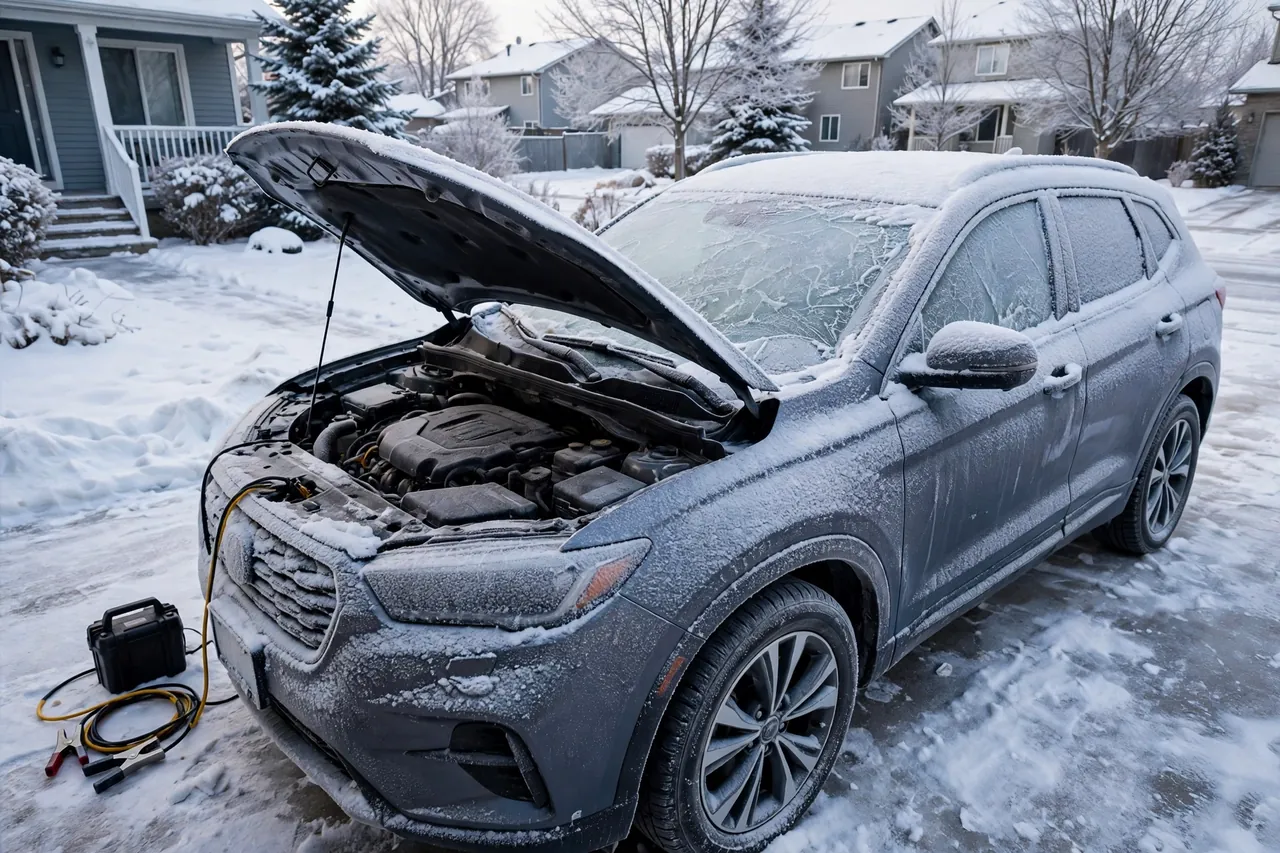
It is minus 28 in Edmonton, the wind is cutting across the parking lot, and your car turns over once, slowly, and gives up. Nothing about that morning is mysterious. Cold does two things at once: it takes power away from the battery and asks more power from the starter, and the gap between those two is where Canadian winters strand cars. AAA puts the numbers on it plainly: a battery loses about 35 percent of its strength at 0 degrees Celsius and about 60 percent at minus 18, while the engine needs up to twice the normal current to turn over. NAPA Canada's own figures agree and sharpen them: a battery loses about 20 percent of its charge at 0 degrees and nearly half at minus 18, while a winter start demands 225 to 500 amps against 100 to 400 in summer. An older battery does not stand a chance against that arithmetic, which is why the first cold snap of the year is the busiest week of the year for battery sales.
The battery is the cause nine times out of ten, so start there and start in the fall. AAA puts average battery life at three to five years, and Consumer Reports, citing AAA data, notes batteries last 58 months or more in the coldest northern regions but under 41 months in the hottest southern ones — the heat of summer ages the battery, and the cold of January is simply when the bill comes due. A battery that is four or five years old and cranks slowly on a cool October morning will not survive January. Get it load-tested before the first freeze; most parts stores do it free in five minutes. The number that matters in winter is cold cranking amps, or CCA: OPTIMA Batteries explains the test as a new, fully charged battery chilled to minus 18 degrees Celsius, delivering current for 30 seconds while staying at or above 7.2 volts, and NAPA Canada describes the same test in the same terms. Match or beat the CCA your owner's manual specifies — an extra 300 CCA above spec is, in OPTIMA's own words, usually not necessary. In Canada a shop-installed car battery typically runs $170 to $305 CAD, with AGM batteries for start-stop cars costing more, and a new battery in October is a purchase, while a new battery bought from a tow truck in January is an emergency.
The block heater is the cheapest winter insurance in Canada, and Natural Resources Canada's advice is specific: put it on a timer set to come on no more than two hours before you start the engine, because longer than that wastes electricity without warming the engine any further. A block heater warms the coolant, the engine turns over more easily, and the battery does less work — which is the whole problem restated as a solution. If your car does not have one, installation typically runs $220 to $375 CAD, and it pays for itself the first winter it saves you a single tow. Park facing the wind if you can, keep the fuel tank at least half full so condensation has less room to form, and use the winter-grade oil your manual specifies — 0W-20 or 5W-30 flows at minus 30 in a way 10W-30 simply does not, and thick oil is the second half of the cold-start problem after the battery.
Diesels have their own winter. Diesel fuel gels when temperatures fall below roughly minus 9 to minus 6 degrees Celsius, and glow plugs that are worn out will not heat the combustion chambers enough for the fuel to ignite. A set of glow plugs typically runs $220 to $395 CAD in Canada, and winter diesel or an anti-gel additive is cheap prevention against a fuel system that has turned to jelly. If you drive a diesel, plug in the block heater every night below minus 15, and do not assume a gasoline car's habits apply.
When it will not start, work the checklist in order. First, listen: rapid clicking with dim lights is a weak battery, and a slow, laboured crank is the same diagnosis in a quieter voice. A single solid click with bright lights is the starter, not the battery, and cold makes a failing starter worse because the thick oil asks more of it. Second, try a boost from another car or a portable jump pack, and leave the donor car connected for a few minutes before cranking — a deeply discharged battery needs a little charge before it can help the starter at all. Third, once it starts, drive it for at least twenty to thirty minutes; a five-minute idle does not recharge a battery that has just given everything it had. Fourth, get the battery and the charging system tested the same day, because a boost that works once and a dead car the next morning means the battery is finished, the alternator is not charging, or something is draining the battery overnight. Interstate Batteries' voltage rule is a useful home check: a fully charged battery reads 12.6 volts or higher at rest, and 11.9 volts or below is considered dead — and a discharged battery can freeze at about minus 9 degrees Celsius, while a fully charged one will not freeze until far below zero, so keeping it charged is also keeping it from being destroyed. Never use ether starting fluid on a gasoline car with a catalytic converter, and never keep cranking a flooded engine; wait, hold the accelerator to the floor while cranking on most fuel-injected cars to clear a flood, and try again.
The decision rule for winter is a calendar, not a feeling. In October, test the battery, check the CCA against the manual, clean the terminals, and confirm the block heater works. In November, switch to winter-grade oil if your manual calls for it, and replace a battery that is four years old and slow rather than gambling on it. In January, plug in the block heater two hours before you leave, keep a portable jump pack charged in the house — not in the car, where the cold drains it too — and keep a set of booster cables in the trunk. A remote starter, typically $440 to $825 CAD installed, is comfort, not a fix: it will not start a car with a dead battery. If the car will not start and the battery tests good, the problem is the starter or the charging system, and that is a shop visit — read Car Won't Start: Battery, Starter, or Alternator? for the sound test, and Car Battery Keeps Dying: Parasitic Draw Diagnosis Cost if the battery is new and still dies overnight. Run any quote through the RepairPrice calculator (calculator.php) before you approve it, and remember the real lesson of a minus-28 morning: the battery that fails in January was already failing in October, and October is when it is cheap to find out.
Common questions:
Q: Why won't my car start when it is cold? A: Cold slows the chemical reaction inside the battery, cutting its strength by about 35 percent at 0 degrees Celsius and about 60 percent at minus 18, according to AAA, while thick oil makes the engine need up to twice the normal current. A battery older than three to five years usually cannot bridge that gap.
Q: How many cold cranking amps do I need in Canada? A: Match or beat the CCA in your owner's manual. For cold regions, guides recommend at least 650 CCA, and over 800 CCA in extreme cold below minus 30. OPTIMA notes an extra 300 CCA above spec is usually not necessary.
Q: How long should I plug in the block heater? A: Natural Resources Canada recommends a timer set to no more than two hours before you start the engine. Longer wastes electricity without warming the engine further.
Q: My car started with a boost but is dead again this morning. What now? A: The battery is likely finished, the alternator is not charging, or something is draining it overnight. Get the battery load-tested and the charging system checked the same day, before buying another battery.
| Repair | Typical range (CAD) | Notes |
|---|---|---|
| Battery replacement, car | $170–$305 | The most common cold-start fix |
| Starter motor replacement, car | $370–$685 | Click but no crank |
| Alternator replacement, car | $490–$910 | Battery keeps going flat |
| Glow plugs, diesel (set) | $220–$395 | Hard cold starts on diesels |
| Block heater installation, car | $220–$375 | Plug in 2 hours before starting (NRCan) |
| Remote starter installation, car | $440–$825 | Comfort, not a fix for a dead battery |


 RepairPrice
