
Brake Master Cylinder Replacement Cost
By Oleksandr Potapenko · 2026-11-16 · How we research prices
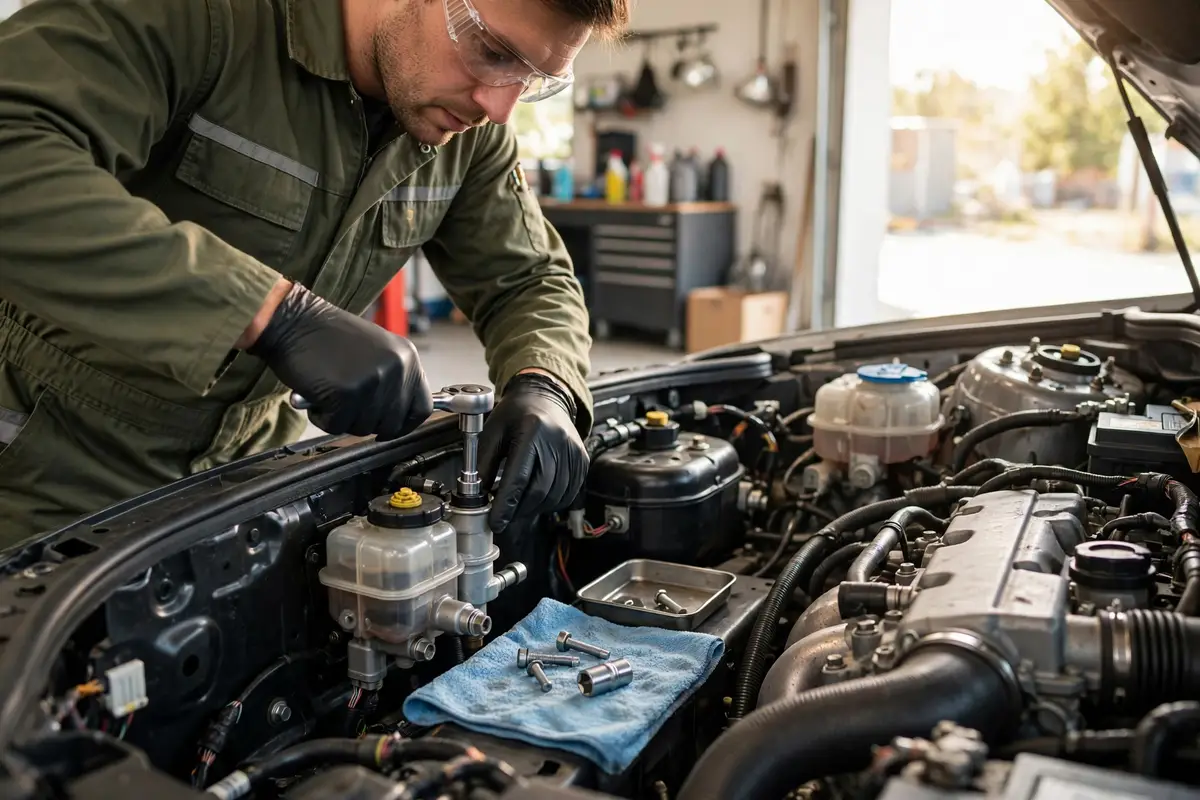
The pedal sinks slowly toward the floor while you hold steady pressure at a red light. You lift, press again, and it feels normal. Then it sinks again. That is the signature of a failing master cylinder, and it is one of the few brake faults that can fool you into thinking the problem has gone away. It has not. It is getting worse, a little more with every stop, and the day it stops fooling you is the day the pedal goes to the floor and stays there.
The master cylinder is the heart of the hydraulic system. It sits on the firewall, bolted to the brake booster, with the fluid reservoir on top. Press the pedal and its pistons push fluid down the lines to the calipers. Inside are rubber seals, and when those seals wear, fluid slips past the piston instead of pushing forward. Pressure bleeds away internally, with no puddle on the ground and no visible leak, which is why this fault is so often misdiagnosed. The pedal sinks, the fluid level stays normal, and the car looks fine from the outside. The other classic symptom is a pedal that feels normal one moment and soft the next, or brakes that work and then fade. A brake warning light can come on, and the fluid in the reservoir can look dark from seal debris.
The price depends on which parts catalogue your shop is reading, and the gap is large enough to explain. RepairPal's September 2026 national estimate for a master cylinder replacement in the United States is $656 to $796, with $450 to $493 of that in parts and $206 to $303 in labour. Kelley Blue Book is higher still, at $841 to $944. Those figures price new, original-equipment-grade parts. RepairPal's own model pages show the spread: a Honda Civic runs $614 to $773, a Nissan Altima $460 to $571, a 2026 Ford Escape $572 to $751 in Dallas, and a 2026 Chevrolet Blazer, whose cylinder is integrated with an expensive electronic module, $2,131 to $2,322 in Denver. At the other end, a Canadian independent shop doing the same job with a quality aftermarket cylinder prices it far lower: roughly $290 to $535 for a car, $335 to $615 for an SUV or truck, and $395 to $720 for a luxury model, based on a part at $120 to $300 plus about 1.8 hours of labour. The conflict between the sources is real, and it is the part tier again. An aftermarket cylinder at $120 to $300 is a different purchase from an original-equipment cylinder at $450 to $493, and on some cars the cylinder is not a standalone part at all but part of an integrated brake module, which is why the Blazer costs four times the Civic. Ask which part your quote is for before you compare numbers.
Before you authorise the job, make the shop rule out the cheaper suspects, because a sinking pedal has several causes and the master cylinder is the expensive one. Air in the lines gives a spongy pedal and is fixed by a bleed, which RepairPal prices at $114 to $168 in the United States. An external leak, a weeping caliper seal or a corroded line, drops the fluid level and is visible if you look. A failing brake booster gives a hard pedal, not a sinking one, and is a different repair. A good diagnostic is the hold test: with the engine running, press the pedal firmly and hold it. If it sinks slowly and steadily toward the floor, that is the master cylinder's internal seal. If it feels spongy and pumps up firm, that is air. If it drops suddenly, that is a leak. Tell the shop what you observed; it saves diagnostic time and it tells you whether the shop is thinking or just replacing parts.
Two things must be included in the job, and a quote that omits them is unfinished. First, the bench bleed. A new master cylinder has to be bled on the bench before it is fitted, or air is trapped inside it from the first moment. Second, the four-wheel bleed after fitting, to purge the whole system. Otherwise the pedal stays soft and the new cylinder gets blamed for an installation fault. Confirm both are on the invoice, along with fresh fluid, and ask whether the reservoir and the level sensor are included or extra. If the fluid is dark or contaminated, a full flush at the same time is the right call; Brake Fluid Flush Cost in Canada puts that at $100 to $155 for a car, and Brake Fluid Flush Cost in the USA gives the American numbers.
The safety question deserves a straight answer. A car with a failing master cylinder can still stop, most of the time, because the system has two hydraulic circuits and the cylinder usually fails gradually. But gradual is not safe. The failure can accelerate without warning, and the pedal can reach the floor during a hard stop, when the pressure is highest and the seal is under the most strain. Do not drive it on the highway, do not tow with it, and do not wait for the next service. If the pedal sinks, book the car in within days, drive gently on quiet roads, and keep your following distance long.
The decision rule: if the pedal sinks under steady pressure and the fluid level is normal, suspect the master cylinder and get it diagnosed promptly. If the quote is for an aftermarket cylinder at a Canadian independent shop, $290 to $535 for a car is the fair band; if it is for an original-equipment cylinder, or the car has an integrated electronic module like the Blazer, expect RepairPal's $656 to $796 or more, and get a second quote before you agree. And if the car is older and the cylinder is the third hydraulic repair in a year, ask the shop to look at the whole system, because a master cylinder that fails early often points to contaminated fluid that is eating every seal in the system. Our guide How Do I Know If My Brakes Need Replacing? covers the other causes of a soft pedal, and Brake Line Replacement Cost in Canada covers the external leaks that mimic this fault. If you want a price for your own car before you call around, the RepairPrice calculator (calculator.php) gives a fair range for your vehicle and city.
Common questions:
Q: How much does it cost to replace a brake master cylinder? A: At a Canadian independent shop with an aftermarket part, roughly $290 to $535 for a car. RepairPal's United States estimate with new original-equipment parts is $656 to $796, and Kelley Blue Book puts it at $841 to $944. On cars with an integrated electronic module, such as the 2026 Chevrolet Blazer, it can exceed $2,100.
Q: What are the symptoms of a bad master cylinder? A: A pedal that slowly sinks toward the floor while you hold steady pressure, a pedal that feels normal one moment and soft the next, brakes that fade, a brake warning light, or dark fluid in the reservoir. The fluid level often stays normal because the leak is internal.
Q: Can I drive with a bad master cylinder? A: Only briefly and gently. The car can usually still stop, but the failure can accelerate without warning and the pedal can reach the floor during a hard stop. Avoid highways and towing, and book the repair within days.
Q: How long does it take to replace a master cylinder? A: About 1.8 hours of labour, plus the bench bleed before fitting and a four-wheel bleed afterwards. The car is usually ready the same day.
| Job | Typical range, independent shop | Notes |
|---|---|---|
| Master cylinder, car | $290–$535 | Part $120–$300 + ~1.8 h labour |
| Master cylinder, SUV/truck | $335–$615 | Larger part, similar labour |
| Master cylinder, luxury | $395–$720 | Pricier part, higher labour rate |
| Must be included | Bench bleed + 4-wheel bleed | Otherwise the pedal stays soft |
| Rule out first | External leaks, booster, air in lines | A sinking pedal has several causes |


 RepairPrice
