
ABS Light On: Causes and Repair Cost in Canada
By Oleksandr Potapenko · 2026-11-16 · How we research prices
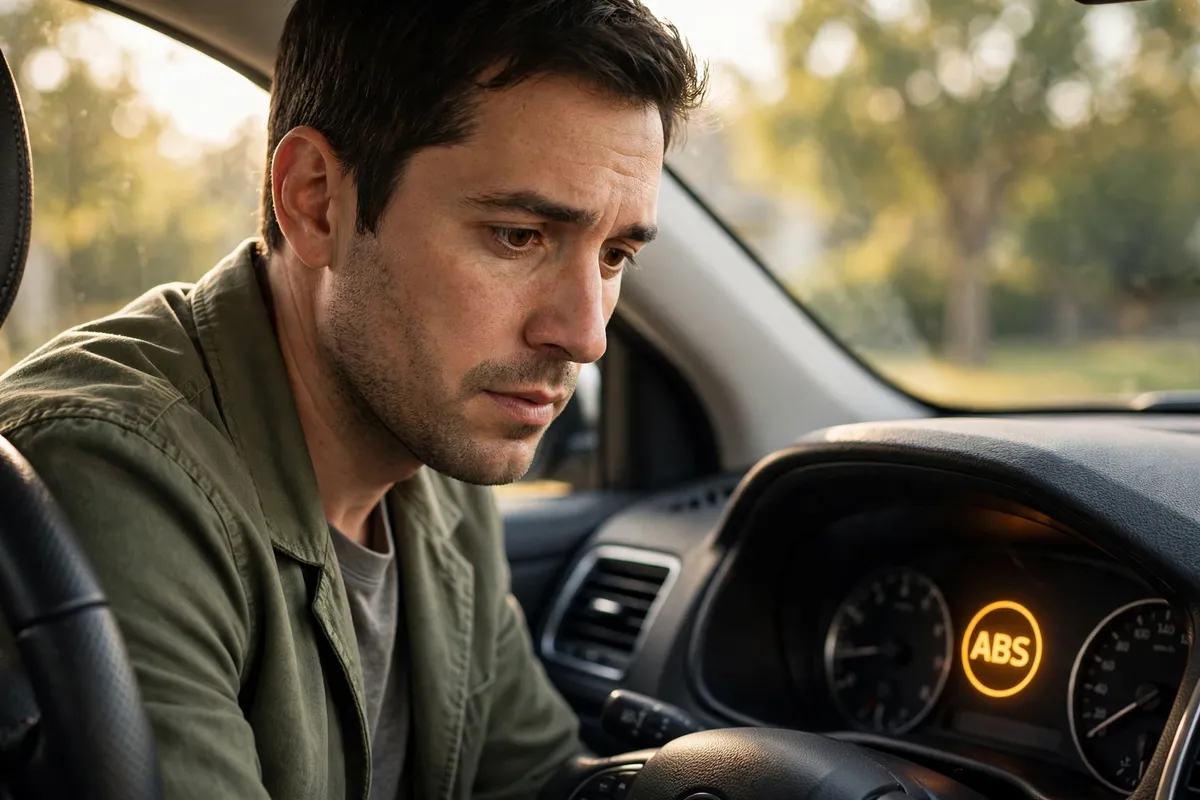
First, the reassurance, because it matters: when the ABS light comes on, your regular brakes still work. What you have lost is the anti-lock function, the system that stops the wheels locking up in a hard stop on a slippery road. Your car now brakes like an older car without ABS, which is to say it stops, but in an emergency stop on ice or in the rain a wheel can lock and the car can skid instead of steering. That is why the light is not a panic, but it is also not a light to ignore until spring. In a Canadian winter, ABS is the difference between stopping in a straight line and sliding into the intersection.
The most common cause, by a wide margin, is a wheel speed sensor. Each wheel has a sensor that tells the ABS computer how fast that wheel is spinning. The sensors sit right behind the wheel, exposed to water, road salt, brake dust, and pothole hits, which is why they fail more often in Canada than anywhere else. YouCanic, a repair guide, calls a faulty wheel speed sensor one of the most common problems behind the ABS light, and the specialist rebuilder Sinspeed reports that over 90 percent of the ABS units sent to it began as a supposed wheel-speed-sensor fault. That last number comes with a warning, though: Sinspeed says most of those sensors turn out to be healthy, and the real fault is inside the module. NHTSA complaint data cited by EngineCrux puts sensor faults at only about 15 percent of reported ABS issues. The spread is wide because the sources count different things — fault codes pointing at a wheel versus parts confirmed faulty after testing — so treat 'the sensor is the usual suspect' as a starting point for diagnosis, not a percentage you can bank on. The sensor itself is a small sealed part, and it is replaced, not repaired. The fix is a bolt-on job at the wheel hub, often fifteen to thirty minutes once the wheel is off, and a budget aftermarket sensor costs $15 to $50. RepairPal's September 2026 estimate prices the part much higher, at $145 to $179 US, with $89 to $131 US of labour, for $234 to $310 US installed — roughly $330 to $435 Canadian at about 1.40 CAD per US dollar — which sits comfortably inside the Canadian $200 to $550 range quoted below; the gap is mostly the difference between a budget part and an original-equipment-grade one. Jerry, another estimator, gives a broader $189 to $357 US or more. At a shop in Canada, expect roughly $200 to $550 for one sensor fitted, including diagnosis, with the lower end for a straightforward swap and the higher end when the old sensor is seized in the hub or the corner needs more dismantling. American pricing for the same job runs about $150 to $400 per sensor. If the sensor is the fault, it is the best-case outcome and the cheapest ABS repair there is.
The second group of causes lives around the sensor rather than in it. The wiring flexes with the suspension and can chafe, corrode, or get torn, especially after winter salt or a big pothole, and the connector can corrode in wet weather, which is why an ABS light that comes and goes in the rain often points to a connector rather than a sensor. The tone ring, the toothed ring the sensor reads, can rust, crack, or lose teeth, giving an erratic signal that mimics a bad sensor. And a failing wheel bearing can destroy the tone ring, which is why an ABS light plus grinding or humming is urgent: the bearing itself can fail. Wiring repairs run about $100 to $300 in Canada, a hub or wheel bearing with a built-in tone ring about $250 to $700 per wheel, and a tone ring alone about $150 to $400 fitted.
The expensive end of the scale is the module. The ABS control module or hydraulic unit is the computer and pump that modulate brake pressure during an ABS stop. Module replacement runs $400 to $1,200 or more for the part alone, plus labour and programming, and a hydraulic unit replacement typically runs $600 to $1,800 at a shop. RepairPal's model-by-model estimates often run higher than that top end — about $821 to $935 US for a Dodge Journey module, and over $2,000 US on some GM crossovers — so on some cars the module bill can pass the $1,800 top end before labour and programming are finished. Before you authorise a module, make sure the diagnosis is real. The same wheel-speed code can come from the ring, the bearing, the wiring, or the module itself, and the costly mistake is fitting a sensor the car did not need, or a module when the fault was a $30 connector. Ask for the fault code, ask which corner it names, and ask what was tested before the part was ordered. A proper diagnosis uses an ABS-capable scan tool, not a generic engine-code reader, and a diagnostic scan costs $80 to $150 at most shops.
The light combinations are a diagnostic shortcut worth knowing. ABS light on, brakes feel normal: usually a sensor fault, book soon, before winter. ABS light plus traction control light: a sensor, wiring, or bearing issue, because the traction system uses the same wheel-speed data. ABS light after wheel or bearing work: the sensor was disturbed or damaged during the job, and the shop that did the work should see the car again promptly. ABS light plus the red brake warning light: low fluid or a hydraulic fault, urgent, check the fluid now, because this combination can mean the base brakes are affected, not just the ABS. ABS light plus grinding or humming: a failing wheel bearing, urgent. And a light that comes and goes with speed, rain, or bumps: a physical problem at the wheel, the gap to the ring, the ring, the connector, or the cable.
Winter makes every part of this worse, and it also makes the fix more urgent. Salt corrosion on sensors and connectors becomes far more likely past roughly 150,000 kilometres, and module failures tend to appear later, often preceded by intermittent lights that come and go with temperature. A sensor that fails in July is an inconvenience. The same sensor failing in January, on an icy road, is the difference between a controlled stop and a skid. If the light is on, book the diagnosis before the first snowfall, not after it.
The decision rule: read the code first, replace parts second. A single sensor is a $200 to $550 job in Canada and the most likely outcome. A module is a $400 to $1,800 job and the least likely, so it deserves a second opinion and a confirmed diagnosis. Never clear the light and hope it stays off; the fault is still there, the ABS is still disabled, and the next emergency stop will remind you. And if the ABS light is on together with the red brake warning light, treat it as urgent and check the fluid level before driving further. Our guide Brake Fluid Flush Cost in Canada covers the fluid side of the system, and Brake Line Replacement Cost in Canada covers the hydraulic faults that can light both warnings at once. If you want a price for your own car before you call around, the RepairPrice calculator (calculator.php) gives a fair range for your vehicle and city.
Common questions:
Q: Is it safe to drive with the ABS light on? A: Your regular brakes still work, but the anti-lock function is disabled, so a wheel can lock up in a hard stop on a slippery road. It is safe to drive gently to a shop, but do not ignore it, especially before winter.
Q: What is the most common cause of the ABS light? A: A failed wheel speed sensor — YouCanic calls it one of the most common causes, though sources disagree sharply on the share: Sinspeed says over 90 percent of ABS units sent to it started as a supposed sensor fault, while NHTSA data cited by EngineCrux puts confirmed sensor faults near 15 percent of reported ABS issues. The sensors sit behind the wheels, exposed to water, salt, and brake dust, and they are the cheapest ABS repair, roughly $200 to $550 fitted in Canada.
Q: How much does it cost to fix the ABS light in Canada? A: It depends on the cause. A wheel speed sensor runs about $200 to $550 fitted (RepairPal: $234 to $310 US installed), wiring repairs $100 to $300, a wheel bearing with a tone ring $250 to $700 per wheel, and an ABS module or hydraulic unit $400 to $1,800 — though RepairPal prices some models well above that top end. A diagnostic scan costs $80 to $150.
Q: Why does my ABS light come on only when it rains? A: Usually a corroded sensor connector or damaged wiring at one wheel. Water gets into the connector and interrupts the wheel-speed signal. It is worth fixing before winter, because the fault will get worse, not better.
| Symptom | Likely cause | How urgent |
|---|---|---|
| ABS light on, brakes feel normal | Wheel speed sensor fault | Book soon, before winter |
| ABS light + traction control light | Sensor, wiring, or bearing issue | Book soon |
| ABS light after wheel or bearing work | Disturbed or damaged sensor | Return to the shop promptly |
| ABS light + brake warning light | Low fluid or a hydraulic fault | Urgent — check fluid now |
| ABS light + grinding or humming | Failing wheel bearing | Urgent — bearing can fail |
| Intermittent ABS light in wet weather | Corroded sensor connector | Book soon |

 RepairPrice
