
Brake Fluid Flush Cost in the USA
By Oleksandr Potapenko · 2026-11-16 · How we research prices
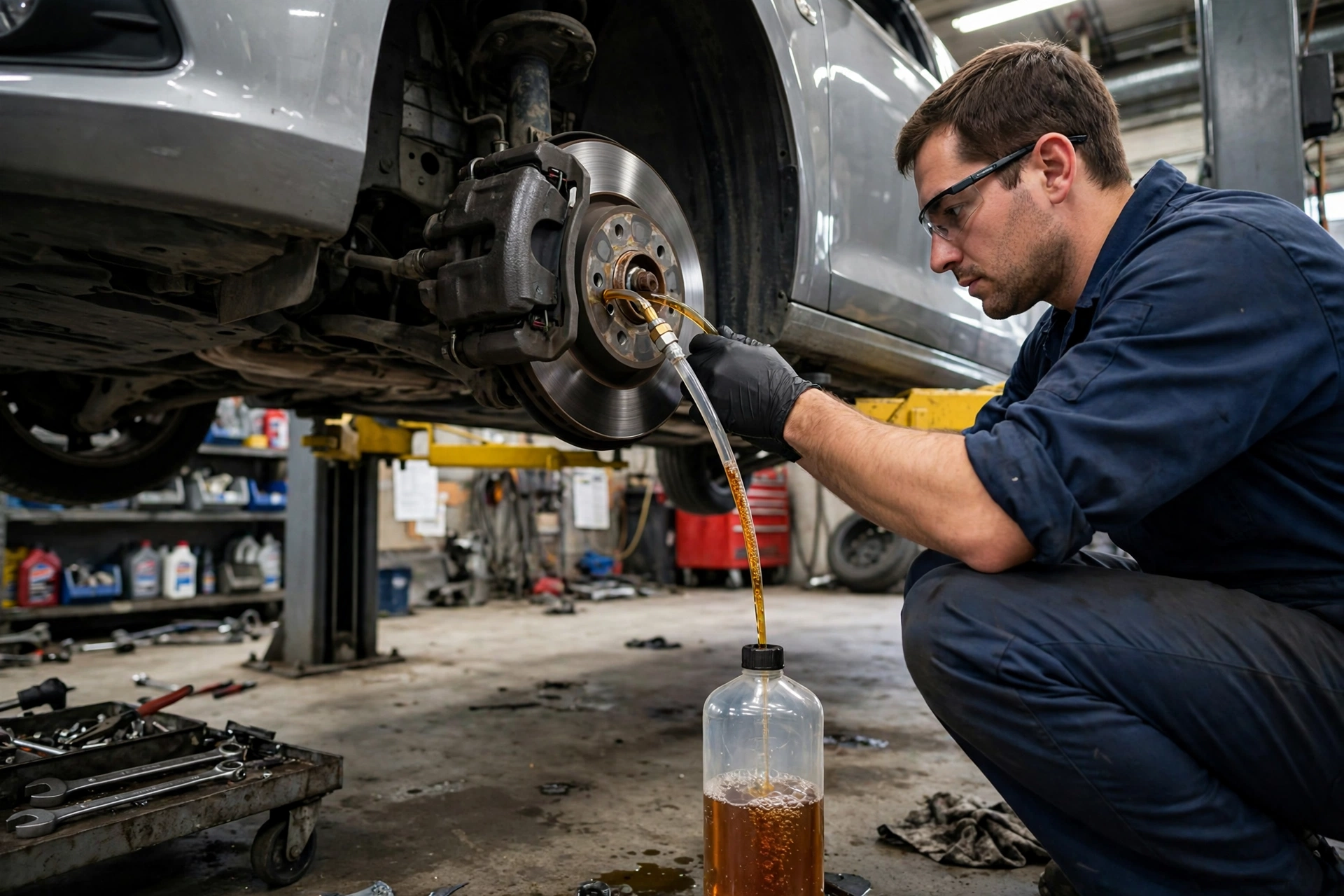
The quote says $189. The shop down the road says $100. Your neighbour says he paid $114 for a bleed and swears it was the same thing. All three of you are right, and that is the problem with brake fluid pricing in the United States: three different services share one vague name, and the national averages mix them together.
Here is the split, with the numbers attached. A brake bleed, removing trapped air from the system, usually after a caliper or master cylinder replacement, runs $114 to $168 by RepairPal's August 2026 estimate, with model examples from $90 to $131 for a Honda Civic to $160 to $235 for a Toyota Corolla. A full brake fluid flush, replacing all the old fluid throughout the system, runs $173 to $205 by Kelley Blue Book's current estimate. And a flush at an independent shop, the job most drivers actually buy, runs $80 to $150, with a median posted price of $100 across 67 independent shops that publish one, according to the Data for Trades Auto Repair Data Pack from October 2026, and a middle half of $80 to $150. The cheapest route is doing it yourself with a one-person bleeder kit, a $15 hose-and-check-valve assembly, for under $40 in fluid and kit. The dearest is a European dealer, $180 to $300, because BMW, Mercedes, and Audi require DOT 4 LV fluid at $15 to $25 a litre instead of $8 to $12 for standard DOT 3 or DOT 4, and the procedure needs a scan tool to cycle the ABS pump.
Why does KBB say $173 to $205 when the shops post a median of $100? Because they are measuring different markets. KBB's figure is a national average across shop types, including dealers, who charge $150 to $225 for the same service with original-equipment fluid and higher labour rates. The posted-price median of $100 comes from independent shops only, and independents are where most flushes happen. The $48 gap between the $141 midpoint of the bleed range and the $189 midpoint of the flush range is also real: a bleed is a targeted fix for air, a flush is a full fluid exchange, and they take different amounts of time. The lesson is not to pick the lowest number and call it the price. It is to check which service the quote is for, because a $100 flush and a $189 flush can both be fair, and a $114 bleed sold as a flush is not.
The interval is where the upsell lives, so here is what the makers say. Most manufacturers want the fluid changed every two to three years regardless of mileage, and some, like Honda and BMW, specify two years. The reason is the chemistry: brake fluid is hygroscopic, it absorbs moisture from the air every day, and contaminated with just 3 percent water, its boiling point drops from around 205 degrees Celsius to around 140. On a long descent or a hard stop, old fluid can boil inside the caliper, and vapour compresses where liquid does not, so the pedal goes soft exactly when you need it most. A moisture test or a copper test strip can tell you the actual condition. A copper reading above 200 parts per million, or moisture above 3 percent, means the fluid is done. Ask for the test before you agree to the service. A shop that tests is a shop that is not guessing, and a flush sold at every oil change is the upsell version of this service.
Labour is the part of the bill that moves most. Across 207 independent shops that post an hourly rate, the median is $129 an hour, with the middle half charging $100 to $165. California shops post a median of $160, Ohio shops $75. A flush is a labour-dominated job, roughly 75 percent of the bill is the time to do it, not the parts, because the fluid itself costs $15 to $35 and the job takes half an hour to an hour. The same flush on the same midsize car runs about $100 in a low-rate state like Mississippi, at $90 an hour, versus roughly $140 in a high-rate state like California, at $150 an hour. That is why a national average is a poor guide to your town, and why two quotes in the same city can still differ by $50.
The cost of skipping the service is the argument for doing it, and it is not theoretical. Moisture-laden fluid corrodes the inside of the system: the caliper pistons, the ABS modulator, the steel lines. An ABS module or hydraulic unit costs $400 to $1,500 or more, and a corroded brake line can cost hundreds more. A flush costs $80 to $150 at an independent shop. It is the cheapest insurance in the whole brake system, and it is the service most often skipped, because nothing feels wrong until the fluid boils or the module fails. There are two cases where it is not optional: the fluid in the reservoir looks dark brown or black instead of clear amber, and the car is more than three years old with the fluid never changed. If you tow, drive in the mountains, or commute down a long hill, the boiling-point margin matters more to you than to a flat-city driver.
The decision rule is short. Flush every two to three years, and ask for a moisture or copper test first. If the test says the fluid is fine, wait. If the quote is $80 to $150 at an independent shop, it is fair. If it is $150 to $225 at a dealer, it is fair for a dealer. If someone offers a $40 flush, ask what is being skipped, because a proper flush replaces the fluid at all four corners and takes the better part of an hour. And if the system has been opened for a caliper or a master cylinder, the bleed is already part of that job, so do not pay for a flush on top of it unless the fluid is old. Our guide Brake Caliper Replacement Cost in the USA explains when a bleed joins a bigger bill, and Brake Fluid Flush Cost in Canada gives the Canadian numbers for comparison. If you want a price for your own car before you book, the RepairPrice calculator (calculator.php) gives a fair range for your vehicle and ZIP code.
Common questions:
Q: How much does a brake fluid flush cost in the USA? A: About $80 to $150 at an independent shop, with a median posted price of $100. Kelley Blue Book's national average across shop types is $173 to $205, and dealers run $150 to $225. A brake bleed, which is a different service, runs $114 to $168 by RepairPal's estimate.
Q: How often should brake fluid be changed? A: Every two to three years regardless of mileage. The fluid absorbs moisture from the air even when the car is not driven, which lowers its boiling point and invites corrosion inside the system.
Q: What is the difference between a brake flush and a brake bleed? A: A flush replaces all the old fluid throughout the system. A bleed only removes trapped air, usually after a caliper or master cylinder replacement. A top-up only adds fluid to the reservoir and leaves the old fluid in the calipers.
Q: Can I do a brake fluid flush myself? A: Yes, with a one-person bleeder kit for under $40 in fluid and kit, and a quart of DOT 3 or DOT 4 fluid. It takes an hour or so. But if the car has ABS and the procedure needs a scan tool to cycle the pump, or if you are not confident bleeding brakes, a shop is the safer choice.
| Service / shop type | Typical range (USD) | Notes |
|---|---|---|
| Independent shop | $80–$150 | Most common; median posted price $100 |
| Major chains (Firestone, Midas) | $80–$150 | Firestone $90–$120 standalone |
| Dealership | $150–$225 | OEM fluid, higher labour rate |
| National average | $173–$205 | Across shop types, 2026 |
| Brake bleed only (RepairPal) | $114–$167 | Air removal, not a full flush |
| Moisture / copper test only | $0–$30 | Ask for this before agreeing to a flush |
| DIY: fluid + bleeder kit | $40–$90 | Fluid $10–$30, kit $30–$60 |
| ABS modulator damage from neglect | $400–$1,500 | What a skipped flush can cost |

 RepairPrice
