
Coolant Flush Cost in the USA
By Oleksandr Potapenko · 2026-11-16 · How we research prices
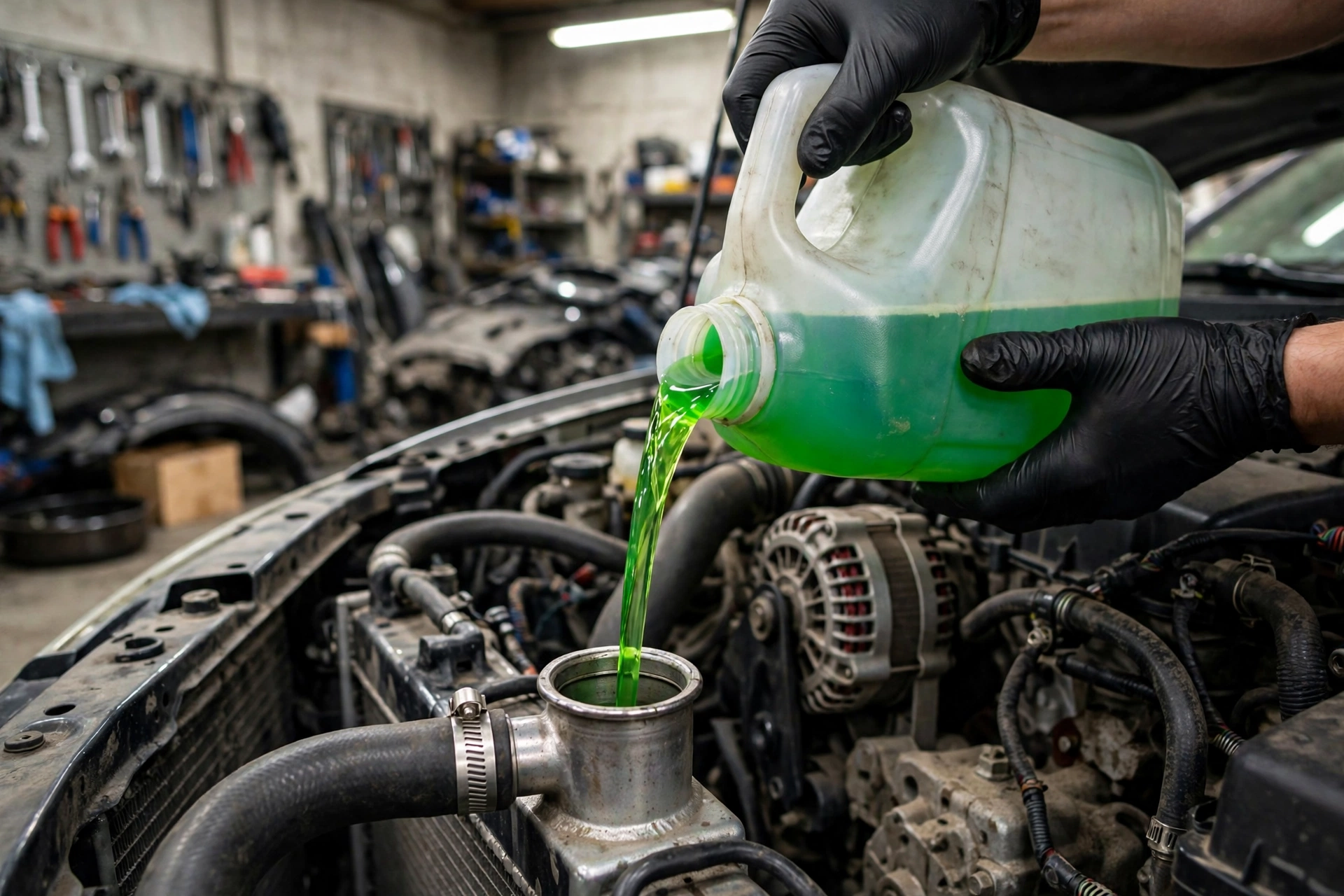
Two trusted sources disagree about the price of a coolant flush by more than $300, and both of them are right, which is the first thing to understand about this job. Kelley Blue Book's current national average for a coolant flush is $131 to $209. RepairPal's average is $440 to $512. The gap is not a mistake; it is a difference in what each source is counting. Kelley Blue Book is pricing the fluid exchange itself: fresh coolant, an hour of labour, and a bleed. RepairPal's figure is parts-heavy, and it almost certainly includes work that rides along with a flush, such as a thermostat or a set of hoses, which is the same reason a dealer quote for a flush can reach $450 with factory coolant and a multi-step service. The honest answer for a standalone flush at an independent shop is $100 to $250, and the honest answer for a flush bundled with other cooling work is whatever the bundle costs. Ask the shop which one the quote is before you compare it to either number.
A coolant flush in the USA typically costs $90 to $150 for a drain-and-fill and $150 to $250 for a machine flush. Firestone Complete Auto Care says a radiator fluid exchange typically costs no more than $200, Take 5 publishes a coolant exchange range of $90 to $160, and Jiffy Lube does not publish one national price at all: its coolant exchange page asks for your vehicle and location, and CarsBibles' 2026 reporting puts Jiffy Lube's range at $70 to $150 depending on location. Dealers charge more, roughly $200 to $250 according to Kelley Blue Book's dealer guidance, and up to $450 with factory coolant. ThePricer, which checked its figures against 11 cited sources in August 2026, puts the professional range at $100 to $250, with many drivers paying around $130 to $210, and notes that the strongest current national benchmark is Kelley Blue Book's $131 to $209. A do-it-yourself flush costs $25 to $75 in coolant, distilled water, and a drain pan.
There are two versions of this job, and shops do not always say which one they are selling. A drain-and-fill empties the radiator and refills it, which replaces roughly half the fluid, because the rest sits in the engine block and the heater core. A machine flush pushes fresh coolant through the whole system, including the block and the heater core, and replaces nearly all of it. The drain-and-fill is cheaper and it is a legitimate service on a car whose coolant is changed on schedule, because the remaining old fluid is still fresh enough to mix safely. The machine flush is the right choice when the coolant is overdue, rusty, or sludgy, or when the system has just had a major repair, such as a water pump or a radiator, because that is when the old fluid is doing damage. Ask the shop which one the quote covers, and how many quarts of coolant are included, because a quote for a flush that turns out to be a drain-and-fill is the most common disappointment in this service.
What the flush actually buys is the additives. Coolant does two jobs: it carries heat away from the engine, and its additives stop the inside of the cooling system from corroding. When those additives are exhausted, the fluid turns rusty or sludgy, the water pump and thermostat suffer, and the engine starts running hot. A coolant pH test tells the story in seconds: the safe range is roughly 7.5 to 11.0, and below 7.0 the fluid is acidic and actively corroding aluminum parts, even if it still looks clean. The interval depends on the chemistry your car was built for, and the owner's manual is the only source that matters: Toyota's Super Long Life coolant is due first at 10 years or 100,000 miles, then every 5 years or 60,000 miles; Honda's blue coolant is due at 5 years or 60,000 miles; Ford's Motorcraft Yellow is due first at 10 years or 200,000 miles, then every 5 years or 100,000 miles; and conventional green coolant is due every 2 years or 30,000 miles, with the AAA coolant guide putting it at 2 years or 24,000 miles. A car that covers 4,000 miles a year still reaches the time limit, and a car that covers 25,000 a year hits the distance limit first.
The chemistry warning is the one most drivers miss. Coolant types are defined by their inhibitor chemistry, not their colour: inorganic acid technology, usually green, lasts about two years; organic acid technology, often orange, red, or pink, lasts five to ten years; hybrid organic acid technology, often yellow or blue, sits in between. Colour alone is not a reliable guide, and mixing chemistries can gel and clog the system. The safe rule is to use exactly the specification in the owner's manual, Dex-Cool, G12, Toyota Super Long Life, or whatever your car names, and to top up only with the same type. The flush is also the moment to bundle the cheap add-ons: a thermostat costs $100 to $250 extra while the system is already open, and it is worth it past 100,000 miles, which is why our guide "Thermostat Replacement Cost in the USA" and our guide "Water Pump Replacement Cost in the USA" both treat the flush as a companion job rather than a standalone one. Check the range for your car with the RepairPrice calculator (calculator.php), and ask the shop to confirm the coolant specification and the service type in writing, because a flush quoted as a drain-and-fill and a green coolant poured into a Dex-Cool system are the two mistakes that cost the most.
Common questions:
Q: How much does a coolant flush cost in the USA? A: Typically $90 to $150 for a drain-and-fill and $150 to $250 for a machine flush at an independent shop. Kelley Blue Book's current average is $131 to $209, Firestone says a fluid exchange typically costs no more than $200, and Take 5 publishes $90 to $160. RepairPal's $440 to $512 average is higher because it is parts-heavy and likely includes a thermostat or hoses.
Q: How often should coolant be flushed? A: Follow the owner's manual, because the interval depends on chemistry. Toyota Super Long Life is first due at 10 years or 100,000 miles, Honda at 5 years or 60,000 miles, Ford Motorcraft Yellow at 10 years or 200,000 miles for the first change, and conventional green coolant every 2 years or 30,000 miles.
Q: What is the difference between a drain-and-fill and a flush? A: A drain-and-fill replaces about half the coolant, because the rest stays in the block and heater core. A machine flush pushes fresh coolant through the whole system and replaces nearly all of it. The flush is the right choice when the coolant is overdue, rusty, or sludgy.
Q: Can I mix different colours of coolant? A: No, not safely. Colour does not reliably identify chemistry, and mixing incompatible types can gel and clog the system. Use exactly the specification in the owner's manual and top up only with the same type.
| Service | Typical range (USD) | Notes |
|---|---|---|
| Drain-and-fill | $90–$150 | Replaces about half the coolant |
| Machine flush | $150–$250 | Full system, including heater core |
| Independent shop, either service | $100–$250 | Most common range |
| Dealership flush | $200–$250 | Up to $450 with OEM coolant, multi-step |
| Kelley Blue Book average | $131–$209 | Current national benchmark |
| RepairPal average | $440–$512 | Parts-heavy; likely includes thermostat or hoses |
| Thermostat at the same time | $100–$250 extra | Worth it past 100,000 miles |
| DIY supplies | $25–$75 | Coolant, distilled water, drain pan |


 RepairPrice
