
All-Season vs Winter Tires in Canada
By Oleksandr Potapenko · 2026-11-16 · How we research prices
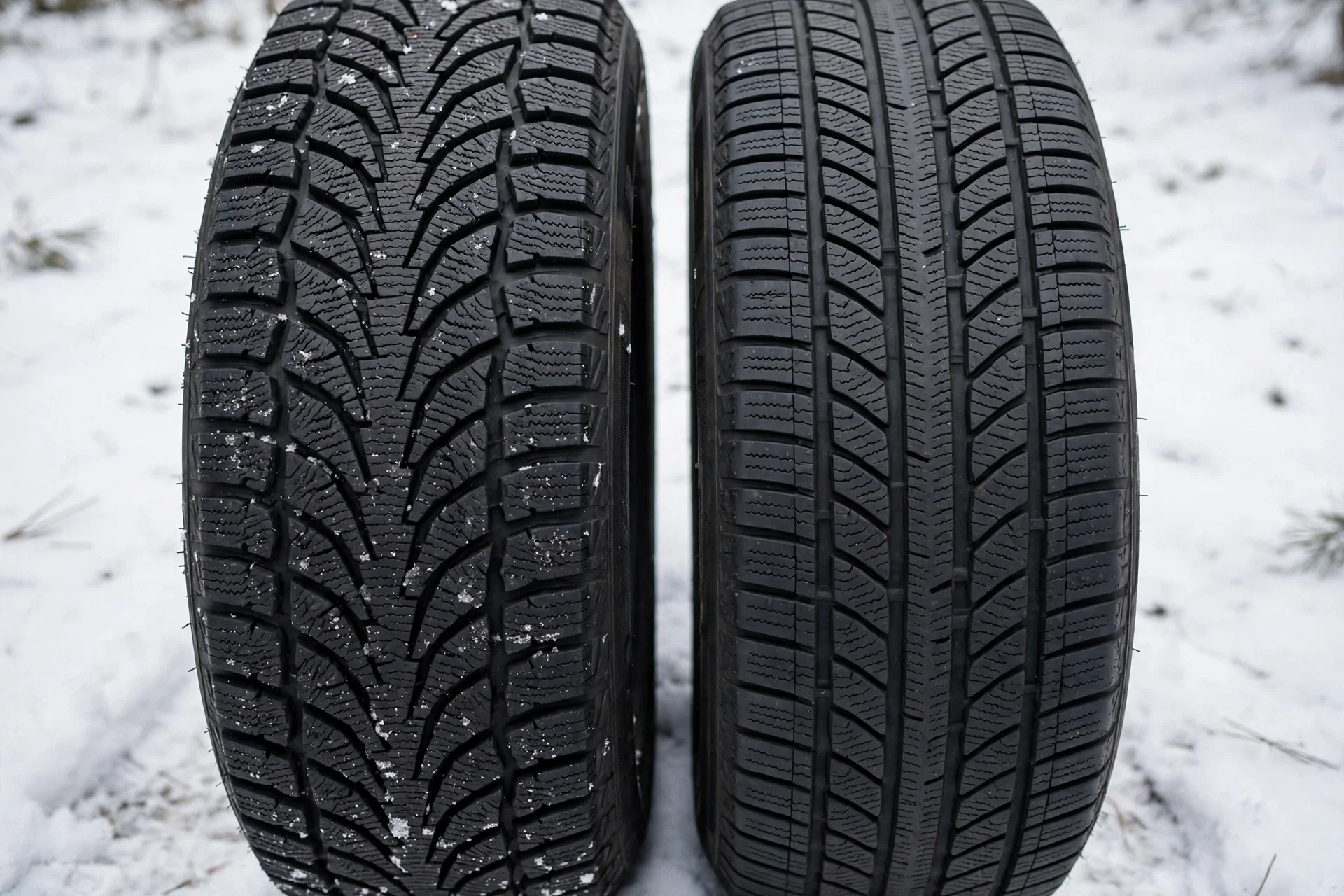
The temperature, not the snowfall, is what ends the argument. Transport Canada states it plainly: below 7 °C, all-season and summer tires begin to lose elasticity, and with it, traction. The rubber that has to stay flexible through a hot July is the same rubber that goes stiff in a Canadian October, and no tread pattern can compensate for a compound that has turned hard. Winter tires use a softer compound that stays pliable in deep cold, plus thousands of tiny slits called sipes that bite into ice. That is the whole difference, and it shows up in the one number that matters: stopping distance.
The Tire and Rubber Association of Canada puts stopping distances with winter tires at as much as 30 percent shorter than with all-seasons just below freezing, and notes that winter tires grip better on ice or snow at minus 30 than all-seasons manage at plus 4. The Ontario Ministry of Transportation puts the same gap at 25 percent shorter braking distances in frost, snow and icy conditions, and Mitsubishi Motors Canada cites the same Ontario figure. In practical terms, at 50 km/h on packed snow a car on winter tires typically stops in 35 to 38 metres, while the same car on all-seasons needs 50 to 55 metres — roughly two car lengths extra, from the same speed, in the same conditions. Four-wheel drive does not close that gap: it helps you get going, not stop, and the car that cannot stop is the car that hits something. TRAC's 2025 survey found 80 percent of Canadian drivers now use winter tires, up 12 percent in ten years — the market has already voted.
So the honest answer is that all-season tires are really three-season tires in most of Canada. They are a reasonable choice if you live in coastal British Columbia or southern Ontario, drive little, and can stay home on the two or three worst days of the year. They are the wrong choice in Québec — where winter tires are legally required from December 1 to March 15, with fines of $200 to $300 — on the Prairies, in northern Ontario, and anywhere your winter means months below freezing rather than weeks. British Columbia requires winter tires or chains on most mountain highways from October 1. The middle option is the all-weather tire: it carries the three-peak mountain snowflake symbol, which Transport Canada only allows on tires that pass a traction test on packed snow, so it is winter-certified and legal in Québec, and it can stay on all year. It gives up some deep-snow grip and some summer tread life against a dedicated winter tire, but for a driver in a mild-winter city who cannot store a second set, it is the best compromise on the market.
The cost argument against winter tires is weaker than it looks. A set of four all-seasons installed on a car runs roughly $595 to $1,230, and a winter set runs roughly $695 to $1,430 — about $100 to $200 more for the set, according to the 2026 Canadian price guides from TrustedLocalAuto and AutoExpertSource. But the two sets share the year's kilometres: while the winter set is on the car, the summer set is not wearing, so a pair of sets lasts roughly twice as long as either set alone. Add the seasonal changeover — $40 to $80 for a swap on rims, $80 to $160 for a mount-and-balance changeover, per Cansumer's 2026 survey — and the annual cost of running winter tires is roughly $80 to $160 in swaps, plus storage of $60 to $100 a season if you do not store them at home. Some Ontario and Alberta insurers offer a 2 to 5 percent premium discount for verified winter tire use, which offsets part of that. The real comparison is not winter tires against free; it is $100 to $250 a year against one winter collision, one insurance deductible, and one afternoon in a ditch.
The decision rule is a map, not a slogan. If your winter lasts five months and your town plows late, buy dedicated winter tires on steel wheels and switch at 7 °C — see Winter Tires and Seasonal Changeover Cost in Canada for the booking and price details, and Tire Storage Cost in Canada (Seasonal) if you have nowhere to keep the off-season set. If your winter is mild, short, and mostly bare roads, all-weather tires with the mountain snowflake are a defensible single-set answer. If you already own all-seasons and wonder whether they will do for one more winter, check their tread: Transport Canada advises against using tires worn close to 4 mm on snow-covered roads, and a five-year-old all-season at 5 mm is not the tire it was when new. Price your exact options on the RepairPrice calculator (calculator.php) before you decide — and decide before the first snowfall, when every shop in the country is booked solid.
Common questions:
Q: Are winter tires really better than all-season tires? A: Yes, below 7 °C. The Tire and Rubber Association of Canada reports stopping distances up to 30 percent shorter with winter tires just below freezing, and the Ontario Ministry of Transportation reports 25 percent shorter braking distances in frost, snow and ice. At 50 km/h on packed snow, that is roughly 15 metres — two car lengths.
Q: Can I use all-season tires in winter in Canada? A: Legally yes, except in Québec from December 1 to March 15 and on designated B.C. highways. Practically, all-season rubber hardens below 7 °C, according to Transport Canada, so in most of Canada they are a compromise that costs stopping distance on exactly the days you need it most.
Q: What are all-weather tires? A: Tires that carry the three-peak mountain snowflake symbol, meaning they passed Transport Canada's packed-snow traction test. They are winter-certified and legal in Québec, and can stay on all year — a good compromise for mild-winter cities, though they give up some grip to a dedicated winter tire in deep snow.
Q: How much more do winter tires cost than all-seasons? A: About $100 to $200 more per set of four installed, per 2026 Canadian price guides. Because the two sets share the year's kilometres, the pair lasts roughly twice as long, so the true annual cost is mostly the $80 to $160 a year in seasonal swaps.
| Option | Typical range (CAD) | Notes |
|---|---|---|
| All-season set of 4, installed, car | $595–$1,230 | Mounting, balancing, disposal included |
| Winter set of 4, installed, car | $695–$1,430 | About $100–$200 more than all-seasons |
| Seasonal changeover, own wheels | $75–$105 | SUVs about 15% higher, luxury 35% |
| All-weather tires (mountain-snowflake) | Similar to all-seasons | Winter-certified, usable year-round |
| Winter tires, Québec law | Dec 1 – Mar 15 | Legally required; fines for non-compliance |




 RepairPrice
