
TPMS Sensor and TPMS Light: Replacement Cost in Canada
By Oleksandr Potapenko · 2026-11-16 · How we research prices
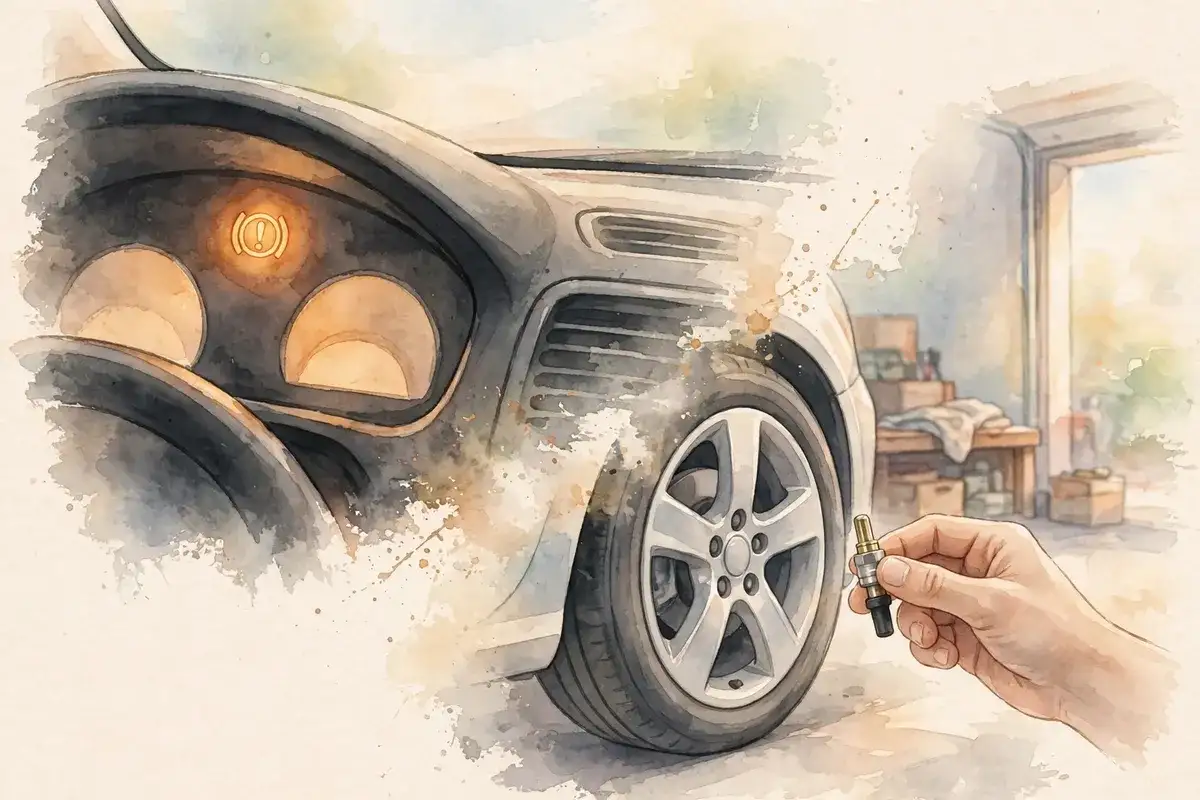
The TPMS light comes on on the first cold morning of October, and half the drivers who see it assume the sensor is broken. Most of the time it is not. Cold air contracts, tire pressure drops by about 1 psi for every 5 °C of temperature fall, and the tire pressure monitoring system is doing exactly what it was designed to do: warn you that a tire is low. Check the pressure first, with a gauge, against the number on the driver's door placard — not the number on the tire sidewall, which is the maximum, not the recommendation. Inflate to the placard pressure, drive a few kilometres, and in most cars the solid light goes out by itself. A light that stays on after the pressures are correct, or a light that flashes for a minute when you start the car and then stays solid, is a different story: the flashing pattern is the system's way of saying a sensor itself has failed.
The sensor is a small battery-powered unit inside each wheel that reports pressure to the car, and the battery is sealed inside — when it dies, the whole sensor gets replaced. How long does the battery last? The U.S. National Highway Traffic Safety Administration describes it as enclosed, non-serviceable and expected to last seven to ten years, and Discount Tire puts typical battery life at six to ten years or 90,000 to 120,000 miles. That is the single most useful fact in this guide: on a nine-year-old car, a dead sensor is wear, not bad luck, and the other three sensors have lived the same life in the same climate. On a three-year-old car, a dead sensor is damage — a pothole strike or a careless tire mounting — and replacing just that one is the right call.
What does one sensor cost? The published estimators disagree more here than on almost any other tire job, and the reason is what each one is actually pricing. RepairPal's September 2026 estimate puts a standalone TPMS sensor replacement at $240 to $299 USD, with parts at $164 to $187 and labour at $77 to $112; Kelley Blue Book puts the same standalone job higher still, at $314 to $368 USD. J.D. Power, by contrast, gives a general estimate of about $40 to $100 for the sensor itself and $100 to $150 typically installed, and Car Talk's dealer phone survey found $125 to $200 per sensor at dealers — a Subaru Forester sensor at $171, about $210 once remounted and balanced. The gap is real and explicable: RepairPal and Kelley Blue Book price a standalone dealer-style visit with an original-equipment sensor, while J.D. Power and the independent tire shops price an aftermarket sensor, often bundled with other tire work. TirePressureCheck's September 2026 analysis makes the same point numerically: $240 to $299 per wheel standalone, but only $60 to $150 per wheel when bundled with a tire change. In Canada, expect $160 to $320 for one sensor on a car at an independent shop, $180 to $350 for an SUV or truck, and $200 to $400 for a luxury car at a dealer with original-equipment parts. A standalone relearn — teaching the car to recognize the new sensor — runs about $49 to $71 USD according to RepairPal, and is often included in the replacement price.
The decision rule follows from the battery math. Replace one sensor when it failed young from damage, or when the car is new enough that the others have years left. Replace all four when the car is eight to ten years old and one sensor has died of age — you pay the tire-removal labour once instead of four times, and you stop the slow drip of one light after another. Either way, time the job with a tire changeover if you possibly can: a sensor fitted while the tire is already off the rim costs a fraction of a sensor fitted as a standalone visit, because the expensive part of the job is the tire-machine labour, not the sensor. Ask for an itemized quote that separates the sensor, the mounting and balancing, the programming, and any diagnostic charge, and ask whether the sensor is original equipment or aftermarket — a compatible aftermarket sensor from a known brand is usually fine, but the cheapest no-name sensor is the one that triggers a second visit.
One more check before you authorize anything: make sure the problem is the sensor and not the pressure. A slow leak from a valve stem, a puncture, or a corroded wheel will keep tripping the light no matter how many sensors you replace. If the light comes on for one tire again and again, read Tire Puncture: Repair or Replace in Canada? and have the shop soap-test the valve and the bead. And if the car has no TPMS light at all but a tire looks low, check it anyway — the system only warns at about 25 percent below the recommended pressure, which is already low enough to damage the tire. Run your exact car through the RepairPrice calculator (calculator.php) for a fair price before you book.
Common questions:
Q: How much does it cost to replace a TPMS sensor in Canada? A: Typically $160 to $320 for one sensor on a car at an independent shop, and $200 to $400 at a dealer with original-equipment parts. U.S. estimators run higher for a standalone visit — RepairPal reports $240 to $299 USD and Kelley Blue Book $314 to $368 USD — but the same sensor costs $60 to $150 USD per wheel when bundled with a tire change.
Q: Why is my TPMS light on when my tires look fine? A: Usually cold weather: pressure drops about 1 psi per 5 °C, so the first cold morning trips the light. Check pressures with a gauge against the door placard and inflate. A light that flashes for a minute at startup and then stays solid means a sensor has failed.
Q: How long do TPMS sensors last? A: Six to ten years, according to Discount Tire, or seven to ten years per the U.S. National Highway Traffic Safety Administration. The battery is sealed inside and cannot be replaced, so a dead sensor means a new sensor.
Q: Should I replace one TPMS sensor or all four? A: Replace one if it failed young from damage. Replace all four if the car is eight to ten years old and one died of age — the other three are close behind, and doing them together saves repeat tire-removal labour.
| Job | Typical range | What moves the price |
|---|---|---|
| One TPMS sensor, car | $160–$320 | Sensor brand, programming included |
| One TPMS sensor, SUV/truck | $180–$350 | Larger wheels, sensor type |
| One TPMS sensor, luxury | $200–$400 | OEM sensors, dealer programming |
| Dealer replacement | Top of range or above | Factory parts, higher labour rate |
| Full set of four (with tire changeover) | 4 × sensor price, less labour | Cheapest when tires are already off the rims |


 RepairPrice
