
Tire Storage Cost in Canada (Seasonal)
By Oleksandr Potapenko · 2026-11-16 · How we research prices
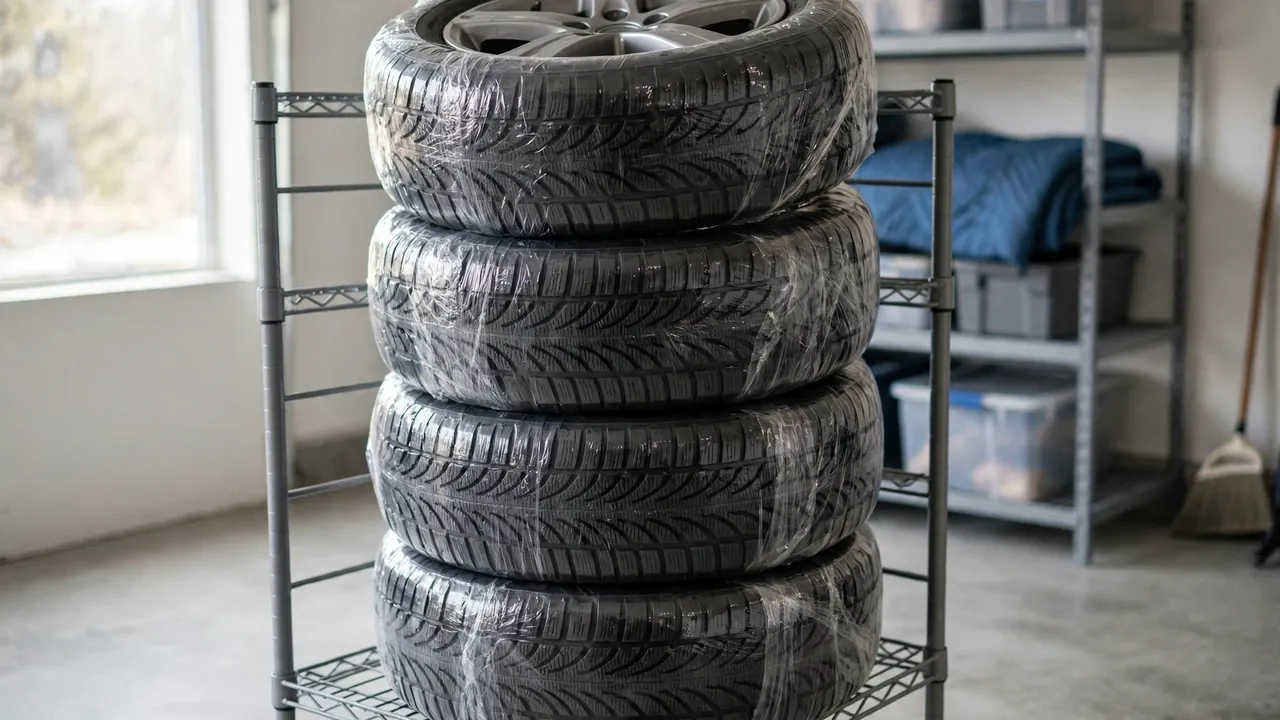
Twice a year, every Canadian driver with two sets of tires faces the same question, and it is not really about the swap — it is about where the off-season set lives for the next six months. The wrong answer is the garage floor in a sunny spot, or stacked under a tarp outside. Tires age faster in heat, sunlight and ozone — the same forces that harden the rubber compound and shorten tire life — so a winter set left baking in a hot garage all summer comes back measurably harder, and a summer set left freezing in an unheated shed is not much better. The right answer is cool, dark, dry, and off the concrete, whether that space is yours or a shop's.
Home storage is free, and done right it is perfectly good. Clean each tire with soap and water and let it dry, because road salt and brake dust left on the rubber keep working all summer. Store tires on their rims standing upright, or stacked flat in a pile no more than four high; store tires without rims standing upright and rotate them monthly so they do not flat-spot. Bag each tire in a sealed plastic bag with the air squeezed out — it slows oxidation — and keep them away from electric motors, furnaces and solvents, which produce the ozone that cracks rubber. Never store tires on bare concrete, which wicks moisture, and never in direct sunlight, even through a window. Mark each tire with its corner — front left, rear right — with chalk, so the rotation pattern is obvious when the set goes back on. If your home is a condo with no storage room, a balcony that bakes in the sun, or a garage already full, home storage is not free at all — it is the reason your tires age early.
Shop storage is the alternative, and its price is now well documented. Cansumer's collected Canadian prices put shop storage at $60 to $100 per season, with independents around $40 to $80, Kal Tire in Winnipeg at $90 to $100, and dealerships around $100. Canadian Home Binder's 2026 guide puts it at $60 to $120 per season, and Ridez's 2026 breakdown agrees on the split: dealerships in Toronto, Vancouver and Montreal charge $80 to $150 per season for climate-controlled storage, while independent shops and tire chains typically charge $50 to $100. Local examples confirm the range from below: Driver Tires in Edmonton posts $60 to $100 per season for a set of four, $70 to $110 with rims, and Saskatoon Auto Connection charges $80 a season for climate-controlled storage with a free tire health report. The spread is mostly about what you are buying — a bare rack in a warehouse costs less than a climate-controlled, insured, bar-coded tire hotel that photographs your tread and flags wear before the season starts.
The decision is a simple comparison. If you have a cool, dark basement corner and you will actually bag the tires and mark the corners, keep the $60 to $120 a season. If you live in a condo, if the only space is a sun-baked balcony or a damp garage, or if you simply will not do the work, shop storage pays for itself in tire life alone — a set of tires that lasts one season longer because it was stored properly is worth far more than the storage fee. Either way, ask the shop four questions before you hand over the keys: is the price per season or per year, is the storage insured against fire and theft, will the tires be inspected and the tread depth reported when they come out, and is the swap bundled or billed separately — a "$79.95 changeover" that quietly adds storage on top is not the deal it looked like. Some shops bundle storage with the changeover, which is worth asking about; the annual math for a typical driver is two swaps at $40 to $80 each plus storage, or roughly $140 to $280 a year all-in, and that number belongs in your ownership budget next to the tires themselves. See Winter Tires and Seasonal Changeover Cost in Canada for the swap pricing, and How Old Is Too Old for Tires? The DOT Code Explained for why storage conditions matter to tire age. Price your own setup on the RepairPrice calculator (calculator.php) before the season turns.
Common questions:
Q: How much does tire storage cost in Canada? A: Typically $60 to $100 per season according to Cansumer's collected Canadian prices, or $60 to $120 per season per Canadian Home Binder's 2026 guide. Dealerships in big cities charge $80 to $150 for climate-controlled storage; independents and chains typically charge $50 to $100.
Q: How should I store tires at home? A: Clean and dry, bagged in sealed plastic, in a cool, dark, dry place off bare concrete, away from sunlight, ozone from electric motors, and solvents. Tires on rims stand upright or stack flat; tires off rims stand upright. Mark each tire's corner with chalk.
Q: Is tire storage worth it? A: Yes if you have no cool, dark space at home — a condo balcony or a hot garage ages tires early, and one extra season of tire life is worth far more than $60 to $120. If you have a proper basement corner and will bag and mark the tires, home storage is fine.
Q: Does tire storage include the changeover? A: Sometimes. Some shops bundle storage with the seasonal swap and some bill it separately, so ask before you book. The typical annual total is two swaps at $40 to $80 each plus $60 to $120 of storage.
| Service | Typical range (CAD) | Notes |
|---|---|---|
| Seasonal changeover, car | $75–$105 | Wheels already mounted, about 0.8 h labour |
| Seasonal tire storage, shop | $60–$120 | Cansumer: $60–$100; dealers $80–$150 in big cities |
| Tire rotation, car | $40–$50 | Add it when the set goes back on |
| Wheel balancing, set of 4, car | $55–$110 | After storage, before the season |
| Tire puncture repair | $40–$70 | Slow leak found after storage |
| One TPMS sensor, car | $115–$230 | Sensor batteries die in storage |




 RepairPrice
