
Power Steering Flush Cost in Canada
By Oleksandr Potapenko · 2026-11-16 · How we research prices
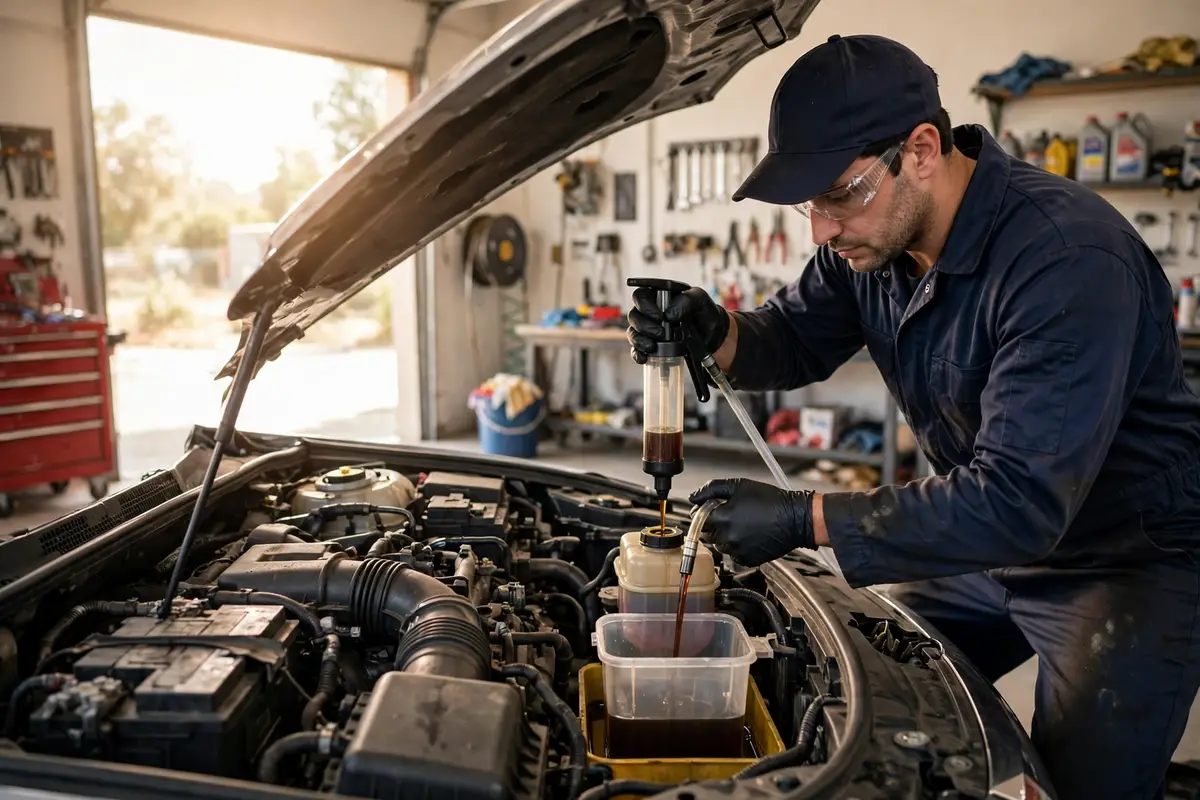
A power steering flush is the cheapest insurance in the whole steering system, and it is the service most drivers skip. The fluid does more than transmit pressure — it lubricates the pump and rack, conditions the seals, and carries heat away. Over time it breaks down, darkens, and collects metal particles from normal wear, and degraded fluid accelerates wear on the pump and rack it is supposed to protect. A pump costs $500 to $1,000 CAD to replace and a rack $1,400 to $2,500 CAD; the flush that protects both costs about a tenth of either. That is the whole case for doing it.
The price is small and the sources agree within a narrow band. A professional flush runs $80 to $150 USD at most American shops, and a full flush — as opposed to a simple fluid change — runs $170 to $205 USD according to AutoNation's service guide. A basic fluid replacement alone is $60 to $125 USD. Converted at a rough 1.39 and adjusted for Canadian shop rates, a typical Canadian car runs about $110 to $210 CAD for a full flush at an independent shop, with SUVs and trucks around $130 to $240 CAD and luxury models around $160 to $280 CAD. The do-it-yourself version is $15 to $40 USD in fluid and tools, but it is a messy job and a mistake — the wrong fluid, or air left in the system — costs more than the saving. RepairPal and CarMD industry data put the same service at $100 to $250 USD, which brackets the same range from above. Kelley Blue Book agrees at the top end: its national estimate is $172 to $204 USD for a flush, and its own guide notes a flush typically costs less than $200 at a dealership — the same band as AutoNation's full-flush figure, and the reason a quote near $200 USD is a full-system exchange, not a reservoir top-up.
Here is the distinction that matters, because it is where the upsell lives. A reservoir siphon — sucking the old fluid out of the reservoir and pouring fresh fluid in — is not a flush. It replaces perhaps a third of the fluid and leaves the old, dirty fluid in the rack and lines. A real flush exchanges the fluid in the whole system: reservoir, pump, rack, and hoses. Some shops use a flush machine, others cycle the fluid by turning the wheel lock to lock with the return line disconnected; either method works if it moves the full volume through. When a shop quotes a flush, ask one question: does it exchange the whole system or just the reservoir? If the answer is the reservoir, you are paying flush money for a top-up.
How often? The honest answer is that there is no single factory number, and the sources reflect that. Most manufacturers list an interval somewhere between 50,000 and 100,000 miles, and shop guidance commonly lands at every 30,000 to 60,000 miles, or every two years — AutoNation's guide says most vehicles need a change every 40,000 to 80,000 miles. The practical rule is simpler: check the fluid. Fresh fluid is red or amber and clear. Dark brown or black fluid, or fluid that smells burnt, is overdue regardless of mileage, and fluid with visible metallic particles means wear is already accelerating. Pair the flush with other steering work when you can. If a shop replaces a pump, a rack, or a hose, the system is open and drained anyway, so fresh fluid should be part of that job rather than a separate visit. Our guides Power Steering Pump Replacement Cost in Canada and Steering Rack Replacement Cost in Canada both assume fresh fluid is included — confirm it, because a new pump fed by contaminated fluid will whine just like the old one.
Use the correct fluid, because power steering fluid is not universal. Some manufacturers specify automatic transmission fluid, others specify a dedicated fluid — the reservoir cap or owner's manual says which, and the wrong fluid can damage seals. If a shop proposes a universal fluid for a car that specifies a particular one, ask why. And note the limit of this guide: it applies only to hydraulic steering. Most new cars use electric power steering, which has no fluid to flush. If your car has electric steering and a shop quotes a power steering flush, that is a red flag — there is nothing to flush, and the quote is either a mistake or a test of whether you are paying attention. For hydraulic cars, a flush every few years, or whenever the fluid looks dark, is inexpensive protection for a pump and rack that together cost well over a thousand dollars to replace. Check the price on the RepairPrice calculator (calculator.php) before you book it, and if the quote is above the range, ask whether it includes a leak inspection — the two jobs belong together.
Common questions: Q: How much does a power steering flush cost in Canada? A: About $110 to $210 CAD for a full flush on a typical car at an independent shop, with larger vehicles higher. A reservoir-only fluid change is cheaper but is not a full flush. Q: How often should power steering fluid be changed? A: Most guidance lands between 30,000 and 60,000 miles, or every two years, but the real test is the fluid itself: dark, burnt-smelling fluid is overdue at any mileage. Q: What is the difference between a flush and a fluid change? A: A flush exchanges the fluid in the whole system — pump, rack and lines. A reservoir siphon replaces only the fluid in the reservoir and leaves most of the old fluid behind. Q: Does my car need a power steering flush? A: Only if it has hydraulic steering. Electric power steering has no fluid, so there is nothing to flush — a quote for one on an electric-steering car is a red flag.
| Job | Typical range, independent shop | Notes |
|---|---|---|
| Power steering flush, car | $110–$210 | Full-system flush; US pro flush $80–$150, full flush $170–$205 (KBB $172–$204) |
| Power steering flush, SUV/truck | $130–$240 | Larger system |
| Power steering flush, luxury | $160–$280 | Parts and labour rate |
| Reservoir siphon only | Not a full flush | Leaves old fluid in rack and lines |
| Electric steering cars | No flush exists | No fluid in the system |


 RepairPrice
