
How to Read a Repair Estimate, Line by Line
By Oleksandr Potapenko · 2026-11-16 · How we research prices
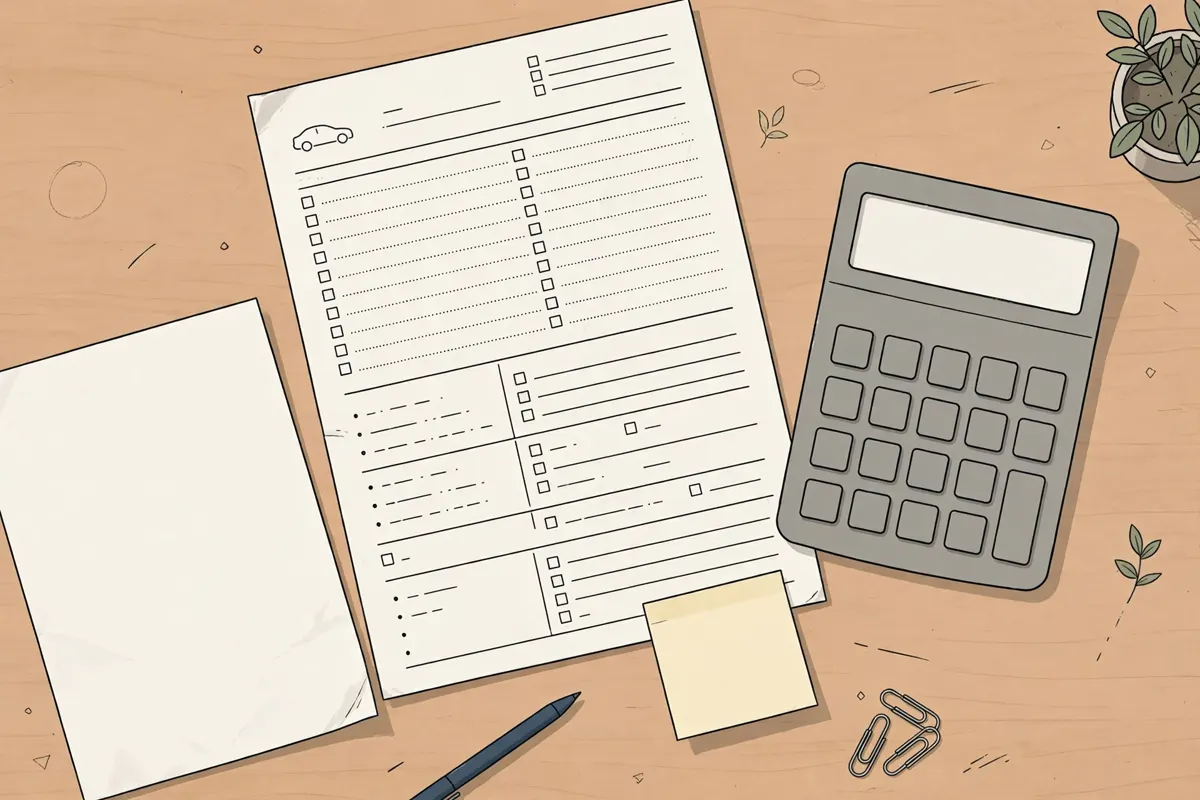
Take a real estimate and read it the way an auditor would, one line at a time, and the document stops being intimidating. Most estimates have the same six or seven lines, in the same order, and each line answers exactly one question. This guide walks through a sample estimate for a front brake job on a 2019 Honda Civic, line by line, so you can read your own estimate the same way and spot the line that does not belong.
The first line is the complaint and the diagnosis, and it is the line most people skip. It should say what is wrong in plain language, what was measured, and why the repair is needed. "Front pads at 2 mm, rotors below minimum thickness, replace pads and rotors" is a diagnosis. "Brake work" is not. If the diagnosis is vague, every line below it is built on sand, because you cannot verify a repair for a problem that was never described. Ask for the measurement: pad thickness in millimetres, rotor thickness against the minimum stamped on the rotor, a fault code number, a leak location. A shop that measured something can tell you the number.
The second line is parts, and it should name each part, its brand or origin, and its price. "Front brake pads, ceramic, $85; front rotors, pair, $160" is readable. "Brake parts $400" is not, and it is the most common hiding place on an estimate. Ask for the breakdown, and check the price against retail. Shops mark parts up 20 to 50 percent over wholesale, according to EngineerFix, so a part at up to about 50 percent above retail is normal. Triple retail is not. Also check the origin: OEM, factory original, aftermarket, or used. Aftermarket parts typically cost 40 to 60 percent less than the equivalent factory part, according to EngineerFix, so an estimate that charges factory prices for aftermarket parts is overcharging you on that line alone. The part's warranty lives here too. A shop-supplied part usually carries a one-to-three-year parts-and-labour warranty. A used part may carry 30 to 90 days, if any.
The third line is labour, and it should show hours multiplied by the hourly rate, not a single labour total. "Labour: 1.5 hours at $150 per hour, $225" is checkable. "Labour $450" is not. The hours should match the book time from the Mitchell 1 or Alldata labour guides for your exact car: front brake pads on a 2019 Civic take about 1.2 hours, an alternator takes one to three hours, a timing belt takes three to five hours. Ask the shop to show you the book time. The rate should sit inside the local band: WarrantyChick's August 2026 guide puts Canadian independents at $120 to $180 an hour and dealers at $160 to $210, while Tekmetric's June 2026 index puts the US average at $132 an hour. If the hours are double the book time, or the rate is far above the local band, that line is where the overcharge lives.
The fourth line is shop supplies, and it is the smallest line that causes the most arguments. A few dollars, or a small percentage of the bill, is normal: rags, cleaners, grease, disposal. A fee of $80 or $100 with no explanation is padding, and it is one of the red flags that repair-cost researchers list most often. Ask what was used. If the answer is a shrug, ask for the fee to be removed. The same test applies to environmental and hazardous-waste fees charged as a straight percentage of the bill with no explanation of what was disposed of.
The fifth line is taxes, and there is little to argue about except the arithmetic. Taxes are added on top of the subtotal, and the rate is your provincial or state rate. What matters is that the tax is calculated on the subtotal shown, not on a larger number, and that a diagnostic fee or a fee you already paid is not taxed twice. Check the multiplication. It takes ten seconds, and errors here are more common than anyone admits.
The sixth line is the one that is missing, and missing lines are where surprise bills come from. After suspension work, an alignment is usually needed, and it costs $100 to $200 on its own. After a brake job, new hardware, clips, and brake fluid may be needed. A timing belt job needs coolant, and often a water pump and tensioners. If those items are not on the estimate, they will appear on the final invoice as additions, and the total will jump. In Ontario, the Consumer Protection Act protects you here: a shop cannot bill more than 10 percent above its written estimate without your consent. Ask, before approving, "Is everything needed for this repair on this estimate, including the alignment, the hardware, and the fluids?" Get the answer in writing, with the words "no additional charges without my approval" on the estimate itself.
The last line is the warranty and the authorization. A reputable shop offers at least one year on parts and labour, in writing. A 30-day warranty on a major repair is a warning sign, not a deal. And the authorization line is the one that protects you most: sign only for the work listed, and write "call me before any additional work" next to your signature. The US Federal Trade Commission advises exactly this: get a written estimate before work starts, and ask the shop to contact you before it exceeds that amount. If the final invoice has a line you did not approve, that line is the dispute, and your written estimate is the evidence. Before you sign, compare the job with the typical range for your vehicle in the RepairPrice calculator at calculator.php, and read "How Do I Check If a Repair Quote Is Fair?" for the five-minute version of the same checks.
Common questions:
Q: What should a repair estimate include?
A: A plain-language diagnosis with measurements, each part named with its brand or origin and price, labour shown as hours times the hourly rate, shop supplies and other fees itemized, taxes on the subtotal, the warranty terms, and an authorization line. The Federal Trade Commission advises getting all of it in writing before work starts. A lump-sum total with no breakdown is not an estimate you can verify.
Q: How do I know if the labour hours on my estimate are fair?
A: Compare them with the book time from the Mitchell 1 or Alldata labour guides for your exact year, make, and model. Front brake pads on a 2019 Honda Civic take about 1.2 hours, an alternator one to three hours, a timing belt three to five hours. RepairPal's estimator, updated in September 2026, gives the same check for free. Hours at double the book time mean the estimate is padded.
Q: What is a normal shop supplies fee?
A: A few dollars, or a small percentage of the bill, to cover rags, cleaners, grease, and disposal. A fee of $80 or $100 with no explanation is padding, and it is one of the most common red flags on repair estimates. Ask what was actually used, and ask for the fee to be removed if the shop cannot explain it.
Q: Can a shop charge me more than the estimate?
A: In Ontario, no, not by more than 10 percent above the written estimate without your consent, under the Consumer Protection Act. Everywhere else, the protection is your written authorization: sign only for the work listed, write "call me before any additional work" on the estimate, and refuse to pay for any line you did not approve. Keep the estimate and the final invoice together; the difference between them is the dispute.
| Estimate line | What it means | Watch for |
|---|---|---|
| Diagnosis | Plain-language problem with measurements (pad mm, fault code) | Vague wording like "brake work" with no numbers |
| Parts | Named part, OEM, aftermarket, or used, with a price each | "Brake parts $400" with no detail; factory price for aftermarket parts |
| Labour | Hours × rate, shown separately | Inflated hours vs the Mitchell 1 / Alldata book time |
| Shop supplies | Small fee, a few dollars or a small % | $80–$100 with no explanation |
| Taxes | Added on top of the subtotal | Tax calculated on a larger number; double-taxed fees |
| Missing items | Alignment after suspension, hardware, disposal, coolant, fluids | Surprise additions later; Ontario 10% over-estimate cap protects you |
| Warranty and authorization | At least 1 year parts + labour in writing; sign only for listed work | 30-day warranty on a major repair |




 RepairPrice
