
Dashboard Warning Lights: What Each One Means
By Oleksandr Potapenko · 2026-11-16 · How we research prices
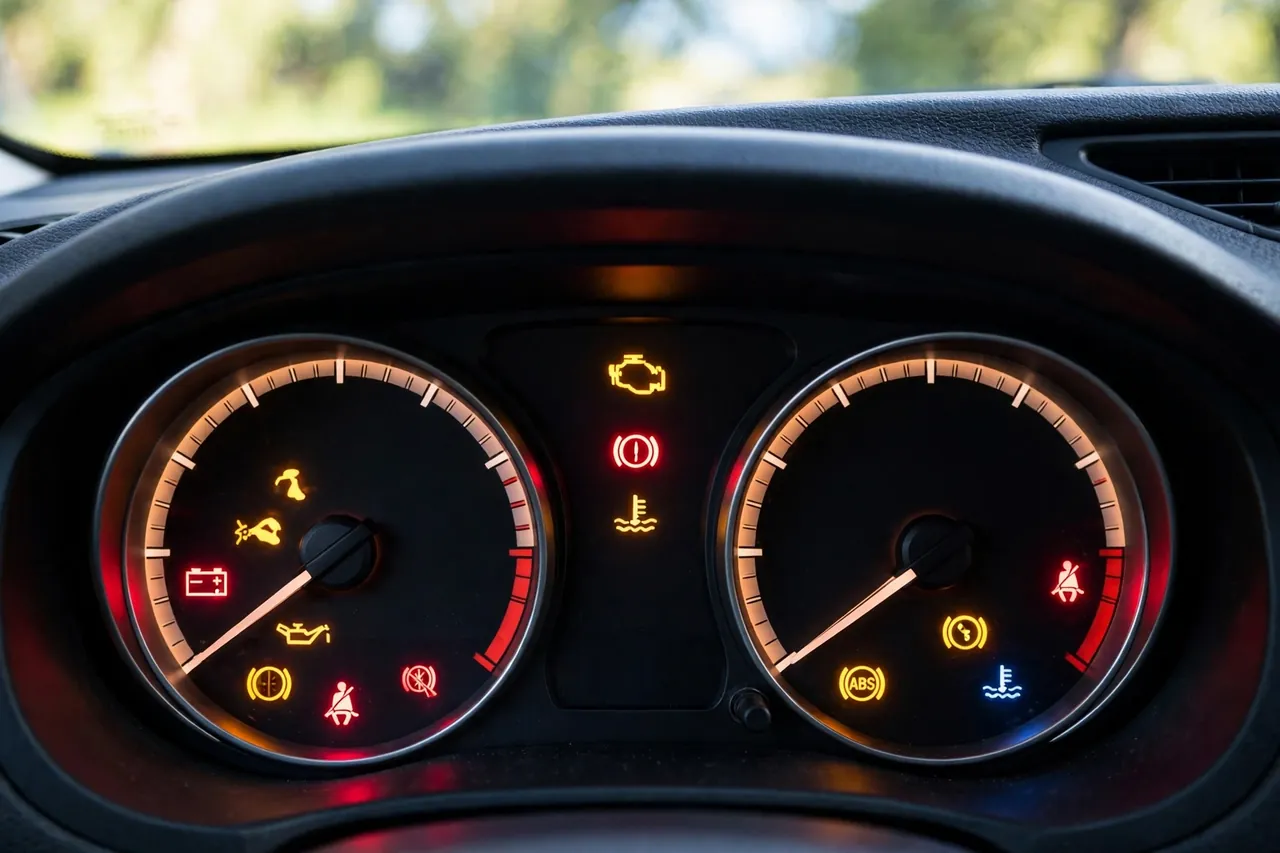
Every light on your dashboard speaks in colour before it speaks in words, and the colour is the whole message. Red means stop. Amber means book a shop soon. Green and blue mean something is on and working. If you remember nothing else from this guide, remember that one rule, because it is the rule that keeps a $200 sensor from becoming a $1,500 converter or a $4,000 engine.
Red lights are the ones that can end your car's life in minutes. The red oil can means oil pressure has dropped, not that the oil is a little low — pull over, turn the engine off, and check the level only after the car has sat for a few minutes, because driving on with no oil pressure destroys bearings with every revolution. The red thermometer means the engine is overheating, and the same stop applies: an overheated engine can warp a cylinder head, and a warped head is a four-figure repair. The red battery light means the charging system has stopped charging, and you have twenty to forty minutes of battery power before the car stalls. The red brake light can mean the parking brake is on, the brake fluid is low, or the braking system has a fault — if the pedal feels wrong as well, stop. A flashing red light of any kind outranks a steady one. The one exception to the panic rule is a faulty sensor: an oil pressure sensor can fail and mimic low oil pressure, and in Canada that sensor typically costs $135 to $250 CAD to replace — but you cannot know it is the sensor until a mechanic checks the actual pressure, so never assume.
Amber lights are the working lights, and the check engine light is the one you will see most. A steady check engine light means a fault is stored; book a diagnostic within the week. A flashing check engine light means an active misfire, and unburned fuel is heading for the catalytic converter — ease off and get to a shop the same day. CarMD's 2026 Vehicle Health Index, built from more than 39 million vehicles, puts the average check engine repair at a record $554 USD, and the ten most common causes include a catalytic converter at $1,511 USD, an oxygen sensor at $287, ignition coils and spark plugs at $480, a mass air flow sensor at $346, and an ABS wheel speed sensor at $314 — which is why the ABS light belongs in this list too. The ABS light on its own means the anti-lock system is off, and your ordinary brakes still work, but you have lost the system that keeps the wheels from locking in a panic stop; in Canada an ABS wheel speed sensor typically costs $155 to $310 CAD. The traction control light that comes on with it usually means the same sensor. The tire pressure light — TPMS — is the most ignored amber light on the dashboard: check the pressures first, because cold weather drops tire pressure by roughly 1 PSI for every 5 to 6 degrees Celsius, and a light that will not reset after inflation usually means a dead TPMS sensor, typically $115 to $230 CAD each in Canada. The airbag light means the restraint system has a fault and may not deploy in a crash; it is not a drive-it-for-a-month light.
Green and blue lights are information, not warnings. A green headlight or cruise control indicator, a blue high-beam indicator, a green ECO light — all of these mean a system is switched on. The one green light that confuses people is the shift indicator on some cars, which is only a suggestion. Nothing green or blue on your dashboard has ever meant stop driving.
The decision rule, light by light, is this. Red: pull over safely, turn the engine off, call for help. Flashing amber: drive gently to the nearest shop today. Steady amber: book a diagnostic within the week and do not clear the code first — clearing it erases the evidence the technician needs, and on some cars it resets the emissions monitors. A professional diagnostic scan in Canada typically costs $95 to $130 CAD and is often credited toward the repair; in the United States, RepairPal puts general diagnosis at $122 to $179 USD and check engine diagnosis at $122 to $233 USD. If you own an OBD2 scanner, read the code before your appointment and write it down — a P0420 converter code, a P0300 misfire code, and a P0171 lean code point at three very different repairs, and knowing which one you have makes the shop visit shorter and cheaper. For the full price picture behind the check engine light, read My Check Engine Light Is On — How Much Will the Diagnostic Cost?, for the ABS light specifically, read ABS Light On: Causes and Repair Cost in Canada, and run any quote through the RepairPrice calculator (calculator.php) before you authorise it. One last rule worth keeping: a light that comes on and goes off by itself has still stored a code, and that code is still worth reading. Intermittent faults are the ones that become expensive, because they are the ones people ignore until they stop being intermittent.
Common questions:
Q: What does a red oil light mean? A: Low oil pressure, not just low oil level. Pull over, turn the engine off, and do not keep driving. A faulty oil pressure sensor can mimic the same light, and replacing it typically costs $135 to $250 CAD, but only a pressure test can prove it is the sensor.
Q: Can I drive with the ABS light on? A: Yes, cautiously, to a shop. Your ordinary brakes still work, but the anti-lock system is off, so the wheels can lock in a hard stop. The most common cause is a wheel speed sensor, typically $155 to $310 CAD in Canada.
Q: Why does my tire pressure light stay on in winter? A: Cold air contracts, and tire pressure drops roughly 1 PSI for every 5 to 6 degrees Celsius. Inflate the tires to the pressure on the driver's door sticker, not the number on the tire. If the light will not reset, a TPMS sensor has usually died.
Q: My check engine light is flashing. How urgent is it? A: Very. A flashing light means an active misfire is sending unburned fuel into the catalytic converter, which CarMD prices at an average of $1,511 USD to replace. Ease off the accelerator and get to a shop the same day.
| Light or part | Typical range (CAD) | Notes |
|---|---|---|
| Diagnostic scan | $95–$130 | Often credited toward the repair |
| Ignition coil, each, car | $135–$285 | Common check-engine cause |
| Oxygen sensor, car | $175–$350 | Common check-engine cause |
| ABS wheel speed sensor, car | $155–$310 | ABS + traction lights together |
| Oil pressure sensor, car | $135–$250 | A faulty sensor can mimic low oil pressure |
| TPMS sensor, each, car | $115–$230 | Tire pressure light that will not reset |
| Battery replacement, car | $170–$305 | Battery light in winter — test charging first |

 RepairPrice
