
Catalytic Converter Replacement Cost in the USA
By Oleksandr Potapenko · 2026-11-16 · How we research prices
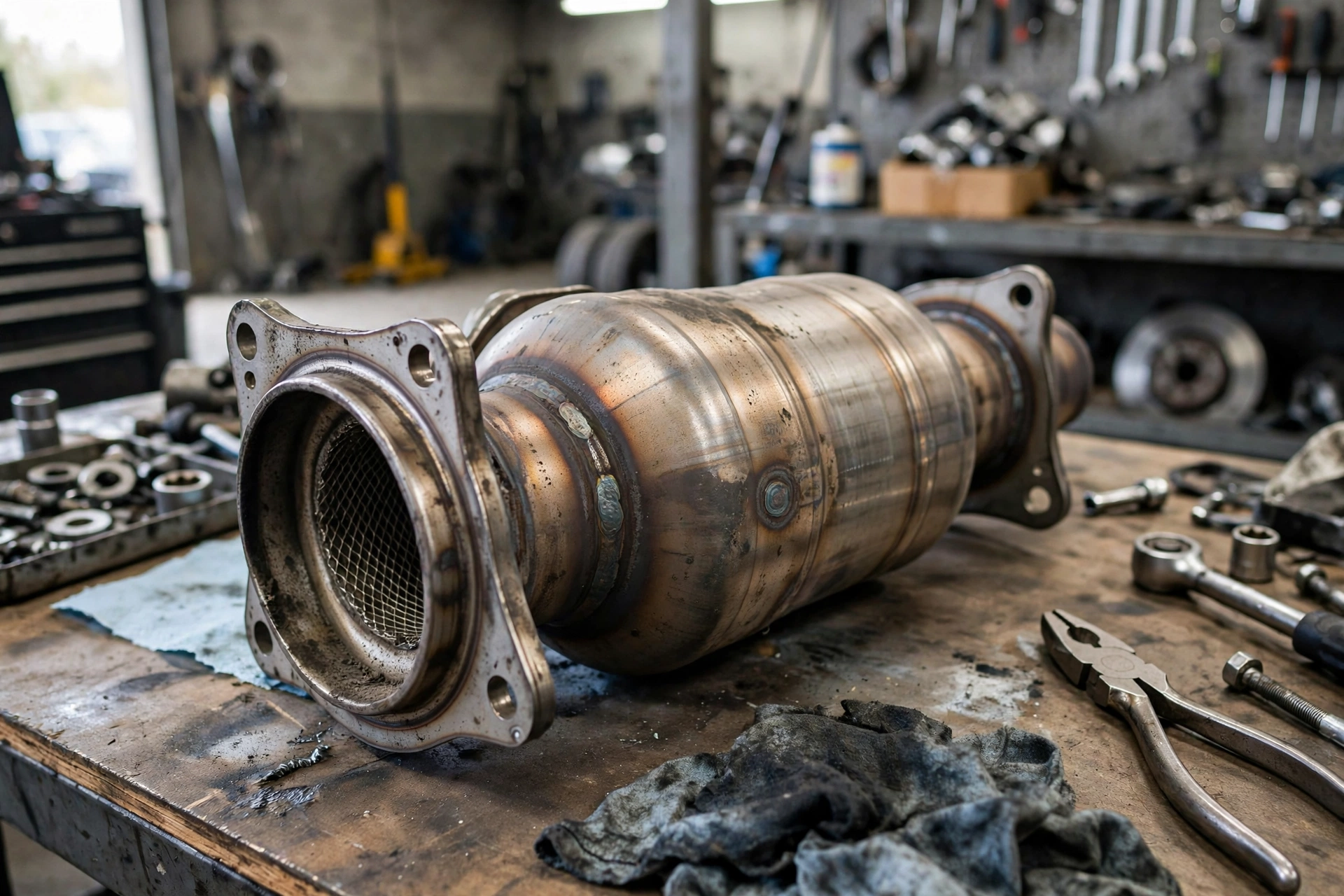
Two respected sources give you two different answers for the same job, and both of them are right. AAA says replacing a catalytic converter in the USA typically costs $1,000 to $4,000 for parts and labour. RepairPal, whose estimator is built from shop data and was last updated September 3, 2026, puts the national average at $2,280 to $2,480. Edmunds, citing RepairPal, reports a similar average of $2,164 to $2,483. The gap is not a mistake. AAA describes the whole spread of real jobs, from a cheap universal converter on an old sedan to a factory converter on a truck with two of them, while RepairPal's average prices a near-OEM converter at list price on a typical car. Fixxr, a 2026 repair-cost guide, makes the same point from the shop floor: RepairPal's $2,293 to $2,468 comes with $2,062 to $2,130 of that in parts, because it prices near-OEM converters, while the most common real ticket, a direct-fit aftermarket unit at an independent shop, runs $420 to $1,200 installed. So the number that matters is not the national average, it is which converter your car is getting.
RepairPal's own breakdown, as reported by CarParts.com and JunkCarsUS, is parts of $2,044 to $2,133 and labour of $236 to $347, which is two to three hours at typical rates. AAA breaks it down differently and more usefully for comparing quotes: the part at $300 to $2,500, labour at $160 to $200 an hour, and OEM converters costing 40 to 70 percent more than aftermarket ones. Fixxr's scenario table, built from 2026 shop pricing, fills in the middle: a universal weld-in converter at a muffler shop in an EPA state runs $250 to $700, a direct-fit aftermarket converter bolted on at an independent shop runs $420 to $1,200, an OEM converter at an independent shop runs $950 to $2,750, and a theft replacement on a hybrid or tall truck, with an anti-theft shield added so it does not happen twice, lands at $1,800 to $4,000. The pattern is consistent across every source: the part is most of the bill, the brand of the part decides the bill, and labour is the smaller share.
Why the part costs so much comes down to three metals. A catalytic converter's honeycomb core is coated with platinum, palladium and rhodium, and rhodium, the most valuable of the three, traded at roughly $8,400 per troy ounce on August 29, 2026, according to Kitco, cited by Fixxr. That is why a part a thief can cut off in about 90 seconds still fetches $50 to $800 at a scrapper, and why the converter is the most stolen part on American cars. Trucks, SUVs and hybrids are the top targets, because the converter is easy to reach underneath and hybrids carry more precious metal. A stolen converter is the same $1,000 to $4,000 repair, plus cut pipes and sensors, and comprehensive insurance usually covers it minus your deductible, so check the deductible before paying out of pocket. A catalytic converter shield, a metal plate bolted under the car, costs $200 to $500 installed and is the best prevention on a high-risk vehicle.
California is the expensive exception, and it is not just California any more. Four states now require CARB-certified aftermarket converters with an Executive Order number stamped on the shell: California, New York, Colorado and Maine, according to Walker's emissions guidance cited by Fixxr. A federal EPA converter is illegal to sell or install in those states and will fail the smog check. Fixxr puts a CARB-compliant replacement at $650 to $2,000, and on some cars the CARB converter alone can run $1,000 to $2,000 more than the federal version. If you live in one of those four states, confirm the quote is for a CARB-compliant converter before you approve anything, and if a quote looks suspiciously cheap in California, that is usually why.
The most important thing to know is the same in the USA as anywhere else: a catalytic converter rarely fails on its own. It is usually killed by something upstream, an engine misfire that dumps raw fuel into the exhaust, a bad oxygen sensor that makes the engine run rich, or an oil leak that coats the catalyst. If a shop replaces the converter without fixing the cause, the new converter will fail within months and the warranty will not cover it, because the warranty covers the part, not the misfire that killed it. The check engine light will usually show code P0420, catalyst system efficiency below threshold on bank 1, or P0430 for bank 2, but a P0420 does not always mean a dead converter: a lazy oxygen sensor can trigger it too, which is why the diagnosis matters more than the part number. Ask for the diagnostic codes and the oxygen sensor readings that prove the converter is dead, and ask what killed it. For the sensor side of the bill, see Oxygen Sensor Replacement Cost in the USA, and for the Canadian version of this same repair, see Catalytic Converter Replacement Cost in Canada.
Finally, the repair-versus-scrap rule. A converter should last 100,000 to 150,000 miles on a well-maintained car, according to TheMotorGuy and MyApexDriver, and a factory converter can last the life of the vehicle, while quality aftermarket converters typically last 50,000 to 80,000 miles. On a car worth $3,000, a $2,400 converter job is most of the car's value, and the honest question is whether the rest of the car justifies it. If the car is otherwise solid and you plan to keep it for years, an aftermarket direct-fit converter at $420 to $1,200 is the sensible call. If the car has rust, a failing transmission and a converter that just died, the converter is the moment to stop spending. Either way, get the quote itemized, check it against the RepairPrice calculator (calculator.php) for your exact year, make and model, and get a second opinion if the number lands well above the range in the table.
Common questions:
Q: How long does a catalytic converter last? A: Most last 100,000 to 150,000 miles, according to TheMotorGuy and MyApexDriver, and a factory converter on a well-maintained car can last the life of the vehicle. Misfires, oil burning and coolant leaks can shorten that to 50,000 miles, while quality aftermarket converters typically last 50,000 to 80,000 miles.
Q: Can you drive with a bad catalytic converter? A: It depends. A converter that has simply lost efficiency, with a steady check engine light and no other symptoms, can usually be driven for a short time while you book the repair, according to MyApexDriver. A clogged converter that cuts power, or a flashing check engine light, means stop driving and get it towed, because restricted exhaust flow can overheat and damage the engine.
Q: Which states require CARB-compliant catalytic converters? A: Four states require CARB-certified aftermarket converters: California, New York, Colorado and Maine, according to Walker's emissions guidance. A federal EPA converter is illegal to sell or install in those states and will fail the smog check.
Q: Does insurance cover a stolen catalytic converter? A: Usually yes, under comprehensive coverage, minus your deductible. Normal wear and failure are not covered, but theft is, which is why you should check the deductible before paying out of pocket, and consider a $200 to $500 anti-theft shield on a high-risk vehicle.
| Vehicle / situation | Typical range (USD) | Notes |
|---|---|---|
| Standard car (RepairPal national average) | $2,280–$2,480 | Parts $2,044–$2,133, labour $236–$347 |
| Typical aftermarket job | $420–$1,200 | Direct-fit unit at an independent shop (Fixxr) |
| California (CARB-compliant) | $650–$2,000+ | CARB converter; also required in NY, CO, ME |
| Truck / SUV | Above average | Larger converter; also top theft target |
| Converter shield (prevention) | $200–$500 installed | Best theft protection on high-risk cars |


 RepairPrice
