
Car Pulls to One Side: Causes and Repair Cost
By Oleksandr Potapenko · 2026-11-15 · How we research prices
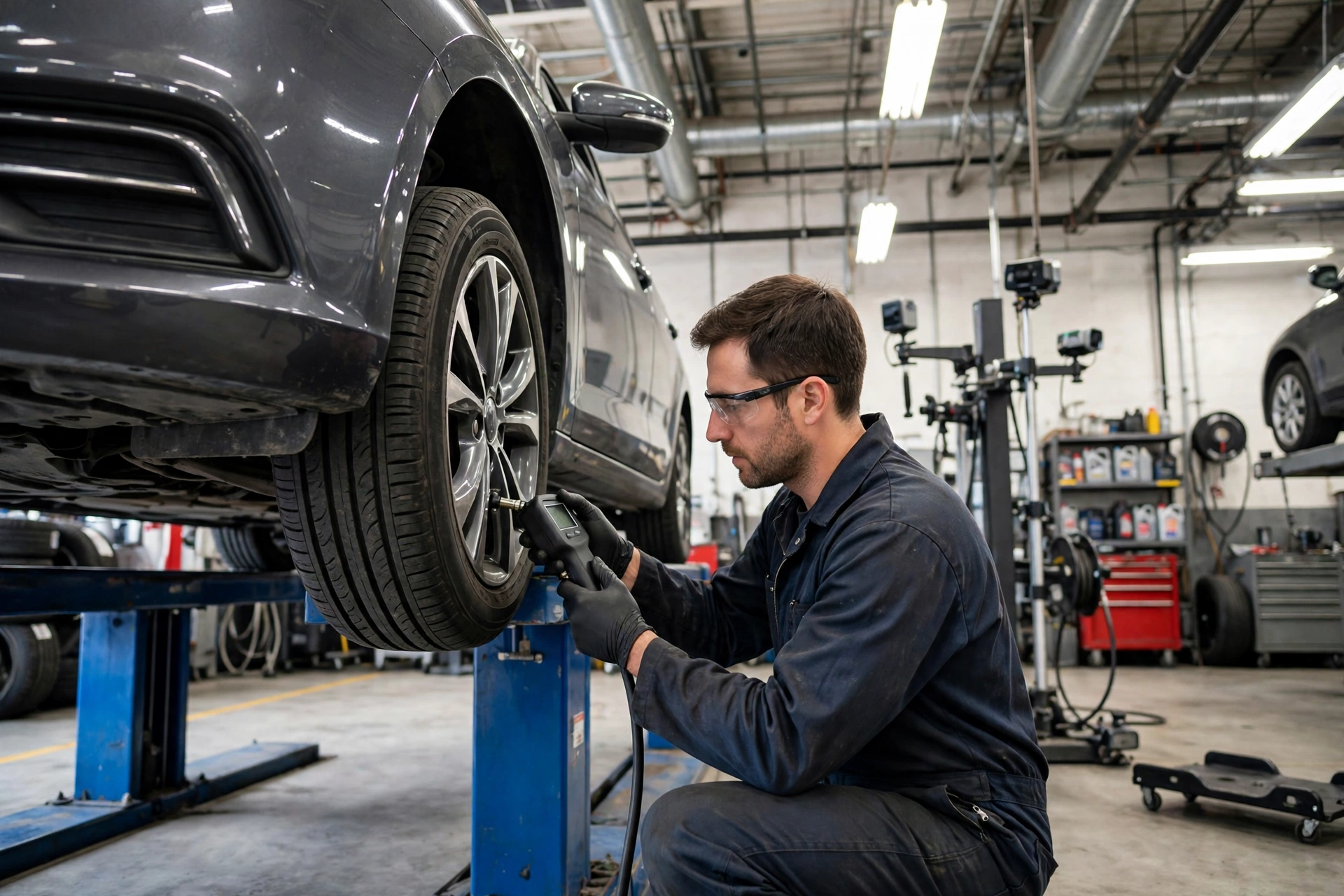
A car that pulls to one side is one of the most common driving complaints, and also one of the most misdiagnosed — the fix ranges from free to well over $1,000, and the first job is to work out when the pull happens. Start with the free checks: tires cause more pulls than anything else. A tire 5 to 10 PSI lower than its partner on the same axle rolls with more resistance and drags the car toward the soft side, so check all four pressures cold, against the figure on the driver's door jamb, not the number molded on the tire. Most roads are crowned — slightly higher in the middle so rain runs off — so a gentle drift right on a straight, flat road can be normal. What is not normal is a steady tug forcing you to hold the wheel just to stay in your lane.
The one question that sorts the causes: does it pull only when you brake, or all the time? Pulling only under braking almost always means a brake problem — usually a sticking caliper or a collapsing flexible brake hose on one side — while drifting at constant speed points to tires, alignment or worn steering and suspension parts. A pull only under hard acceleration in a powerful front-wheel-drive car is often torque steer, normal to a degree, not a fault. Can I keep driving with my car pulling to one side? A mild, steady pull is usually safe to drive carefully to a shop — but a sudden strong pull, loose or vague steering, or a hot or smoking wheel means pull over and stop: a seized caliper can overheat a rotor, and a failed ball joint can let a wheel fold under the car.
Diagnose cheapest first. After pressure, swap the two front tires side to side: if the pull changes direction, the tire is the problem, and a new tire runs about $80 to $250 each by size and brand. Next, the alignment — front-only about $75 to $120, four-wheel about $100 to $275, dealers typically $150 to $250 — but always ask for the before-and-after printout; a shop that will not show the numbers has proven nothing. If the pull appears only when braking, feel the wheels after a short drive: one wheel noticeably hotter points to a dragging brake. Budget about $200 to $400 per caliper, or $100 to $200 per side for a flexible hose, plus pads and a rotor if damaged.
If tires, alignment and brakes check out, the pull comes from worn steering or suspension parts. A tie rod end plus the alignment that must follow runs about $150 to $350 per side; a ball joint about $250 to $500; a control arm about $300 to $700, heavier trucks and SUVs at the top; a wheel bearing about $150 to $400 per wheel, most ordinary cars around $160 to $240, luxury models higher. Never pay for an alignment before worn parts are fixed — an alignment set on loose tie rods or ball joints will not hold, and you will pay for it twice. Clunks over bumps, vague steering, an off-center wheel or one tire wearing an edge faster all point to worn parts. Check the fair price for your exact year, make and model with the RepairPrice calculator first. Why does my car pull only when braking? One side brakes harder than the other — a sticking caliper or swollen hose — a safety repair, not a comfort one. See also our guides on brake caliper, tie rod end, and control arm and ball joint replacement costs in the USA.
| Cause / repair | Typical cost (USD) | How to confirm | Notes |
|---|---|---|---|
| Tire pressure correction | Free | Gauge, tires cold, vs. door placard | A 5–10 PSI gap between same-axle tires pulls the car |
| Front-only wheel alignment | $75–$120 | Alignment printout, before and after | Cheapest paid fix; ask to see the numbers |
| Four-wheel alignment | $100–$275 | Alignment printout, before and after | Dealers typically $150–$250; most modern cars need all four wheels |
| New tire | $80–$250 each | Uneven wear, sidewall damage, age | Price by size and brand; replace in axle pairs where possible |
| Sticking brake caliper | $200–$400 per caliper | One wheel hotter after a drive | Add pads and rotor if overheated; pull appears mainly when braking |
| Flexible brake hose | $100–$200 per side | Hose swollen or collapsed internally | With a caliper, pads and rotor, one corner can approach $1,000 |
| Tie rod end + alignment | $150–$350 per side | Play at 3 and 9 o'clock with the wheel jacked up | Alignment afterward is part of the job, not an upsell |
| Ball joint | $250–$500 per side | Clunk over bumps, play at 12 and 6 o'clock | Safety-critical; a failed joint can let the wheel fold under |
| Control arm | $300–$700 per side | Clunk, wandering, uneven tire wear | Heavier trucks and SUVs at the top; alignment required after |
| Wheel bearing | $150–$400 per wheel | Humming that changes with speed, play in the wheel | Most mainstream cars $160–$240; luxury models higher |
 RepairPrice
