
Car Diagnostic Fee Cost in the USA
By Oleksandr Potapenko · 2026-11-14 · How we research prices
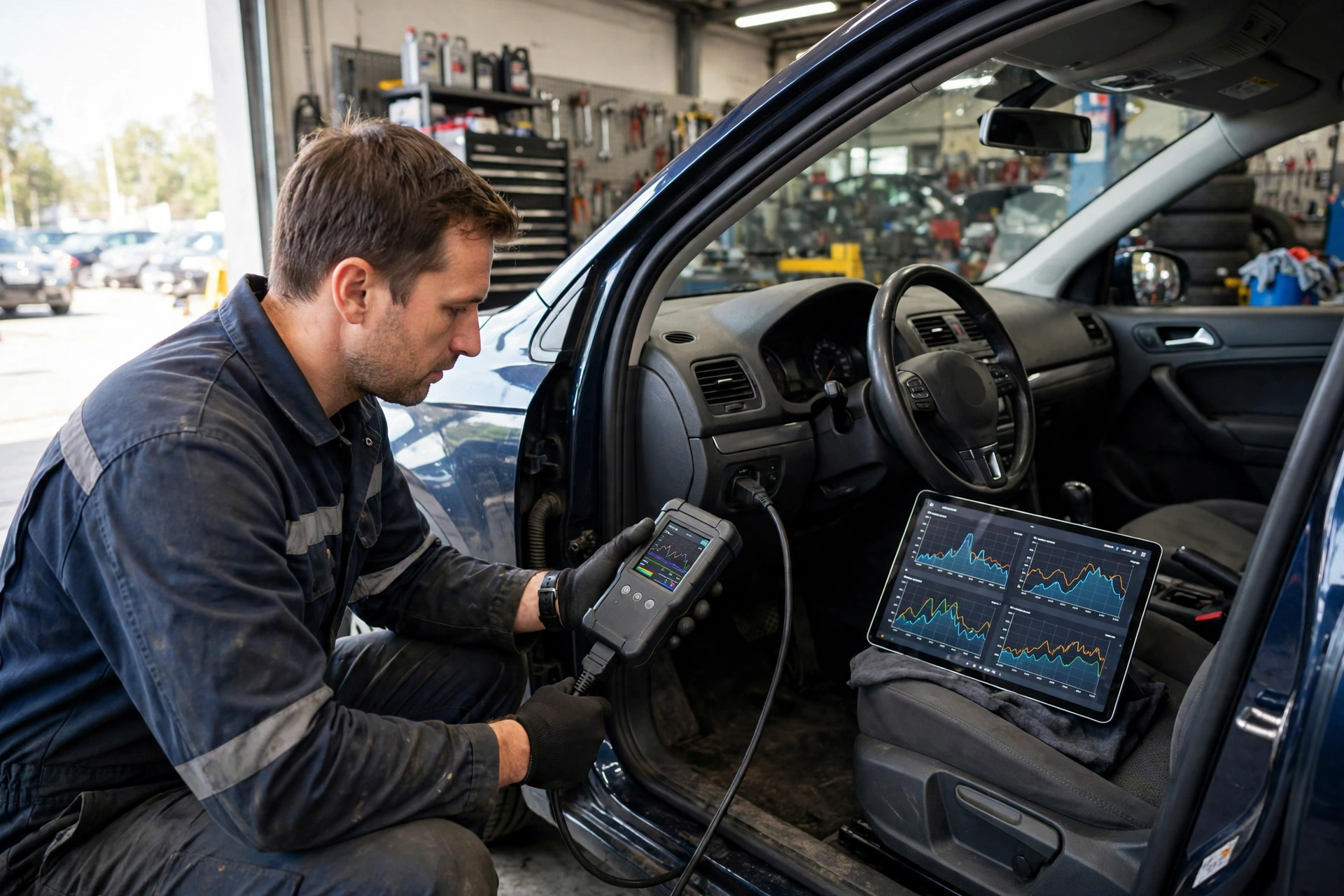
A diagnostic fee is not a charge for plugging in a computer. It is a charge for an hour of a trained technician's time, a $10,000 scan tool, the software subscription that keeps it current, and the testing that turns a code into a cause — and understanding that distinction is the difference between paying $120 once and paying $120 three times for three wrong parts. In the United States, RepairPal's national estimator puts general diagnosis at $122 to $179 USD, and check engine light diagnosis and testing at $122 to $233 USD in its July 2026 estimate. A separate real-invoice dataset from ARI, built from actual completed fleet jobs rather than estimates, puts the median diagnostic at $120 USD. Those two numbers agree with each other almost exactly, and that agreement is the anchor for everything else in this guide: a fair diagnostic fee in America is about $120 to $180, and a quote far outside that range needs an explanation.
Why do the RepairPal numbers themselves disagree? Because they measure two different jobs. The $122 to $179 range is general diagnosis — the category RepairPal uses for a broad fault-finding visit. The $122 to $233 range is check engine light diagnosis and testing specifically, a category that includes more pinpoint testing and therefore a longer labour window, and it is the number secondary guides such as Carista and Uptown Imports cite from RepairPal's July 2026 data. RepairPal's own estimator pages, crawled in November 2026, still show $122 to $179 for the general category, which is why a driver who checks the RepairPal site directly sees the lower number while a driver who reads a guide sees the higher one. Both are RepairPal; they are simply different line items. The NHTSA owner-reported median of $200, drawn from 1,863 complaints between 2024 and 2026, sits higher than both, and the skew is visible in the source: complaints skew toward dealers and toward unresolved disputes, so the median describes the angriest bills, not the typical ones. The ARI median of $120, from invoices that were actually paid, is the better picture of what a normal diagnostic costs.
What the fee buys varies by shop, and that variation is where the money is won or lost. A basic OBD-II scan at a shop, $50 to $100, is a code pull with minimal testing — the code, the freeze-frame data, and a short look at live data. A full diagnosis at an independent shop, $80 to $150, is the scan plus live data plus pinpoint testing of the suspect component, and it ends with a written finding. A dealership charges $120 to $300 or more, and the premium buys factory scan tools, brand-specific procedures, and a recall lookup by VIN — worth it for a warranty issue, a brand-specific electronic fault, or a car under a recall, and rarely worth it for a ten-year-old car with a misfire. A complex or intermittent electrical fault can run $300 to $500, because it needs multi-system testing, test drives, and sometimes leaving the car overnight so the fault can be caught cold. AAA's labour-rate explainer adds the context that makes all of this cohere: shop rates across its approved network range from $47 to $215 an hour, and a diagnostic fee is typically calculated as one to one-and-a-half hours of that rate. The fee is the rate, not the work, which is why the same test costs $85 in one town and $185 in another.
The part nobody tells you is that the diagnostic fee is negotiable in the only way that matters: whether it is credited toward the repair. Most independent shops credit the fee if you have the repair done there, and most dealers do not, or do so only on warranty and recall work. That single policy can make a $180 dealer diagnosis more expensive than a $150 independent diagnosis even before the repair quote arrives, because the independent shop's $150 disappears into the repair bill and the dealer's $180 does not. Ask three questions before authorising anything: is the fee credited toward the repair, what is the time cap before you call me for authorisation, and will I get the trouble code and the test results in writing. A shop that cannot answer those three is a shop that will call you with a $900 estimate for a part you did not authorise. Two more protections come from AAA's guidance: a diagnostic fee appears on the bill when a technician uses the shop's equipment to find the source of a problem, and no shop should do any repair you have not authorised. In California, no charges may accrue until you authorise the work at all.
The decision rule is about matching the shop to the problem. A free code read at AutoZone or O'Reilly, or a $20 to $120 OBD-II scanner of your own, is the right first step for a steady check engine light on a car you know — it tells you the code, and the code tells you whether the problem is a gas cap or a converter. An independent shop's full diagnosis is the right step for anything you cannot see, anything intermittent, and anything where the repair costs more than $300, because the diagnosis is cheaper than the wrong part. The dealer is the right step for warranty work, recalls, and brand-specific electronics, and the wrong step for a general fault on an older car. And when the diagnosis comes back, check it against CarMD's 2026 Vehicle Health Index before you approve the repair: the average check engine repair hit a record $554 USD in 2025, with a catalytic converter at $1,511, an oxygen sensor at $287, and ignition coils and spark plugs at $480 — if your quote for one of those jobs is double the CarMD average, you have a negotiating point or a reason to get a second opinion. Run the numbers through the RepairPrice calculator (calculator.php) first. The diagnostic fee is the cheapest hour you will ever buy on a car, because it is the hour that stops you buying the wrong part.
Common questions:
Q: How much is a car diagnostic fee in the USA? A: RepairPal puts general diagnosis at $122 to $179 USD and check engine light diagnosis at $122 to $233 USD. ARI's median from real paid invoices is $120 USD, and NHTSA owner reports put the median at $200, skewed toward dealer bills. A fair expectation is about $120 to $180 at an independent shop.
Q: Why does RepairPal show two different diagnostic prices? A: They are two different line items. The $122 to $179 range is general diagnosis; the $122 to $233 range is check engine light diagnosis and testing specifically, which includes more pinpoint testing. Both are RepairPal figures from 2026.
Q: Is the diagnostic fee credited toward the repair? A: Often, at independent shops — ask before authorising. Dealers credit it less often, usually only on warranty or recall work. A credited $150 fee costs less than an uncredited $120 fee once the repair is added.
Q: Can I get a free diagnostic? A: A free code read at a parts store is free, but it is a code, not a diagnosis. A real diagnosis — scan, live data, and testing of the suspect part — takes an hour of technician time, and AAA reports that 92 percent of shops now charge for it.
| Diagnostic option | Typical range (USD) | Notes |
|---|---|---|
| Parts-store code read (AutoZone, O'Reilly) | $0 | Codes only, no diagnosis |
| DIY OBD-II scanner | $20–$120 one-time | Reads codes; not the cause |
| Basic OBD-II scan, shop | $50–$100 | Quick code pull, minimal testing |
| Independent shop, full diagnosis | $80–$150 | Scan + live data + testing |
| RepairPal general diagnosis | $122–$179 | National estimate |
| RepairPal check engine diagnosis | $122–$233 | July 2026 estimate, more pinpoint testing |
| ARI real-invoice median | $120 | Actual completed jobs |
| Dealership | $120–$300+ | Factory tools, higher labour rate |
| Complex / intermittent electrical | $300–$500 | Multi-system testing, test drives |
| NHTSA owner-reported median (2024–2026) | $200 | 1,863 complaints; dealer-skewed |
 RepairPrice
