
Backup Camera Not Working: Replacement Cost in Canada
By Oleksandr Potapenko · 2026-11-16 · How we research prices
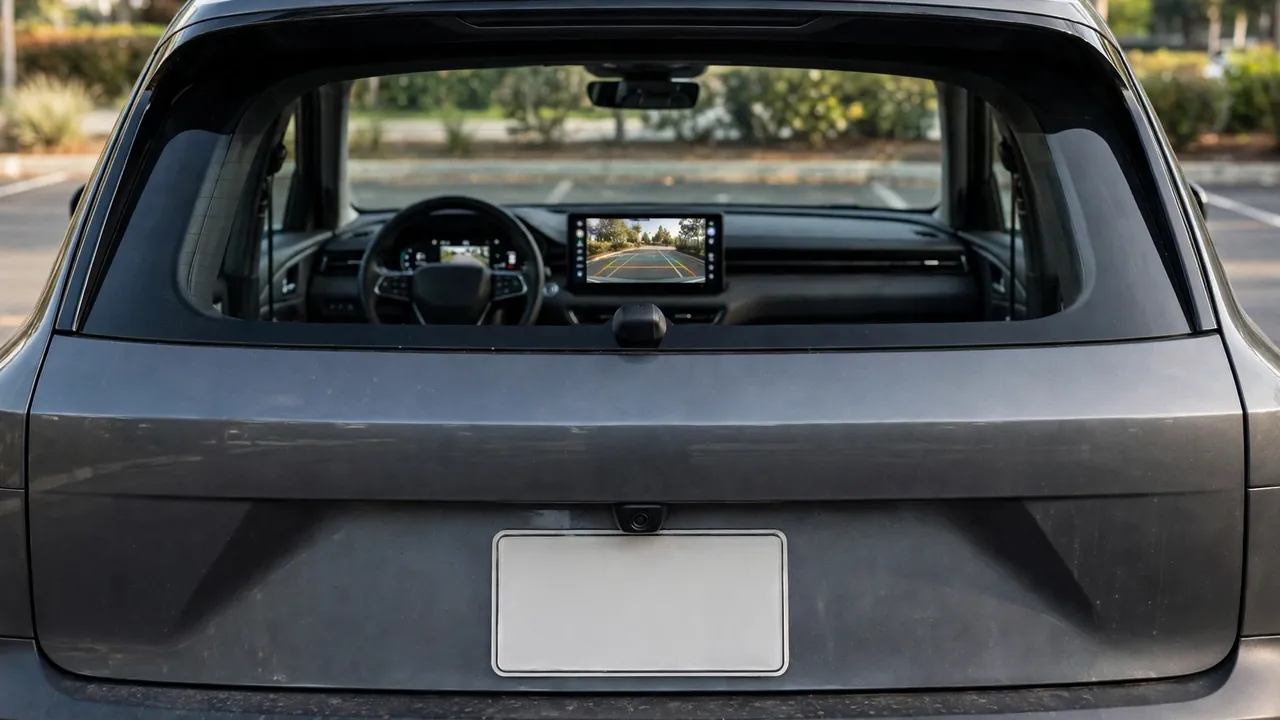
Since May 2018, every new vehicle sold in Canada has been required to have a backup camera. That makes a dead camera more than an annoyance; on a car that came with one, it is a safety system that no longer works, and a buyer who notices a black screen on a test drive will either walk away or demand a discount larger than the repair. The good news is that half of all backup camera failures are not the camera at all. Before you approve a replacement, work through the cheap causes in order: the fuse, the wiring where the tailgate harness flexes every time the hatch opens, and the display itself. A camera that shows a black screen, a blue screen, a flickering image, or guidelines with no picture is telling you something different in each case, and a proper diagnosis separates a $20 fuse from a $1,000 camera module.
The symptoms are the diagnosis. A completely black screen when you shift into reverse usually means no power is reaching the camera or the display, which points at a fuse, a connector, or the reverse signal wire. A blue or blank screen with the radio still working points at the camera or its video feed. A flickering or distorted image points at a damaged wire in the tailgate harness, the section that bends every time the hatch opens and closes and eventually breaks internally. Guidelines on screen with no image behind them point at the camera sensor itself. Water or condensation inside the lens, common after winter road salt and car washes, points at a failed camera seal. A shop should test for power at the camera connector and check the harness before condemning the module; a professional diagnostic typically costs $100 to $180 in Canada and is money well spent when the alternative is replacing a good camera.
The replacement price depends heavily on the car, and RepairPal's estimator data shows why a single average is misleading. RepairPal's park assist camera data, updated September 2026, puts its overall US average at $736 to $785, with parts around $631 and labour of $105 to $154, and its model-by-model figures run from a 2017 Toyota Tundra at $524 to $570 in US dollars, a 2020 Hyundai Tucson at $625 to $665, a 2021 Mercedes-Benz GLC300 at $768 to $813, a Genesis G70 at $1,344 to $1,372, a Lexus LC500 at $1,384 to $1,475, and a Mercedes-Benz GLC300 on other model years at $1,499 to $1,546. The pattern is consistent: mainstream cars with a simple tailgate camera cost far less than luxury cars where the camera is integrated with parking sensors, a 360-degree view system, or a module that needs programming and calibration after installation. A second named source agrees with RepairPal's average: Jalopnik, writing in June 2026, puts a typical park assist camera replacement at about $575 for the part plus $93 to $137 in labour, or $670 to $712 all-in. The Canadian ranges below are estimates converted from these US figures, not Canadian list prices, so treat them as a planning range rather than a quoted price. In Canadian dollars at an independent shop, expect roughly $350 to $700 for a standard car, $400 to $800 for an SUV or truck, and $600 to $1,500 or more for a luxury car, with dealers above that. An aftermarket camera, $150 to $350 installed on many cars, is a legitimate option when the factory camera is discontinued or priced like a luxury part. Go-Parts.com, a parts retailer, prices a new OEM rear camera at $250 to $450 and an aftermarket one at $80 to $200, which is why the installed aftermarket option stays well under the factory price, but it may not integrate with the factory guidelines or the 360-degree view.
The decision rule starts with the diagnosis, not the part. If the diagnostic shows a blown fuse, a corroded connector, or a broken wire in the tailgate harness, fix that; it costs a fraction of a camera and the camera itself is fine. If the camera module is confirmed dead, replace it with a quality part and ask whether programming or calibration is included in the quote, because on cars with 360-degree view or parking assist the new camera may need to be coded to the car. If the car is older and the factory camera is discontinued or costs more than the car is worth, an aftermarket camera with its own small display, or a camera integrated into a replacement rearview mirror, is a sensible compromise. And if you are buying a used car, test the backup camera on the test drive: shift into reverse and look for a clear image with guidelines. A black screen is a negotiating point worth several hundred dollars, and it is also a sign to check the rest of the car's electronics carefully. For the full used-car checklist, see How Much Does a Pre-Purchase Inspection Cost in Canada?
One more practical note: keep the lens clean. Winter road salt, slush, and grime coat the lens in days, and a dirty lens produces exactly the blurry, useless image that people mistake for a failing camera. Wipe it when you wash the car, and check it before a long trip. If the image is clear after cleaning, the camera is fine and the problem was maintenance, not electronics. If the image stays black, flickering, or fogged from the inside, book the diagnostic. A backup camera is one of the few repairs where the diagnostic is cheaper than the guess, and where fixing it promptly protects both your safety and your resale value. Check any quote against the RepairPrice calculator (calculator.php), and compare it with our guide on How Do I Check If a Repair Quote Is Fair? For the camera you add yourself rather than the one the factory fitted, see Dashcam Installation Cost in Canada.
Common questions:
Q: How much does a backup camera replacement cost in Canada? A: Roughly $350 to $700 for a standard car, $400 to $800 for an SUV or truck, and $600 to $1,500 or more for a luxury car at an independent shop. RepairPal's US data shows an overall average of $736 to $785, $524 to $570 for a 2017 Toyota Tundra and $1,344 to $1,546 for luxury models, before the Canadian premium; Jalopnik's June 2026 figure of $670 to $712 all-in lines up with that average.
Q: Why is my backup camera showing a black screen? A: Usually no power reaching the camera or the display, which points at a fuse, a connector, or the reverse signal wire. A blue or blank screen with the radio working points at the camera or its video feed, and a flickering image points at a damaged wire in the tailgate harness.
Q: Can I replace a backup camera myself? A: On some cars, yes, if the camera is a simple bolt-in unit in the tailgate handle. On cars where the camera is integrated with parking sensors or a 360-degree view, or where the new camera needs programming, pay a professional. A wrong connection can disable other safety systems.
Q: Is a backup camera required in Canada? A: Yes, on new vehicles sold since May 2018. A dead camera on a car that came with one is a failed safety system, and it will cost you at resale, since a buyer who sees a black screen will demand a discount larger than the repair.
| Service | Typical range (CAD) | Notes |
|---|---|---|
| Backup camera replacement, car | $350–$700 | Camera module plus labour; RepairPal US data $524–$570 for a 2017 Tundra |
| Backup camera replacement, SUV or truck | $400–$800 | Larger tailgate, more trim work |
| Backup camera replacement, luxury | $600–$1,500+ | May include parking sensors and 360-degree view; RepairPal puts some models at $1,344–$1,546 US |
| Professional diagnostic | $100–$180 | Camera vs wiring vs fuse; always do this first |
| Aftermarket camera, installed | $150–$350 | When the factory camera is discontinued or overpriced |


 RepairPrice
