
Turbocharger Replacement Cost in Canada
By Oleksandr Potapenko · 2026-11-16 · How we research prices
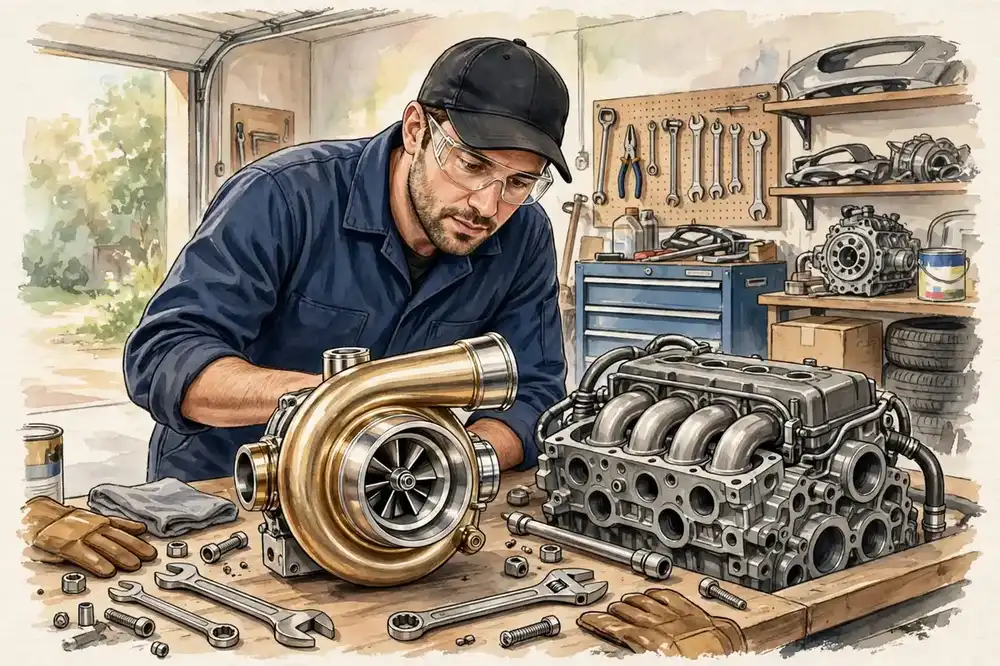
Here is a realistic Canadian invoice, itemized, for a common 1.5-litre turbocharged crossover at a reputable independent shop: an OEM or tier-one replacement turbocharger assembly at $1,650, gaskets, oil feed and drain lines, fresh oil and a filter, and five hours of labour, for an estimated subtotal of $3,210 before taxes. Take the same vehicle to a franchised dealer with a higher door rate and list-price OEM parts, and the total easily climbs past $4,200 before taxes. That invoice, published by a Canadian warranty guide in September 2026, is the most useful number in this guide, because it shows why older Canadian guides quoting $1,075 to $2,150 for a turbo job no longer match the market. A second Canadian source puts the total range at $2,000 to $5,000, with an OEM turbo alone at $1,200 to $2,800, an aftermarket or remanufactured unit at $700 to $1,500, and shop labour rates of $130 to more than $220 an hour. In the United States, RepairPal puts a Toyota Tundra turbocharger assembly at $6,943 to $8,203 US, a Tacoma at $3,987 to $4,255 US, and a Highlander at $4,479 to $4,855 US. My working range for Canada is $2,000 to $3,500 for a typical car, $2,500 to $4,500 for an SUV or truck, and $3,000 to $5,500 for a luxury model, with performance and diesel applications higher still. The old range is kept here only as a warning: if a shop quotes you $1,200 for a turbo on a modern car, ask what is missing from the quote.
A turbocharger forces extra air into the engine, letting a small engine make big-engine power, which is why so many Canadian cars, from compact crossovers to diesel trucks, have one. Turbos spin at over 100,000 rpm, so they are unforgiving of dirty or low oil. When a turbo fails, the signs are dramatic: a loud whining or siren noise under acceleration, a loss of power, blue or white smoke from the exhaust, or a check engine light with boost-pressure codes. The most common causes are oil starvation, a clogged feed line or neglected oil changes, and foreign-object damage from a broken intake part. The quote should include new gaskets, fresh oil and a filter, and, critically, a check of the oil feed and drain lines. Replacing a turbo without fixing the oil starvation that killed the first one just schedules the second failure, and that is the single most expensive mistake in this repair. A real Canadian retail datapoint shows the parts spread: a Dorman replacement turbo for a Buick Encore or Chevrolet Cruze lists at $1,224 Canadian, while a CTS replacement turbo for a Golf GTI or Audi A3 lists at $917.99 Canadian. Those are parts-only prices, before labour.
Before approving a turbo, confirm the diagnosis carefully, because the expensive part is not always the broken part. Boost leaks from a cracked hose or a failed wastegate actuator feel like a dead turbo but cost a fraction to fix, and a good shop pressure-tests the intake system before condemning the turbo. Ask whether a remanufactured turbo is available for your model. Reman units are common for popular engines, they cost significantly less than new, and they usually carry a solid warranty. The decision rule is simple: if the car is worth less than the turbo job and has other looming repairs, the turbo is the moment to think about selling. If the car is otherwise solid, fix the cause, not just the turbo, and buy the reman or OEM unit with the best warranty, not the cheapest no-name unit. Cheap turbos fail early, and the labour to replace a turbo twice wipes out any parts saving.
Turbo life is almost entirely an oil story. Use the exact oil grade the manufacturer specifies, change it on time, sooner if you tow or do lots of short winter trips, and let the engine idle for a minute after hard highway driving so the turbo cools before the oil stops flowing. Those three habits are the difference between a turbo that lasts the life of the car and one that fails at 150,000 km. If your turbo is drinking oil, the same diagnostic path is covered in High Oil Consumption: Causes and Repair Cost in Canada, and if the failure has damaged the engine itself, Engine Rebuild vs Replace: The Decision in Canada frames the next choice. Check the fair price for your exact car on the RepairPrice calculator (calculator.php) before you approve a turbo quote, and get the quote itemized: turbo part number and brand, feed and drain lines, gaskets, oil and filter, and labour hours.
Common questions:
Q: How much does it cost to replace a turbocharger in Canada? A: Roughly $2,000 to $3,500 for a typical car, $2,500 to $4,500 for an SUV or truck, and $3,000 to $5,500 for a luxury model at an independent shop. A realistic itemized invoice for a 1.5-litre crossover totals $3,210 before taxes.
Q: Can I drive with a bad turbo? A: Short distances to a shop, slowly, but a failing turbo can shed metal into the engine and the exhaust, and a seized turbo can block the exhaust. A loud siren noise or heavy smoke means stop driving and tow it.
Q: Is a remanufactured turbo reliable? A: Yes, from a reputable supplier, and reman units are often the best value on popular engines. They cost significantly less than a new OEM turbo and usually carry a solid warranty. Avoid no-name turbos with no warranty.
Q: What kills a turbocharger? A: Oil starvation is the leading cause: clogged feed lines, neglected oil changes, the wrong oil grade, or shutting a hot engine off immediately after hard driving. Fix the oil supply or the replacement turbo will fail the same way.
| Job | Typical range, independent shop | What moves the price |
|---|---|---|
| Turbocharger, car | $2,000–$3,500 | OEM turbo $1,200–$2,800 + ~5 h labour |
| Turbocharger, SUV/truck | $2,500–$4,500 | Diesel and larger turbos |
| Turbocharger, luxury | $3,000–$5,500 | Parts and labour rate |
| Remanufactured turbo, popular engines | $700–$1,500 parts | Best value; check warranty |
| Must be included | Gaskets, oil + filter, feed-line check | Oil starvation kills the next turbo too |
| Rule out first | Boost leaks, wastegate actuator | A fraction of a turbo bill |


 RepairPrice
