
Tire Rotation and Balancing Cost in Canada
By Oleksandr Potapenko · 2026-11-16 · How we research prices
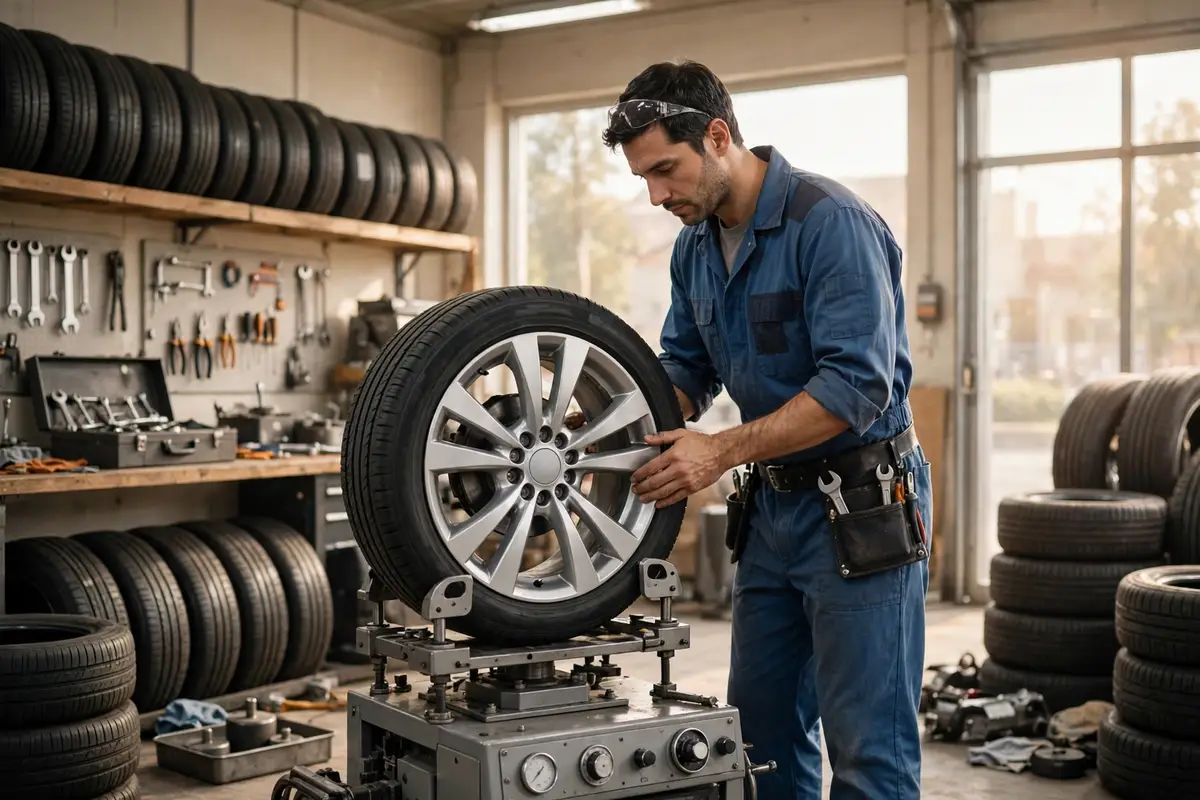
Rotation and balancing get sold together so often that most drivers think they are one job. They are not, and knowing which one you need is the difference between a $50 visit and a $150 visit. Rotation moves each tire to a different corner of the car so they wear evenly — front tires do the steering and most of the braking, so they wear their shoulders faster, while rear tires wear flatter. Balancing spins each wheel-and-tire assembly on a machine and adds small weights so it rotates without shaking. Rotation is maintenance on a schedule. Balancing is a repair you do when something feels wrong.
The prices tell the story of why the two get confused. RepairPal's September 2026 estimate puts a standalone tire rotation at $49 to $72 in the United States, all labour, and Kelley Blue Book reports a similar $60 to $72. Add balancing to all four wheels and RepairPal's estimate jumps to $109 to $160, while Kelley Blue Book puts the combined job at $112 to $132. The two estimators agree closely — the combined job costs roughly double the rotation alone — and the gap between them is mostly which shops their data weights toward. In Canada, independent shops typically charge $45 to $70 for a rotation and $60 to $110 for balancing a set of four, with the combined visit landing around $95 to $150 before tax. Midas advertises rotation starting at $19.99 at some U.S. locations, which shows how much of this job is a loss leader: many shops rotate for free with an oil change, and tire chains such as Costco and Discount Tire rotate and balance free for the life of tires bought from them. Never pay for a rotation twice — ask whether it is included in the oil change or the tire purchase before you book it separately.
When should you rotate? The U.S. Tire Manufacturers Association and most owner's manuals say every 8,000 to 12,000 km, which for most drivers is every second oil change; Midas and many manufacturers phrase it as every 6,000 to 8,000 miles, roughly the same interval. Front-wheel-drive cars wear their front tires fastest and benefit most; rear-wheel-drive cars wear rears faster under acceleration; all-wheel-drive cars need rotation most of all, because uneven tread depths across axles stress the drivetrain. The rotation pattern matters too: front-to-back on the same side for directional tires, and a cross pattern for non-directional ones. A shop that rotates without checking the tire's rotation arrow is a shop to leave.
Balancing is different — you do it when the car tells you to. The classic symptom is a vibration in the steering wheel or the seat at 90 to 110 km/h that fades at lower and higher speeds. New tires always need balancing, and a balance should be rechecked after a puncture repair, after a curb hit, or whenever a wheel weight has clearly fallen off. If the vibration does not go away after balancing, balancing was not the problem: a bent rim, a separated tire, or worn suspension parts such as tie rods and wheel bearings cause the same shake, and no amount of wheel weights will fix them. Road-force balancing, which presses a roller against the spinning tire to simulate the road, costs more and is worth it only for persistent vibrations that a standard spin balance cannot cure.
The decision rule is short. Rotate on schedule, every 8,000 to 12,000 km, and treat it as the cheapest tire-life insurance you can buy — skipping rotation is how a $1,000 set of tires dies at 40,000 km instead of 60,000. Balance only when there is a symptom or a new tire, and ask for the before-and-after numbers: a good shop will show you the imbalance in grams per wheel. If the shop recommends balancing at every rotation without a symptom, that is an upsell, not maintenance. Check the price on the RepairPrice calculator (calculator.php) first, and if your car pulls to one side or wears one shoulder bald, the problem is alignment, not balance — read Wheel Alignment Cost in Canada next.
Common questions:
Q: How much does a tire rotation cost in Canada? A: Typically $45 to $70 at an independent shop. RepairPal's September 2026 U.S. estimate is $49 to $72 USD and Kelley Blue Book reports $60 to $72 USD, which tracks closely once currency is considered. Many shops include rotation free with an oil change or with tires bought from them.
Q: How often should tires be rotated? A: Every 8,000 to 12,000 km, or about every 6,000 to 8,000 miles, according to the U.S. Tire Manufacturers Association and most owner's manuals. All-wheel-drive cars should never skip it, because uneven tread depths strain the drivetrain.
Q: Does tire balancing fix vibration? A: Yes, if the vibration comes from an out-of-balance wheel — typically a shake at 90 to 110 km/h. It does not fix a bent rim, a separated tire, or worn suspension parts, which cause the same symptom.
Q: Is rotation and balancing the same thing? A: No. Rotation moves tires between positions to even out wear; balancing adds weights to each wheel so it spins smoothly. Rotation is scheduled maintenance, balancing is done when there is vibration or a new tire.
| Job | Typical range, independent shop | When to do it |
|---|---|---|
| Tire rotation, car | $45–$70 | Every 8,000–12,000 km or each oil change |
| Wheel balancing, set of 4, car | $60–$110 | Vibration at 90–110 km/h |
| Rotation + balancing together | $95–$150 | RepairPal (USD): $109–$160; KBB (USD): $112–$132 |
| SUV/truck or luxury | +15% / +35% | Size and labour rate |
| Rotation free with oil change | Common — ask | Do not pay twice |
| Balancing does not fix | Bent rim, separated tire, worn suspension | Check for damage first |


 RepairPrice
