
Tie Rod End Replacement Cost in Canada
By Oleksandr Potapenko · 2026-11-16 · How we research prices
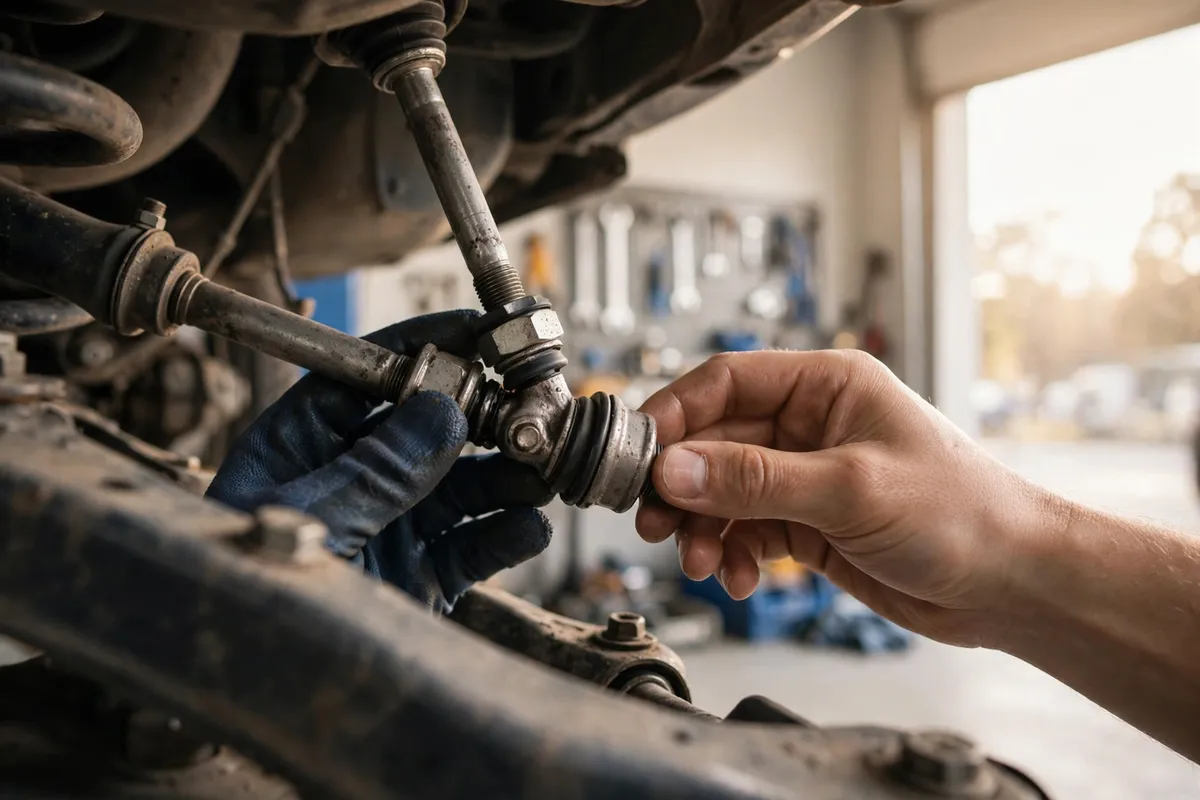
The decision comes before the price on this one, because a tie rod job has two very different versions and the wrong one costs you twice. The outer tie rod end is the small ball joint at the wheel end of the steering linkage. It takes all the wear, it is cheap, and it is the part that fails on most cars. The inner tie rod sits inside the steering rack boots, costs more to reach, and rarely wears out on its own — it usually fails after an impact or when a failed outer end damages it. So the first question to ask any shop is not the price, it is: inner or outer? If the quote covers both plus a steering rack, get a second opinion before approving a four-figure steering bill for what is usually a two-hundred-dollar part.
The numbers, from real invoices rather than guesses: ARI's real-invoice data puts the median outer tie rod job at $250 USD, with a typical quote running $150 to $450 USD per side for parts and labour. RepairPal's September 2026 model pages show how much the car matters. A 2013 Toyota Tacoma is $150 to $190 USD, a 2007 Ford F-150 is $162 to $185 USD, a 2008 Toyota Tundra is $166 to $205 USD, a 2013 Chevrolet Sonic is $138 to $178 USD, and a 2007 Toyota Prius is $189 to $229 USD. Midsize cars run a little higher: a 2018 Volkswagen Tiguan is $219 to $259 USD, a Toyota Corolla is $243 to $283 USD, a Volkswagen GTI runs $352 to $392 USD, and a 2008 Volkswagen Beetle is the outlier at $540 to $580 USD — a reminder that one expensive part or a difficult-to-reach joint can double the bill. Converted at a rough 1.39, that puts a typical Canadian car at about $210 to $450 CAD per side at an independent shop, with SUVs around $240 to $500 and luxury models around $280 to $620.
The part itself is cheap, which is what makes this repair good value. The outer end costs $30 to $150 USD for the part alone; the inner rod costs $80 to $300 USD for the part and takes longer to reach. Labour is usually 0.5 to 2.0 hours per side, with RepairPal's estimator commonly landing between $85 and $125 USD for the job. At a Canadian independent shop charging $95 to $130 an hour, the labour on a straightforward outer end is roughly $120 to $260. The part the quote often leaves out is the wheel alignment afterwards — $75 to $150 USD in the United States, $95 to $150 CAD in Canada — and it is not optional. Replacing a tie rod changes the toe setting, and without an alignment the new tires wear out in months. Some shops include the alignment in the quote and some bill it separately, so confirm before comparing prices: a quote without an alignment is not comparable to one with it. Our guide Wheel Alignment Cost in Canada has the current alignment rates.
The symptoms are a loose or vague feeling in the steering, uneven tire wear on the inside or outside edge, a clunk or knock when turning, or the car wandering on the highway and needing constant correction. On Canadian roads, salt and pothole impacts wear tie rod ends faster than gentle highway use, and a hard pothole hit can bend a rod outright — if the car started wandering right after a pothole, say so, because that points the shop at the steering instead of the tires. Tie rod ends are a safety item, not just a tire-wear item. A tie rod end with significant play makes the steering unpredictable, and a separated tie rod end means no steering control on that wheel at all. If a shop shows you play in a tie rod end during an inspection, do not defer it to the next oil change — the part is cheap and the consequence of failure is severe. For the bigger picture, a worn tie rod can also be the first sign of trouble further up the steering system; our guide Steering Rack Replacement Cost in Canada covers the rack itself, which is the repair you want to rule out before you pay for it.
After replacement, the alignment printout is your proof. Ask for the before-and-after readings: toe should be back within specification on both sides, and the steering wheel should sit straight when driving straight. If the car still pulls or the wheel is off-centre after the job, take it back — the alignment, not the new part, is the problem. Replace one side at a time unless both ends are loose, but always get the alignment, and have the other side inspected while the car is on the lift. A slow trip to the shop is usually possible with a worn end, but a highway drive is not worth the risk — if the joint separates, that wheel no longer steers. Check the fair price on the RepairPrice calculator (calculator.php) for your specific car before you say yes to a quote, and if the quote is far above the range, ask whether it includes inner rods, a rack, or dealer parts that you did not ask for.
Common questions: Q: How much does it cost to replace a tie rod end in Canada? A: About $210 to $450 CAD per side for an outer end at an independent shop, plus $95 to $150 CAD for the alignment that must follow. Trucks and luxury cars run higher, and an inner tie rod costs more because it takes longer to reach. Q: Can I drive with a bad tie rod end? A: A slow trip to the shop is usually possible, but do not take a highway drive — a separated tie rod means no steering on that wheel. Q: Do tie rod ends need to be replaced in pairs? A: Usually only the worn side, but have the other side checked while the car is up, and always get an alignment either way. Q: Why is an alignment required after a tie rod replacement? A: The tie rod sets the toe angle. Replacing it changes that angle, and without a fresh alignment the tires wear unevenly within months.
| Job | Typical range, independent shop | Notes |
|---|---|---|
| Tie rod end, each, car | $210–$450 | ARI median $250 USD; part $30–$150 USD + ~1 h labour |
| Tie rod end, SUV/truck | $240–$500 | Larger steering gear |
| Tie rod end, luxury | $280–$620 | Parts and labour rate |
| Wheel alignment after | $95–$150, mandatory | Tie rods set the toe angle |
| Inner tie rod | Slightly bigger job | Sits inside the rack boots |

 RepairPrice
