
Thermostat Replacement Cost in Canada
By Oleksandr Potapenko · 2026-11-16 · How we research prices
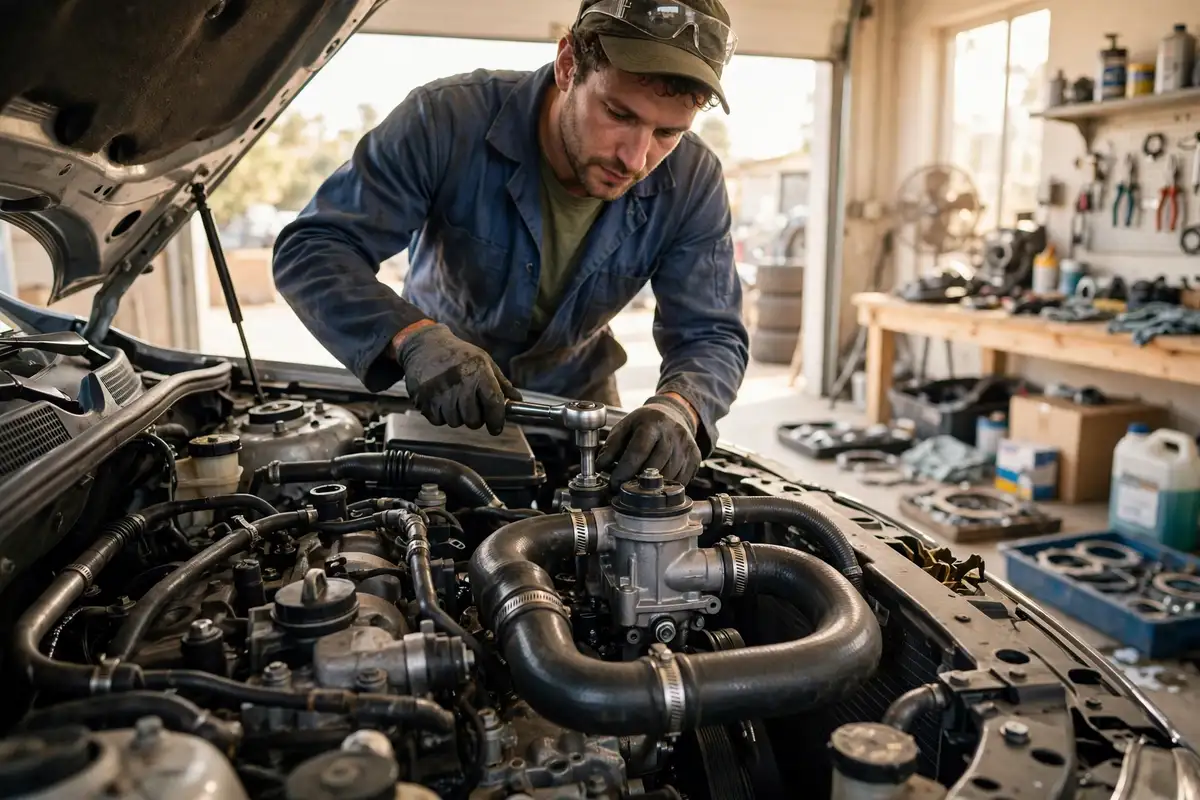
There is a sixty-second test that tells you whether your thermostat is stuck open or stuck closed, and it costs nothing. Start the engine from cold and feel the upper radiator hose. It should stay cool for several minutes, then turn hot all at once as the thermostat opens. If the hose turns hot immediately, the thermostat is stuck open. If the gauge climbs toward the red while the hose stays cool, the thermostat is stuck closed and coolant is trapped in the engine. PulsCar's 2026 thermostat guide describes exactly this test, and it is the first thing a good shop does before quoting you anything, because the two failures are opposite emergencies.
A thermostat is a small valve that holds coolant in the engine until it reaches operating temperature, then opens to let it flow to the radiator. It fails in two ways. Stuck closed, it causes overheating, sometimes fast, and a stuck-closed thermostat can cook a head gasket in a single drive. Stuck open, the engine never warms up properly: the heater blows lukewarm in a Canadian winter, fuel consumption rises, the temperature gauge sits below normal, and the engine computer stays in its cold-running fuel map. The diagnostic code for the stuck-open failure is P0128, which a scan will show, and BimmerTalk's BMW thermostat guide notes the same pattern on BMWs, where a stuck-open thermostat throws P0128 or the BMW-specific codes 2E7C and 2E7D. A stuck-open thermostat will not strand you; owners have driven thousands of kilometres on one. A stuck-closed thermostat will, and the difference between the two is the difference between booking a repair this week and calling a tow truck now.
Replacing a thermostat on a typical car in Canada costs roughly $250 to $600 at an independent shop, according to GarageMap's Calgary pricing guide from 2026, which puts most straightforward jobs in that range and notes that plastic housing assemblies push the bill higher. Cars With Fares, cited by the same guide, puts thermostat housing jobs at $400 to $700, and the guide puts the dealer premium at roughly $100 to $250 over an independent shop for the same job. PulsCar's 2026 figures for the US market, $150 to $350 installed, are lower because the part is often just $20 to $50, but the Canadian numbers reflect higher labour rates and the housing assemblies that many modern cars use. The part itself is cheap on an older car: a standalone thermostat costs $20 to $50, and the rest of the bill is access and bleeding the system. On a modern GM or Volkswagen, the thermostat comes sealed inside a plastic housing with built-in sensors, and that assembly alone can cost $100 to $200 before labour. Always ask which one your car needs before comparing quotes, because a $250 quote for a thermostat and a $600 quote for a housing assembly are not the same job.
That housing question is the one to ask first, and the second is whether the quote includes diagnosis, the correct part, coolant, bleeding, a road test, and warranty terms. GarageMap warns that omissions can make a low price misleading, and it is right: a thermostat job done without a proper bleed leaves air in the system, and air in the system causes exactly the overheating you paid to fix. The job takes one to two hours on most cars, longer when the thermostat sits behind the intake manifold or under a tangle of hoses, which is common on German cars. On a BMW, BimmerTalk puts the independent-shop repair at $350 to $550 US, with the part alone at $60 to $150 for a do-it-yourselfer, and notes that the plastic housing itself often cracks or its O-ring seats degrade, adding a slow coolant leak on top of the thermostat problem.
The decision rule is simple and it depends on which way the thermostat failed. Stuck closed, stop driving, tow the car, and fix it now, because a $200 to $600 thermostat job becomes a $1,500 to $3,000 head gasket job if you keep driving, a range both PulsCar and our guide "Head Gasket Repair Cost in Canada" agree on. Stuck open, book the repair before winter, and do not let it slide past the first frost, because a heater that cannot warm the cabin in January is a safety problem on a prairie highway, not a comfort problem. If you are already replacing the water pump, replace the thermostat at the same time: the coolant is already out, the labour is already paid, and our guide "Water Pump Replacement Cost in Canada" explains why that pairing saves money. The same applies in reverse, and a shop that is already draining the system for a thermostat should be offering you a coolant flush, which our guide "Coolant Flush Cost in Canada" prices, rather than refilling with the old fluid. You can sanity-check any quote against the RepairPrice calculator (calculator.php) before you approve it, and if two shops disagree by more than $200, ask each one to name the part number they are quoting, because that usually reveals the housing difference.
Common questions:
Q: How much does it cost to replace a thermostat in Canada? A: Roughly $250 to $600 at an independent shop in Calgary, according to GarageMap's 2026 guide, with plastic housing assemblies at $400 to $700 and dealers about $100 to $250 more than independents for the same job. Older cars with a standalone $20 to $50 thermostat sit at the low end.
Q: Can I drive with a bad thermostat? A: It depends which way it failed. Stuck open, yes, for a while: the engine runs cool, the heater is weak, and fuel economy suffers, but it will not strand you. Stuck closed, no: coolant cannot reach the radiator, the engine overheats in minutes, and you should pull over and call a tow.
Q: How do I know if my thermostat is stuck open or closed? A: The cold-start hose test: from cold, the upper radiator hose should stay cool for several minutes, then turn hot all at once. Hot immediately means stuck open; a climbing gauge with a cool hose means stuck closed. A scan showing code P0128 points to stuck open.
Q: How long does a thermostat last? A: Typically about 10 years or 75,000 to 100,000 miles, roughly 120,000 to 160,000 kilometres, according to PulsCar's 2026 guide, though many fail between 80,000 and 120,000 miles as the housing plastic ages. There is no fixed replacement interval; replace it on symptoms, or together with the water pump.
| Symptom | Likely thermostat fault | How urgent |
|---|---|---|
| Temperature gauge climbs fast, overheating | Stuck closed | Urgent — pull over if it hits red |
| Heater lukewarm, gauge below normal | Stuck open | Fix before winter |
| Slow warm-up, higher fuel use | Stuck open | Book soon |
| Gauge swings up and down | Sticking intermittently | Book soon |
| Coolant leak at thermostat housing | Failed gasket or housing | Book soon |


 RepairPrice
